
Polity Current Affairs for UPSC
Every Polity story from the daily editions, newest first, each in short with why it matters for Prelims and Mains.
-
PolityPrelimsGS2
State Legislative Councils: Articles 168-172 and the graduates' and teachers' seats
Why in news: Bihar votes on 23 October 2026 for four graduates' and four teachers' seats; several colleges have alleged ineligible names on the Patna Teachers' roll.
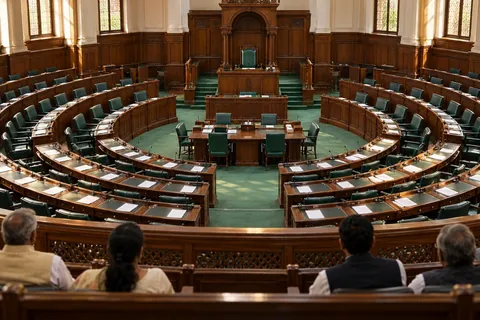
A State Legislative Council is an optional, permanent upper House that Parliament creates or abolishes under Article 169 at the Assembly's request. Article 171 caps it at one-third of the Assembly, never below 40, with about one-twelfth each elected by graduates and teachers. Bihar votes in four graduates' and four teachers' constituencies on 23 October 2026.
Read the story -
PolityGS2GS1
The Aligarh Movement, AMU and the Article 30 minority test
Why in news: On 17 October 2026, AMU marked Sir Syed Day, the 209th birth anniversary of its founder, Sir Syed Ahmad Khan.
The Aligarh Movement was Sir Syed Ahmad Khan's post-1857 drive to bring English education and modern science to Indian Muslims. Its college became Aligarh Muslim University in 1920, and in 2024 a seven-judge Supreme Court bench laid down a new Article 30 test for minority institutions. AMU marked his 209th birth anniversary on 17 October 2026.
Read the story -
PolityPrelimsGS2
UN Convention against Torture, and why India has not ratified it
Why in news: A US superseding indictment unsealed on 8 October 2026 charges Venezuela's former President Nicolas Maduro with conspiring to commit torture under 18 U.S.C. 2340A.
The UN Convention against Torture (1984) bars torture without exception, forbids sending anyone to likely torture and obliges parties to criminalise it. India signed it on 14 October 1997 but has not ratified it. A US indictment unsealed on 8 October 2026 charges Venezuela's former President Nicolas Maduro with torture conspiracy under the 1994 US law implementing it.
Read the story -
PolityPrelimsGS2
CSEAM: POCSO and IT Act offences, court rulings and NCPCR's powers
Why in news: On 15 October 2026 the Supreme Court ordered a National Hash & URL List Database and takedown guidelines to remove CSEAM from platforms.
Child sexual exploitative and abuse material (CSEAM), the Supreme Court's preferred term for child pornography, is any sexual depiction of an abused or exploited child. Indian law punishes making, storing and sharing it, and platforms that fail to remove it lose legal immunity. On 15 October 2026 the Court ordered a national hash and URL database to take it down.
Read the story -
PolityGS2Prelims
State Election Commissions and the bar on courts in local polls
Why in news: The Supreme Court's order of 21 October 2026 on nominations for urban local body elections in Andhra Pradesh, after the High Court refused an extension.
A State Election Commission, set up under Articles 243K and 243ZA, conducts every panchayat and municipal election, and Articles 243-O and 243ZG let such polls be questioned only through an election petition. On 21 October 2026 the Supreme Court asked the Andhra Pradesh State Election Commission to defer its final candidate list for urban local body polls.
Read the story -
PolityPrelimsGS2
Section 175(4) BNSS: the safeguard before probing a public servant
Why in news: On 21 October 2026, the Supreme Court observed that Section 175(4) BNSS expands public servants' safeguards beyond old Section 156(3) CrPC.
Section 175(4) of the Bharatiya Nagarik Suraksha Sanhita, 2023 lets a magistrate order investigation of a complaint against a public servant over official duties subject to a report from the officer's superior and the public servant's own version. On 21 October 2026, the Supreme Court observed that it widens safeguards compared with Section 156(3) of the CrPC.
Read the story -
PolityGS2GS3
TV Programme Code: I&B advisory follows Inter-Departmental Committee's findings
The Ministry of Information and Broadcasting on 21 October 2026 advised private satellite TV channels to follow the Programme Code under the Cable Television Networks Rules, 1994, after the Inter-Departmental Committee found lapses. The advisory asks for editorial control over debates, no live coverage of anti-terror operations and AI only as an assisting tool.
Read the story -
PolityGS2Prelims
Ladakh dissolves Kargil hill council, sets panchayat polls for 21 November
The Union territory of Ladakh administration on 21 October 2026 dissolved the Ladakh Autonomous Hill Development Council (LAHDC), Kargil, with immediate effect after new districts were created. The Deputy Commissioner/Chief Executive Officer, Kargil, holds its powers until new councils are formed. The State Election Commission of Ladakh fixed panchayat polling for 21 November.
Read the story -
PolityPrelimsGS2
ECI lets EROs decide SIR discrepancy notices; hearings made exceptional
The Election Commission of India has changed its ECINet software and procedures for notices issued in the Special Intensive Revision (SIR) of electoral rolls. Electoral Registration Officers (EROs) now decide logical-discrepancy cases themselves, voters may offer documents beyond the 13 listed categories, and personal hearings are held only in exceptional cases.
Read the story -
PolityGS2GS1
SC directs Northeast panel to recommend law changes against racial harassment
The Supreme Court, by an order of 14 October 2026, directed the Monitoring Committee set up by the Union Home Ministry to recommend, by 18 December, changes in law to protect people from the Northeast against violence and harassment elsewhere in India. It also ordered that every complainant's full details, including the address, be recorded on receipt.
Read the story -
PolityPrelimsGS4
Delhi HC: RTI security exemptions shield PM's IAF flight records
The Delhi High Court on 15 October 2026 set aside a 2020 Central Information Commission order that told the Indian Air Force to release Special Flight Returns on the Prime Minister's foreign visits. It held the records exempt under sections 8(1)(a) and 8(1)(g) of the Right to Information Act, 2005, citing national security and the Prime Minister's safety.
Read the story -
PolityGS2GS3
Supreme Court directs Centre to publicise Section 164A interim relief scheme
The Supreme Court on 16 October 2026 directed the Union Government to give wide publicity to the Compensation to Victims (Interim Relief) Scheme, 2026, framed under Section 164A of the Motor Vehicles Act, 1988. It ordered the scheme's publication in the Official Gazette at the earliest and asked the Centre whether it covers accidents involving uninsured vehicles.
Read the story -
PolityGS2Prelims
Dissent against a court verdict is not enmity: Karnataka High Court
The Karnataka High Court has quashed a 2019 FIR against 13 people accused of painting roadside slogans that called a Supreme Court judgment a 'denial of justice'. Relying on the Supreme Court's 2024 ruling in Javed Ahmad Hajam, it held that voicing dissatisfaction with a verdict does not attract sections 153A or 295A of the Indian Penal Code.
Read the story -
PolityPrelimsGS2
Punjab and Haryana HC: blocked users must get copy of intimation
The Punjab and Haryana High Court has held that a user whose content is blocked by a Section 79(3)(b) intimation under the Information Technology Act, 2000 must get a copy when sent to the intermediary. In a ruling reported on 20 October 2026, it voided a Superintendent of Police's intimation to Meta, as the amended Rules require DIG rank.
Read the story -
PolityPrelimsGS2
Accessibility and assistive products under the RPwD Act, 2016
Why in news: Draft Rights of Persons with Disabilities (Amendment) Rules, 2026, reported on 4 October 2026, propose standards for assistive products and invite objections within 30 days.
Section 40 of the Rights of Persons with Disabilities Act, 2016 obliges the Centre to frame binding accessibility standards, carried in Rule 15 of the 2017 Rules. In Rajive Raturi (November 2024) the Supreme Court held Rule 15(1) ultra vires for offering only guidelines. Draft amendment rules now propose standards, repair and grievance redress for assistive products.
Read the story -
PolityGS2Prelims
Article 20: ex post facto laws, double jeopardy and self-incrimination
Why in news: A Jammu & Kashmir and Ladakh High Court ruling reported on 20 October 2026 held preventive CrPC section 107 and 117 proceedings outside Article 20(2).
Article 20 of the Constitution shields every person in criminal law: no conviction or heavier penalty under a law made after the act, no second prosecution and punishment, and no compelled testimony against oneself. A High Court of Jammu & Kashmir and Ladakh ruling, reported on 20 October 2026, held that preventive peace-bond proceedings do not bar a later prosecution.
Read the story -
PolityGS2Prelims
J&K orders Darbar Move: offices to reopen in Jammu on 2 November
Jammu and Kashmir's General Administration Department on 19 October 2026 ordered the annual Darbar Move for winter 2026-27. Forty-one offices, including every Civil Secretariat department, will shift to Jammu in full and 50 in camp. All will reopen in Jammu on 2 November, with J&K Police escorting the employees' bus convoys.
Read the story -
PolityGS2Prelims
Citizenship Act: minor keeps Indian citizenship after father turns UK citizen
The Madurai Bench of the Madras High Court held on 13 October 2026 that a minor born Indian keeps citizenship though his father later became a United Kingdom citizen. Section 8(2) of the Citizenship Act, 1955 ends a minor's citizenship on a parent's renunciation; acquiring foreign citizenship falls under section 9. The passport office must decide renewal within three months.
Read the story -
PolityPrelimsGS2
Trial in absentia: section 356 of the BNSS, 2023
Why in news: On 19 October 2026, Delhi's Lieutenant Governor, reviewing the Directorate of Prosecution, sought the use of trial in absentia in eligible cases.
Section 356 of the Bharatiya Nagarik Suraksha Sanhita, 2023 directs a court to try and judge an absconding proclaimed offender as if he were present, once 90 days have passed since charges were framed and notice steps are complete. A State-paid advocate defends him if unrepresented. Delhi's Lieutenant Governor urged its use in eligible cases on 19 October 2026.
Read the story -
PolityGS2Prelims
Summoning, adjournment, prorogation and dissolution of Parliament: Article 85
Why in news: In letters of 16 and 19 October 2026, the Opposition and the government differed over Parliament staying unprorogued since its 13 August adjournment sine die.
Article 85 of the Constitution lets the President summon each House of Parliament, prorogue either House and dissolve the Lok Sabha, with no more than six months between sessions. Adjournment pauses sittings; prorogation ends a session. Both Houses were adjourned sine die on 13 August 2026, and no prorogation had been notified by 19 October 2026.
Read the story -
PolityGS1GS2
Kambala, jallikattu and the Prevention of Cruelty to Animals Act, 1960
Why in news: Kambala, coastal Karnataka's buffalo race, was held at Mysuru Dasara for the first time on 18-19 October 2026, organised by the district administration.
The Prevention of Cruelty to Animals Act, 1960 punishes inflicting unnecessary pain on animals. In 2014 the Supreme Court ruled that jallikattu and bullock-cart races breach it; Tamil Nadu, Maharashtra and Karnataka amended the Act in 2017, and a Constitution Bench upheld those amendments in 2023. Kambala, Karnataka's buffalo race, made its Mysuru Dasara debut on 18 October 2026.
Read the story -
PolityGS2Prelims
Article 371 special provisions, the Sixth Schedule and Ladakh's proposed Article 371-K
Why in news: The Home Ministry presented a draft Article 371-K for a directly elected Ladakh body on 15 October 2026; Ladakh's two bodies rejected it in principle.
Articles 371 to 371J of the Constitution, each written in by a constitutional amendment, give twelve named States tailored safeguards: regional development boards, duties for the Governor and shields for customary law and land. The Sixth Schedule instead creates law-making tribal councils in four north-eastern States. A Home Ministry draft of 15 October 2026 proposes an Article 371-K for Ladakh.
Read the story -
PolityGS2GS1
Pregnancy termination after 24 weeks: MTP Act, Medical Boards, Article 21
Why in news: On 15 October 2026, the Delhi High Court used Article 226 to let a 16-year-old survivor end a pregnancy of about 31 weeks.
The Medical Termination of Pregnancy Act, 1971, amended in 2021, permits abortion up to 20 weeks, and to 24 weeks for rape survivors, minors and other listed groups. Beyond 24 weeks, a Medical Board may allow it for substantial foetal abnormality. On 15 October 2026, the Delhi High Court let a 16-year-old survivor end a pregnancy of about 31 weeks.
Read the story -
PolityGS2Prelims
Adultery and armed forces law after Joseph Shine (2018)
Why in news: Reported on 19 October 2026: an Army Major has challenged, before the Armed Forces Tribunal, a notice proposing his administrative termination over alleged affairs.
In Joseph Shine v. Union of India (2018), the Supreme Court struck down Section 497 of the Indian Penal Code, ending adultery as a crime. In January 2023 a five-judge Bench clarified that the ruling does not touch the Army, Navy and Air Force Acts. An Army Major now faces a notice proposing administrative termination over alleged extramarital affairs.
Read the story -
PolityGS2Prelims
Remand is judicial work, not a formality: Allahabad High Court
The Allahabad High Court has directed the Judicial Training and Research Institute (JTRI), Lucknow, to prepare remand training modules for Magistrates, it was reported on 19 October 2026. Rejecting a Kushinagar Magistrate's plea of heavy workload, the Court held that remand directly concerns Articles 21 and 22, and ordered the release of an accused whose arrest memo was grossly deficient.
Read the story -
PolityGS1GS2
Karnataka High Court upholds AMASR Act's prohibited and regulated zones
The Karnataka High Court on 9 October 2026 upheld sections 20A, 20B and 20C of the Ancient Monuments and Archaeological Sites and Remains Act, 1958. They bar new construction within 100 metres of a centrally protected monument and regulate it in a further 200 metres. Restricting land use is not acquisition, the court held, so no compensation is due.
Read the story -
PolityGS2Prelims
High Court allows Punjab's plea against MEA's political clearance refusal
The Punjab and Haryana High Court on 16 October 2026 allowed the Punjab government's writ petition against the Ministry of External Affairs' refusal of political clearance for a State delegation, led by the Chief Minister, to a Paris food trade fair. Punjab had argued that the refusal gave no reasons. The court's detailed order was awaited.
Read the story -
PolityPrelimsGS2
IT Rules due diligence: MeitY advisory tells Meta to review recommendation systems
The Ministry of Electronics and Information Technology (MeitY), in an advisory dated 10 October 2026 and seen by PTI, asked Meta to review the recommendation systems of Instagram and Facebook so that users are not disproportionately exposed to "a single or limited set of narratives". Citing intermediary due diligence under the IT Rules, 2021, it sought action with immediate effect.
Read the story -
PolityGS2Prelims
Content takedown: Rule 3(1)(d) intimations, safe harbour and section 69A blocking
Why in news: Amendments in force from 20 February 2026 cut the IT Rules' removal deadline after a valid intimation from 36 hours to three hours.
Indian law offers two ways to remove unlawful online content. Under section 69A of the Information Technology Act, 2000, the Centre blocks access, normally after committee review. Under Rule 3(1)(d) of the IT Rules, 2021, platforms with section 79 safe harbour must act on court orders or senior officers' reasoned intimations. Since February 2026, removal is due within three hours.
Read the story -
PolityPrelimsGS2
Who may practise law: Karnataka HC refuses to quash AIBE case
The Karnataka High Court on 17 October 2026 refused to quash a criminal case under the IPC and section 45 of the Advocates Act, 1961 against a man who practised a decade without clearing the All India Bar Examination (AIBE). Bar Council discipline does not bar criminal courts, it held, and ordered the State Bar Council to track such cases.
Read the story







Other subjects
- National 86 stories
- World & IR 92 stories
- Economy 171 stories
- Environment 106 stories
- Sci-Tech 67 stories
- Defence 29 stories
- Miscellany 5 stories