
IT Rules due diligence: MeitY advisory tells Meta to review recommendation systems
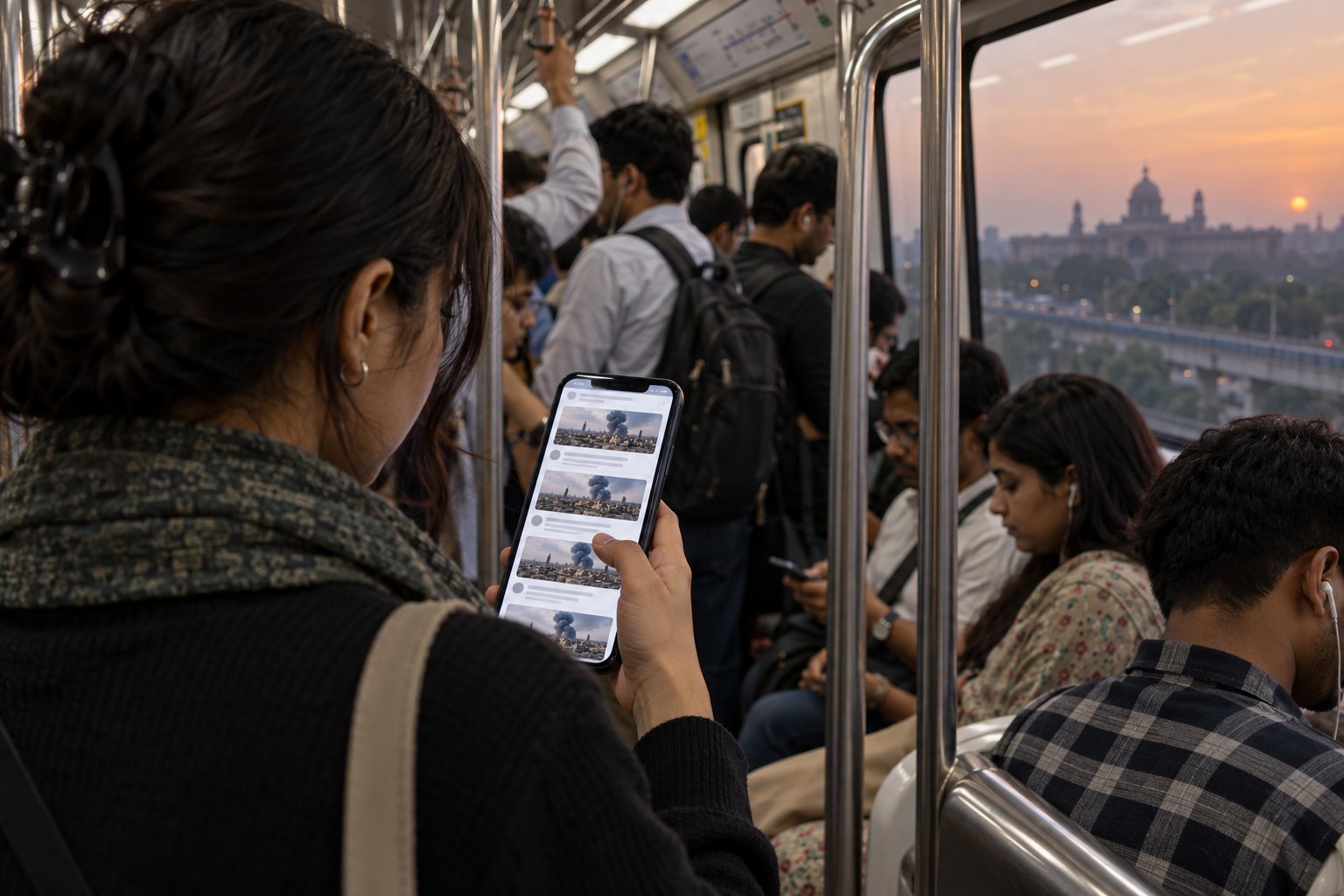
The Ministry of Electronics and Information Technology (MeitY), in an advisory dated 10 October 2026 and seen by PTI, asked Meta to review the recommendation systems of Instagram and Facebook so that users are not disproportionately exposed to "a single or limited set of narratives". Citing intermediary due diligence under the IT Rules, 2021, it sought action with immediate effect.
Syllabus: Prelims · Polity & Governance; GS2 · Governance & e-Governance; GS3 · Cyber Security & Money Laundering
Why this matters for UPSC
GS3 internal security (social media and communication networks) and GS2 governance: Prelims can ask what the IT Rules, 2021 require of a significant social media intermediary and how section 69A differs from Rule 3(1)(d); Mains, about regulating algorithmic amplification.
Why it matters
A student scrolling Instagram during a protest does not pick most of what appears; ranking software does. If that software keeps pushing one clip, an old video passed off as fresh can reach millions before anyone checks it, and a tense street can turn violent. The advisory asks Meta to slow such spread and show a wider mix of credible views. The harder question is who decides which narratives count as credible. If official preference shapes the feed, users lose the very variety the advisory names, and nobody can tell whether a post faded by law, by company policy or by quiet downranking. That is why the line between algorithmic amplification and censorship now matters to every user.
Prelims pointers
- IT Rules, 2021: made under section 87 of the IT Act, 2000, replacing the 2011 intermediary rules; MeitY runs Part II, the I&B Ministry Part III (Digital Media Ethics Code).
- Significant social media intermediary threshold: fifty lakh registered users in India, notified by MeitY on 25 February 2021.
- Extra duties of a significant social media intermediary: a Chief Compliance Officer, a Nodal Contact Person and a Resident Grievance Officer, all resident in India, and a monthly compliance report.
- Rule 3(1)(d) after the 2026 amendment: remove within three hours (earlier 36) of a court order or reasoned intimation from a Joint Secretary-rank officer, or a DIG for police.
- Section 69A blocking follows the Information Technology (Procedure and Safeguards for Blocking of Access of Information by Public) Rules, 2009; MeitY used it to block 118 apps in September 2020.
- After 2026, user grievances must be resolved in 7 days (earlier 15); three Grievance Appellate Committees of three members each were notified in January 2023.
- Article 19(2) of the Constitution: reasonable restrictions on speech for sovereignty and integrity, State security, foreign relations, public order, decency or morality, contempt, defamation and incitement.
Practise a UPSC-style question
With reference to the Information Technology (Intermediary Guidelines and Digital Media Ethics Code) Rules, 2021, consider the following statements:
1. They were made under the Information Technology Act, 2000 and superseded the Intermediaries Guidelines Rules of 2011.
2. Their Part III, the code of ethics for digital news and online curated content publishers, is administered by the Ministry of Information and Broadcasting.
Which of the statements given above is/are correct?
- (a) 1 only
- (b) 2 only
- (c) Both 1 and 2
- (d) Neither 1 nor 2
Show the answer
Answer: (c) Both 1 and 2
Answer: (c) Both 1 and 2. Both describe how the 2021 Rules were made and who runs each part.
Statement 1: correct. The Centre framed the Rules under section 87(2) of the IT Act, 2000, superseding the Information Technology (Intermediaries Guidelines) Rules, 2011.
Statement 2: correct. Part III, the Digital Media Ethics Code, is administered by the Ministry of Information and Broadcasting; Part II, on intermediary due diligence, by MeitY.
Eliminate: Statement 1 is surely correct, since the Rules name the IT Act, 2000 as their parent law. Out: (b), (d).
Eliminate: Statement 2 is also correct, as the 2021 PIB release splits Part II to MeitY and Part III to the I&B Ministry. Out: (a).
Trap: Swapped attribution. A student who knows MeitY runs the intermediary rules may assume it runs the publishers' code too and drop statement 2.
Remember: IT Rules, 2021: Part II (intermediaries) is MeitY's; Part III (digital media ethics) is the I&B Ministry's.
Explainers on this topic
More from the 20 October 2026 edition
- China proposes export curbs on 40 AI, solar and biomedicine technologies World & IR
- Parallel distribution licence: HERC grants one for Gurugram and Nuh Economy
- DGFT notifies tariff-rate quotas for New Zealand apples, kiwifruit, honey Economy
- Remand is judicial work, not a formality: Allahabad High Court Polity
- Karnataka High Court upholds AMASR Act's prohibited and regulated zones Polity
- High Court allows Punjab's plea against MEA's political clearance refusal Polity
- China puts tunnel boring machines under dual-use export control World & IR
- Who may practise law: Karnataka HC refuses to quash AIBE case Polity
- CCPA uses Consumer Protection Act to curb online explosives sales Polity
- Section 17A, Prevention of Corruption Act: bribe demand needs no approval Polity
- Orangutan seized in Thane reported repatriated to Indonesia under CITES Environment
- FSSAI directs cold-chain compliance for perishables under 2011 Licensing Regulations National