
State Legislative Councils: Articles 168-172 and the graduates' and teachers' seats
Why in news: Bihar votes on 23 October 2026 for four graduates' and four teachers' seats; several colleges have alleged ineligible names on the Patna Teachers' roll.
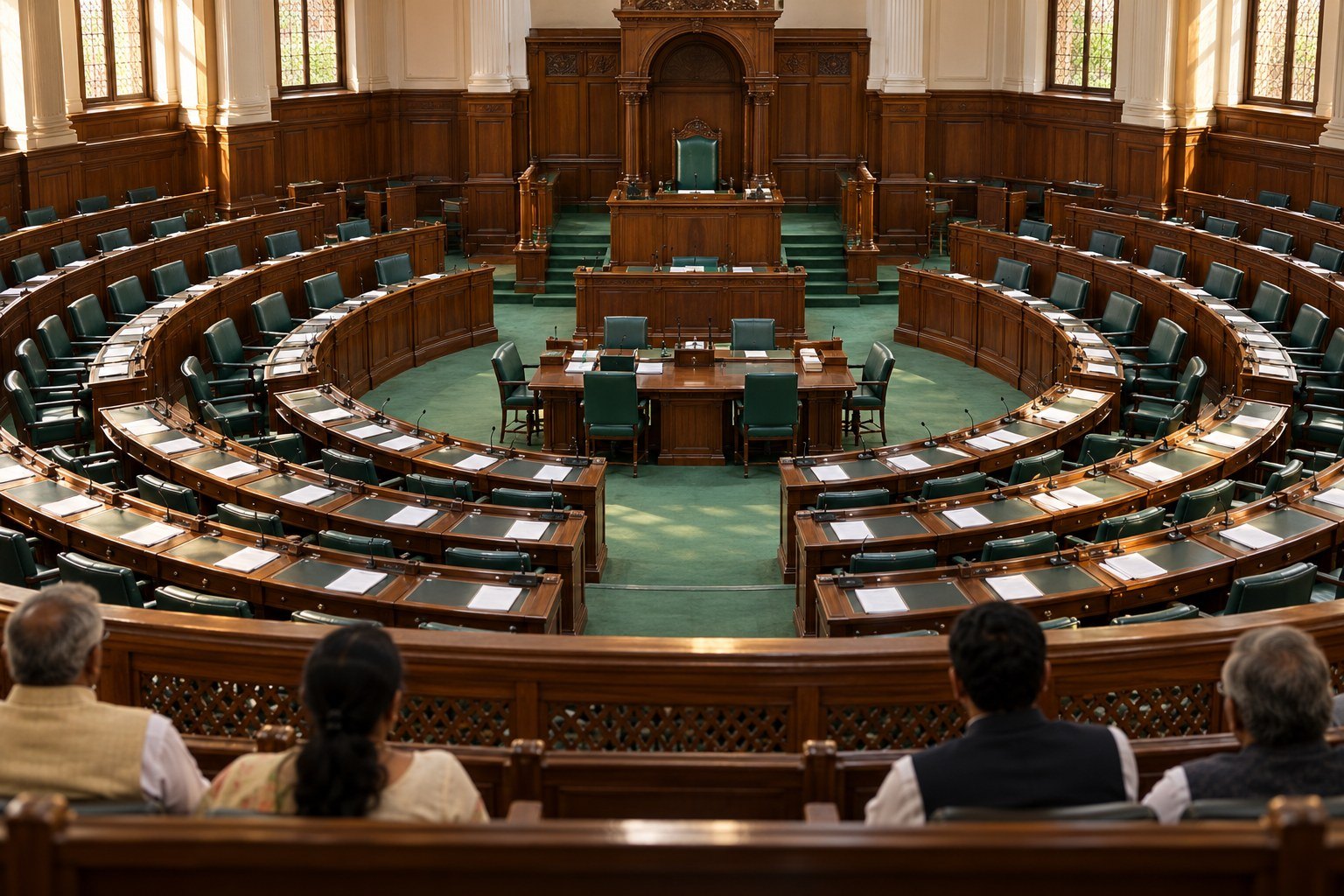
A State Legislative Council is an optional, permanent upper House that Parliament creates or abolishes under Article 169 at the Assembly's request. Article 171 caps it at one-third of the Assembly, never below 40, with about one-twelfth each elected by graduates and teachers. Bihar votes in four graduates' and four teachers' constituencies on 23 October 2026.
Syllabus: Prelims · Polity & Governance; GS2 · Parliament & State Legislatures; GS2 · Representation of the People Act
Why this matters for UPSC
GS2 polity, State Legislatures: Prelims asks Article 169, Article 171 and Article 182, the Council's size cap, its composition and who may vote in graduates' and teachers' seats; Mains asks whether Councils earn their cost and how they are created or abolished.
In short
The Legislative Council is a State's optional second chamber under Articles 168-172: never dissolved, filled by indirect election and nomination, and subordinate to the Assembly in law-making.
Councils justify their cost only with clean rolls, real expertise and a stable footing; a national policy should replace majority-driven creation and abolition.
Why it matters
A teacher at a Patna college who wants a say in the teachers' seat must apply afresh before every biennial election, and a wrong entry left on the roll once nominations close stays there until the poll is over. A graduate in Lucknow or Pune gets a second vote, for the Council, that a graduate in Kolkata does not, because only some States have chosen a second House. When a roll carries people who never taught, each genuine teacher's vote counts for less and trust in the result suffers. The larger question is whether a House that can only delay ordinary laws improves State law-making enough to justify what it costs.
Prelims pointers
- Article 169: Parliament's law creating or abolishing a Council follows an Assembly resolution (majority of total membership, two-thirds present and voting); it is not an Article 368 amendment.
- Article 171(1): a Council may not exceed one-third of the Assembly's strength or fall below 40 members; the Seventh Amendment, 1956 raised the cap from one-fourth.
- Article 171(3)(d): the MLAs elect about one-third of the Council from among persons who are not members of the Assembly.
- Article 171(5): the Governor's nominees have special knowledge or practical experience in literature, science, art, co-operative movement and social service.
- Article 182: the Council chooses its own Chairman and Deputy Chairman from among its members; the Governor nominates neither.
- Articles 197 and 198: the Council can hold an ordinary Bill three months, then one month, before the Assembly's version stands; a Money Bill, fourteen days.
- Article 173(b): the minimum age is 30 for a seat in the Legislative Council and 25 for the Legislative Assembly.
- Article 164(2): the State Council of Ministers is collectively responsible to the Legislative Assembly, not to the Council.
Practise a UPSC-style question
With reference to the creation and abolition of State Legislative Councils, consider the following statements:
1. The resolution that must precede a law abolishing a State's Legislative Council is passed by the Council itself, by two-thirds of members present and voting.
2. A law creating a Legislative Council under Article 169 must be passed by the special majority that Article 368 prescribes.
Which of the statements given above is/are correct?
- (a) 1 only
- (b) 2 only
- (c) Both 1 and 2
- (d) Neither 1 nor 2
Show the answer
Answer: (d) Neither 1 nor 2
Answer: (d) Neither 1 nor 2. The resolution comes from the Assembly, and the law is an ordinary one outside Article 368.
Statement 1: incorrect. Under Article 169(1) the resolution must be passed by the Legislative Assembly, by a majority of its total membership and two-thirds present and voting.
Statement 2: incorrect. Article 169(3) says such a law is not deemed an amendment of the Constitution for the purposes of Article 368, so an ordinary majority suffices.
Eliminate: Judge statement 1 first: the special-majority resolution is the Assembly's, not the Council's, so statement 1 is incorrect. Out: (a), (c).
Eliminate: Statement 2 is incorrect too, because Article 169(3) keeps the law outside Article 368. Out: (b).
Trap: Swapped attribution. The two-thirds resolution is real but is pinned on the Council instead of the Assembly.
Remember: Article 169: Assembly resolution by special majority, then an ordinary law of Parliament.
More Explainers
- Whales and dolphins in Indian waters: legal protection, IUCN status and strandings Environment
- The Aligarh Movement, AMU and the Article 30 minority test Polity
- Environmental clearance by States: SEIAA, SEAC and the EIA Notification, 2006 Environment
- Software vulnerabilities: CVE, CVSS, coordinated disclosure and CERT-In's role Sci-Tech
- Drug trafficking law in India: NDPS Act, PIT-NDPS, NCB and NCORD National
- Choosing the UN Secretary-General: Article 97, UNSC veto and straw polls World & IR
- UN Convention against Torture, and why India has not ratified it Polity
- NavIC: why India's navigation constellation cannot give a standalone position Sci-Tech
- International Energy Agency: membership, 90-day oil stocks and India's status World & IR
- PM Surya Ghar: Muft Bijli Yojana and the rooftop solar subsidy Economy
- HFSS foods: FSSAI's draft limits and front-of-pack warning labels National
- HTT-40 basic trainer and the IAF's pilot-training pipeline Defence