
Article 371 special provisions, the Sixth Schedule and Ladakh's proposed Article 371-K
Why in news: The Home Ministry presented a draft Article 371-K for a directly elected Ladakh body on 15 October 2026; Ladakh's two bodies rejected it in principle.
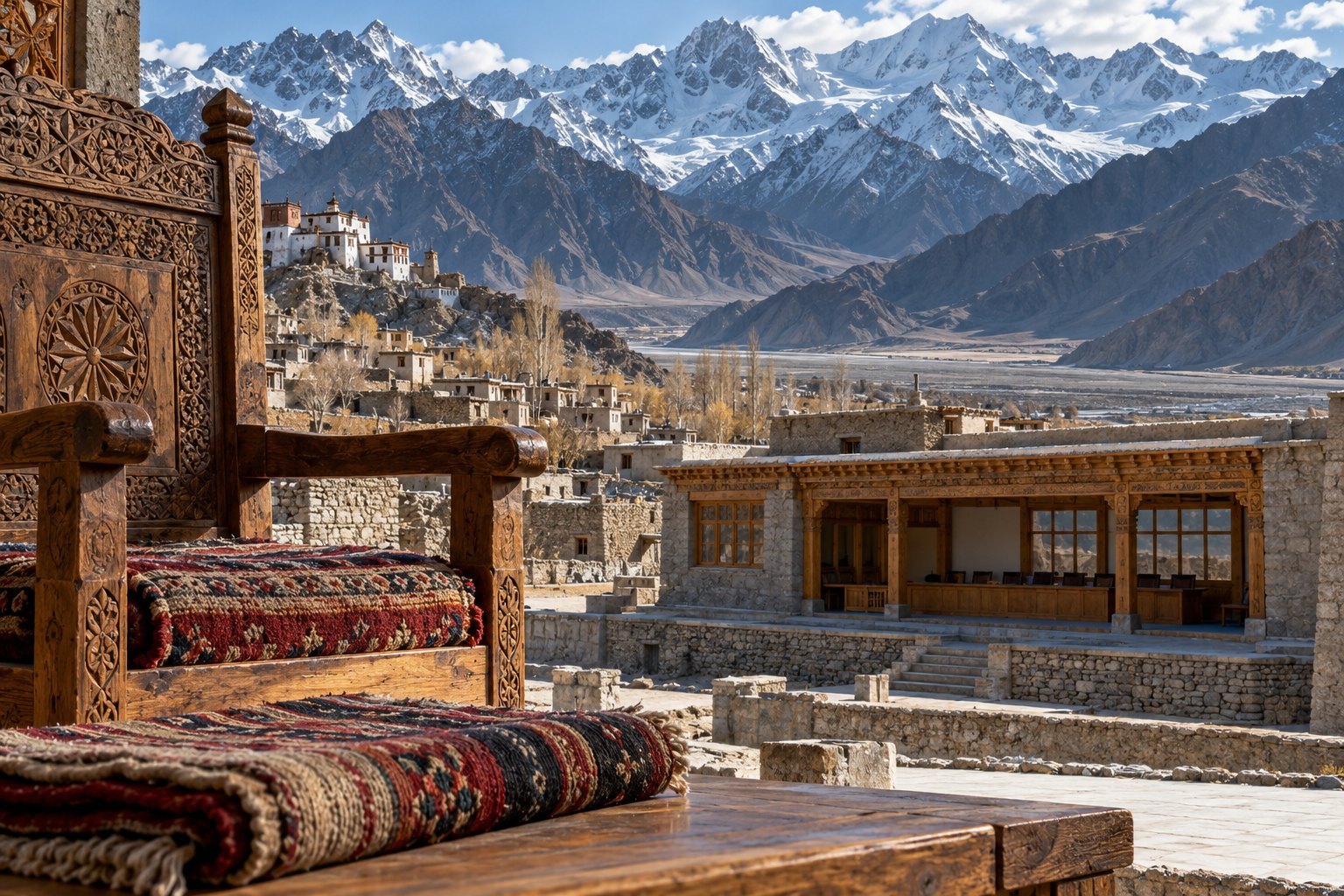
Articles 371 to 371J of the Constitution, each written in by a constitutional amendment, give twelve named States tailored safeguards: regional development boards, duties for the Governor and shields for customary law and land. The Sixth Schedule instead creates law-making tribal councils in four north-eastern States. A Home Ministry draft of 15 October 2026 proposes an Article 371-K for Ladakh.
Syllabus: GS2 · Constitution; GS2 · Federalism & Local Government; Prelims · Polity & Governance
Why this matters for UPSC
GS2 polity: special provisions for States, the Sixth Schedule and Union territories. Prelims can ask which Article 371 provision covers which State and what Article 240 allows; Mains, about asymmetric federalism and constitutional safeguards for Ladakh.
In short
Articles 371 to 371J are special provisions, each written in by constitutional amendment, that tailor governance, regional equity and identity safeguards to named States.
Article 371 shows the Constitution can bend for one region; Ladakh's test is giving an elected body real, entrenched powers within the Union.
Why it matters
For a young person in Leh or Kargil, the route chosen decides who writes the rules on government jobs, land and language, and how easily those rules can later change. Today such rules arrive as Presidential regulations, as the 2025 domicile and reservation rules did, and no elected Ladakh legislature debates them first. Safeguards written into the Constitution would be harder for any future government to dilute. A council with law-making power, like those in the north-east, would let local representatives decide matters of land and custom themselves. The wider question, for every diverse region, is how far one Constitution can bend for local identity without loosening the common rules that bind the Union.
Prelims pointers
- Article 371A (Thirteenth Amendment, 1962): Acts of Parliament on Naga customs, customary law or land ownership apply to Nagaland only if its Assembly so resolves.
- Article 371G (Fifty-third Amendment, 1986) gives Mizoram a like shield; Articles 371F, 371H and 371-I require Assemblies of at least thirty members in Sikkim, Arunachal Pradesh and Goa.
- Article 371J (Ninety-eighth Amendment, 2012): a Hyderabad-Karnataka development board, and orders that may reserve jobs and college seats for people of that region by birth or domicile.
- Article 371D (Thirty-second Amendment, 1973): local cadres and local-area preference in jobs and admissions in Andhra Pradesh and Telangana; Article 371E: a university in Andhra Pradesh.
- Article 244: the Sixth Schedule covers tribal areas of Assam, Meghalaya, Tripura and Mizoram; the Fifth Schedule covers Scheduled Areas in every other State.
- Sixth Schedule, paragraph 2: a District Council has at most thirty members, up to four nominated by the Governor; paragraph 3: its laws need the Governor's assent.
- Article 240(1) lists the Andaman and Nicobar Islands, Lakshadweep, Dadra and Nagar Haveli and Daman and Diu, and Puducherry; Ladakh is not on it.
- Article 368(2) proviso: an amendment touching listed provisions, such as the Seventh Schedule's Lists or States' representation in Parliament, also needs ratification by half the State Legislatures.
Practise a UPSC-style question
With reference to the special provisions in Part XXI of the Constitution, consider the following statements:
1. Article 371J lets the President provide for a separate development board for the Hyderabad-Karnataka region.
2. Under Article 371G, no Act of Parliament on Naga customary law applies to Nagaland unless its Assembly so resolves.
3. Article 371H gives the Governor of Arunachal Pradesh special responsibility for law and order, exercised in his individual judgment.
Which of the statements given above is/are correct?
- (a) 1 and 2 only
- (b) 2 and 3 only
- (c) 1 and 3 only
- (d) 1, 2 and 3
Show the answer
Answer: (c) 1 and 3 only
Answer: (c) 1 and 3 only. The Naga customary-law shield is in Article 371A; Article 371G is Mizoram's.
Statement 1: correct. Article 371J(1)(a), added by the Ninety-eighth Amendment Act, 2012, provides for a Hyderabad-Karnataka development board.
Statement 2: incorrect. Article 371A protects Naga customary law in Nagaland; Article 371G gives a like shield to Mizo customary law in Mizoram.
Statement 3: correct. Article 371H(a) makes law and order the Governor's special responsibility, judged individually after consulting the Council of Ministers.
Eliminate: Judge statement 2 first: Article 371G is Mizoram's provision, so statement 2 is incorrect. Out: (a), (b), (d).
Trap: Swapped attribution. A real shield for customary law is pinned on the wrong Article, Mizoram's instead of Nagaland's.
Remember: 371A Nagaland, 371G Mizoram: Parliament's laws on customs and land need the Assembly's resolution.
In the news
More Explainers
- State Legislative Councils: Articles 168-172 and the graduates' and teachers' seats Polity
- Whales and dolphins in Indian waters: legal protection, IUCN status and strandings Environment
- The Aligarh Movement, AMU and the Article 30 minority test Polity
- Environmental clearance by States: SEIAA, SEAC and the EIA Notification, 2006 Environment
- Software vulnerabilities: CVE, CVSS, coordinated disclosure and CERT-In's role Sci-Tech
- Drug trafficking law in India: NDPS Act, PIT-NDPS, NCB and NCORD National
- Choosing the UN Secretary-General: Article 97, UNSC veto and straw polls World & IR
- UN Convention against Torture, and why India has not ratified it Polity
- NavIC: why India's navigation constellation cannot give a standalone position Sci-Tech
- International Energy Agency: membership, 90-day oil stocks and India's status World & IR
- PM Surya Ghar: Muft Bijli Yojana and the rooftop solar subsidy Economy
- HFSS foods: FSSAI's draft limits and front-of-pack warning labels National