
Dissent against a court verdict is not enmity: Karnataka High Court
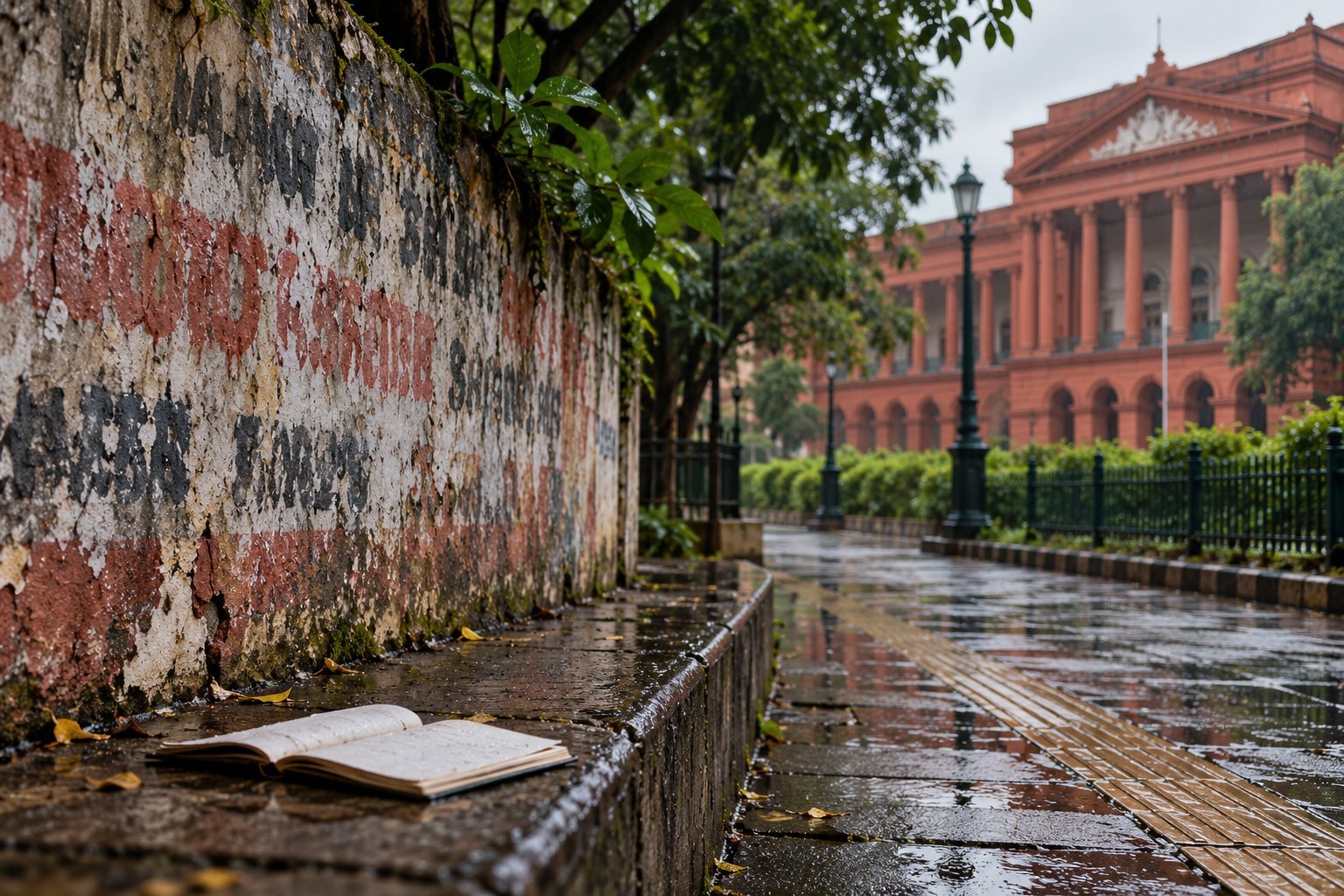
The Karnataka High Court has quashed a 2019 FIR against 13 people accused of painting roadside slogans that called a Supreme Court judgment a 'denial of justice'. Relying on the Supreme Court's 2024 ruling in Javed Ahmad Hajam, it held that voicing dissatisfaction with a verdict does not attract sections 153A or 295A of the Indian Penal Code.
Syllabus: GS2 · Constitution; Prelims · Polity & Governance; GS2 · Executive & Judiciary
Why this matters for UPSC
GS2 (Constitution, judiciary): Prelims can ask the grounds in Article 19(2), what sections 196 and 299 of the Bharatiya Nyaya Sanhita require, and fair criticism under the Contempt of Courts Act, 1971; Mains, the line between dissent and hate speech.
Why it matters
A citizen who thinks a court got a case wrong can now point to a clear High Court ruling that saying so in public is not a crime of spreading hatred. Police often register hate-speech cases against protest slogans, posters or social-media posts; such a case can hang over people for years, as this one did from 2019, even when the words never targeted any community. By asking how ordinary, reasonable people would take the words, rather than how a few might react, the ruling narrows the room for such cases. It belongs to the larger question of how a democracy protects dissent while still punishing speech that truly sets groups against one another.
Prelims pointers
- Article 19(2) in its present form was substituted by the Constitution (First Amendment) Act, 1951, with retrospective effect.
- The words 'sovereignty and integrity of India' were inserted into Article 19(2) by the Constitution (Sixteenth Amendment) Act, 1963.
- Under Article 19(3), the right to assemble peaceably and without arms may be restricted in the interests of sovereignty and integrity of India or public order.
- Articles 129 and 215 make the Supreme Court and every High Court a court of record with power to punish for contempt of itself.
- Under section 12 of the Contempt of Courts Act, 1971, contempt is punishable with simple imprisonment up to six months, a fine up to two thousand rupees, or both.
- Section 196(2) of the Bharatiya Nyaya Sanhita raises the maximum term to five years, with a fine, when the offence is committed in a place of worship or religious assembly.
- The Bharatiya Nagarik Suraksha Sanhita and the Bharatiya Sakshya Adhiniyam came into force with the Bharatiya Nyaya Sanhita on 1 July 2024.
Practise a UPSC-style question
With reference to Article 19(2) of the Constitution of India, consider the following statements:
1. Reasonable restrictions on freedom of speech may be imposed in relation to contempt of court.
2. Clause (2) of Article 19 in its present form was substituted by the Constitution (Forty-fourth Amendment) Act, 1978.
3. The Constitution (Sixteenth Amendment) Act, 1963 added the sovereignty and integrity of India as a ground for restricting speech.
Which of the statements given above is/are correct?
- (a) 1 and 2 only
- (b) 2 and 3 only
- (c) 1 and 3 only
- (d) 1, 2 and 3
Show the answer
Answer: (c) 1 and 3 only
Answer: (c) 1 and 3 only. Contempt of court and sovereignty are both grounds, but clause (2) dates from 1951.
Statement 1: correct. Article 19(2) lists contempt of court, defamation and incitement to an offence among the grounds for reasonable restrictions on speech.
Statement 2: incorrect. Clause (2) was substituted by the Constitution (First Amendment) Act, 1951, with retrospective effect, not by the Forty-fourth Amendment of 1978.
Statement 3: correct. The words 'the sovereignty and integrity of India' were inserted in Article 19(2) by the Constitution (Sixteenth Amendment) Act, 1963.
Eliminate: Statement 2 is wrong because clause (2) came from the First Amendment, 1951. Out: (a), (b), (d).
Trap: Swapped attribution. The 1978 amendment is famous for changes to fundamental rights, so pinning the 1951 substitution of Article 19(2) on it looks plausible.
Remember: Article 19(2): First Amendment 1951 rewrote it; Sixteenth Amendment 1963 added sovereignty and integrity.
More from the 21 October 2026 edition
- India, US review ties in Mumbai, hold trilateral with UAE World & IR
- ECI lets EROs decide SIR discrepancy notices; hearings made exceptional Polity
- Tamil Nadu funds 25 extra work days beyond VB-G RAM G's 125 National
- Japan launches MMX probe to bring back a sample from Phobos Sci-Tech
- Chhattisgarh's Sirpur enters India's UNESCO World Heritage Tentative List National
- SC directs Northeast panel to recommend law changes against racial harassment Polity
- No tax deducted on interest from NDB's Maharajah rupee bonds Economy
- India at UN renews offer of a multilateral No First Use pact World & IR
- Delhi HC: RTI security exemptions shield PM's IAF flight records Polity
- Supreme Court directs Centre to publicise Section 164A interim relief scheme Polity
- SCO Council of Heads of Government adopts 2027 budget in Dushanbe World & IR
- UN dues: India tells Fifth Committee the Charter requires full, timely payment World & IR