
Tropical cyclones in the North Indian Ocean: IMD's scale, warnings and naming
Why in news: IMD named Cyclonic Storm Arnab on 26 October 2026; it forecasts a crossing of the Andhra Pradesh coast near Yanam on 28 October.
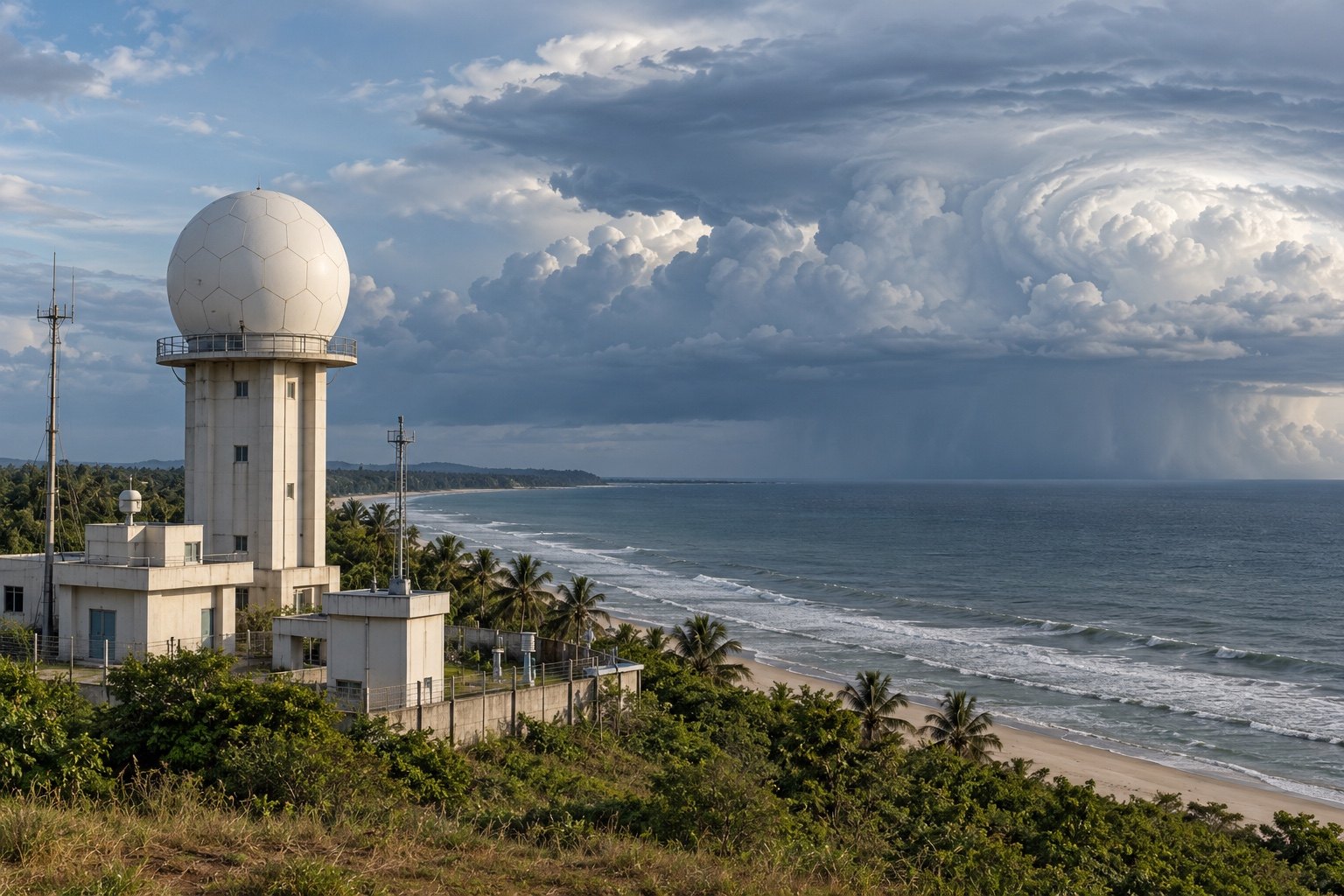
A tropical cyclone is an intense low-pressure system over warm seas. For the North Indian Ocean, the India Meteorological Department grades it by sustained wind, from cyclonic storm at 34 knots to super cyclonic storm at 120 knots. It issues four-stage warnings and names each storm. On 26 October 2026 it named Cyclonic Storm Arnab over the Bay of Bengal.
Syllabus: Prelims · Geography; GS1 · Geophysical Phenomena; GS3 · Disaster Management
Why this matters for UPSC
Tropical cyclones are GS1 geography and GS3 disaster management. Prelims can ask IMD's knot thresholds, the four warning stages and their colours, and the WMO/ESCAP Panel's naming rules; Mains, why the Bay of Bengal is cyclone-prone and how NDMA and NCRMP cut losses.
In short
A tropical cyclone is an intense, non-frontal low over warm tropical seas; IMD, as RSMC New Delhi, grades, warns of and names those forming in the North Indian Ocean.
IMD's warnings now arrive days ahead; the harder task is making coasts surge-proof through shelters, mangrove belts and alerts that reach every fisherman.
Why it matters
For a fishing family near Kakinada or Yanam, the warning ladder decides whether its boat is ashore and its people are in a shelter before the wind arrives. Each stage sets off a step: boats are called back, shelters are opened, people in huts are moved, and after landfall power and roads are restored. The sea is often deadlier than the wind: a surge can flood low coasts and leave salt in the fields for two or three seasons, wiping out a farmer's next harvests. Because so many Indians live along the coast, clear and early warnings save both lives and livelihoods. A warming climate and rising seas could make that job harder in the coming decades.
Prelims pointers
- IMD scale (SOP 2024), by maximum sustained wind: cyclonic storm 34-47 knots, severe 48-63, very severe 64-89, extremely severe 90-119, super cyclonic storm 120 knots or more.
- Averaging period: IMD uses a 3-minute mean wind; the US Joint Typhoon Warning Centre's 'super typhoon' needs a 1-minute mean of at least 130 knots.
- Four-stage warning: Pre-Cyclone Watch (72 hours ahead, no colour), Cyclone Alert (48 hours, yellow), Cyclone Warning (24 hours, orange), Post Landfall Outlook (12 hours before landfall, red).
- WMO/ESCAP Panel members (2020 list): Bangladesh, India, Iran, Maldives, Myanmar, Oman, Pakistan, Qatar, Saudi Arabia, Sri Lanka, Thailand, United Arab Emirates, Yemen.
- Naming rules: at most eight letters; neutral to politics, religion, culture and gender; never reused; a South China Sea storm crossing Thailand into the Bay keeps its name.
- Seasons (IMD): about five cyclones a year in the North Indian Ocean; Bay of Bengal to Arabian Sea about 4:1; main peak November, second peak May.
- Coastal record (IMD): severe cyclonic storms cross Andhra Pradesh most often, cyclones Odisha; on the west coast Gujarat is the most vulnerable State.
- Disaster Management Act, 2005: section 46 creates the National Disaster Response Fund, topping up a State's fund in severe disasters it cannot meet; section 48 creates State funds.
Practise a UPSC-style question
With reference to the India Meteorological Department's classification of cyclonic disturbances, consider the following statements:
1. A very severe cyclonic storm has maximum sustained winds of 90 to 119 knots.
2. A system is classed as a cyclonic storm once its maximum sustained wind reaches 34 knots.
3. IMD measures maximum sustained wind as a 3-minute average at a height of 10 metres.
Which of the statements given above is/are correct?
- (a) 1 and 2 only
- (b) 2 and 3 only
- (c) 1 and 3 only
- (d) 1, 2 and 3
Show the answer
Answer: (b) 2 and 3 only
Answer: (b) 2 and 3 only. The 90-119 knot band belongs to the extremely severe grade, not the very severe one.
Statement 1: incorrect. IMD's 2024 SOP puts a very severe cyclonic storm at 64-89 knots; 90-119 knots is an extremely severe cyclonic storm.
Statement 2: correct. IMD calls a system a cyclonic storm at 34-47 knots, about 62-88 km/h, and names it from that point.
Statement 3: correct. IMD defines maximum sustained wind as the 3-minute average surface wind at 10 metres.
Eliminate: Statement 1 moves the very severe band up one grade, so it is incorrect. Out: (a), (c), (d).
Trap: Look-alike names. 'Very severe' and 'extremely severe' sound close, and the higher band is pinned on the lower grade.
Remember: Knots: 34 cyclonic, 48 severe, 64 very severe, 90 extremely severe, 120 super cyclonic.
In the news
More Explainers
- Crypto in Indian law: virtual digital assets, tax and PMLA cover Economy
- The collegium system for appointing and transferring higher court judges Polity
- Protected Area, Restricted Area and Inner Line Permits Polity
- Scheduled Tribe seats in Assemblies: Article 332 and Goa's 2025 Act Polity
- Ballot papers and EVMs: where India still votes on paper Polity
- Gelephu Mindfulness City: Bhutan's special zone on the Assam border World & IR
- Nuclear fusion, the tokamak and India's role in ITER Sci-Tech
- Gilgit-Baltistan, CPEC and India's sovereignty objection World & IR
- India-Nepal electricity trade: how Nepal sells power to India World & IR
- Infant mortality and child malnutrition among Scheduled Tribes National
- Genocide Convention, 1948: the legal test and who can judge it World & IR
- Chola bronzes: lost-wax casting and Nataraja iconography National