
Ballot papers and EVMs: where India still votes on paper
Why in news: Results for 28 Legislative Council seats, polled on paper, came on 28 October 2026 and revived the EVM-versus-ballot debate.
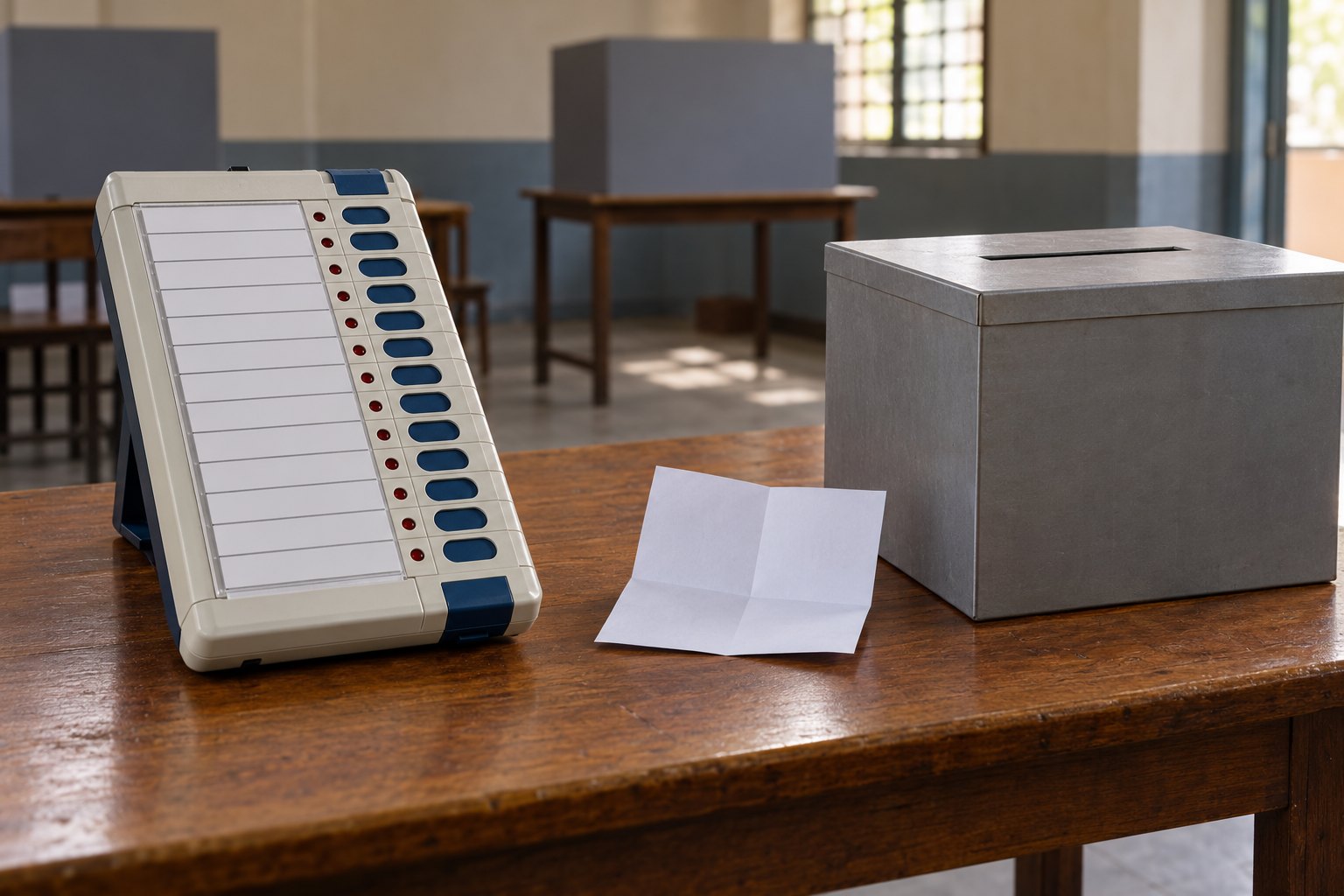
Electronic voting machines (EVMs) run Lok Sabha and Assembly polls under Section 61A of the Representation of the People Act, 1951, but paper ballots survive elsewhere. Elections by single transferable vote, to the Rajya Sabha, Legislative Councils and the President's office, need ranked preferences on paper. Results for 28 Legislative Council seats on 28 October 2026 revived the debate.
Syllabus: GS2 · Federalism & Local Government; Prelims · Polity & Governance; GS2 · Representation of the People Act
Why this matters for UPSC
GS2 polity: the Representation of the People Act, 1951 and modes of voting. Prelims can ask which elections use paper and why; Mains, EVMs in local polls.
In short
Section 61A of the Representation of the People Act, 1951 permits electronic voting machines (EVMs), yet paper remains where ranked votes, open voting or local capacity demand it.
Paper survives where the voting method needs ranked choices; in local polls, each State Election Commission sets the pace of any shift to EVMs, weighing counting costs against funds and voter readiness.
Why it matters
An 86-year-old voter in Bihar who cannot reach a polling booth can still vote: a polling team brings a paper ballot to her home. Paper also lets an MLA rank candidates for the Rajya Sabha, which a machine built for one choice cannot record. In villages, the State's own commission decides whether people press a button or stamp a paper, so the same family may vote by machine for Parliament and by paper for its panchayat. Paper takes longer to count and needs many staff, which slows results and adds cost. The larger question is trust: each mode has critics, and the rules decide where each one fits.
Prelims pointers
- Article 171 of the Constitution provides that elected members of the State Legislative Councils are chosen by the single transferable vote.
- Rajya Sabha polls use an open ballot for party members; the Presidential poll is secret, and the anti-defection law does not apply to it.
- Presidential ballot papers are green for MPs and pink for MLAs; nominated members cannot vote, since only elected members form the Electoral College.
- Until figures of the first census after 2026 are published, an MLA's vote value in the Presidential poll rests on the 1971 census.
- Article 324 vests the conduct of the Presidential election in the Election Commission of India; by convention, the Secretary General of either House is Returning Officer by rotation.
- Rajya Sabha quota: votes cast divided by seats plus one, then one added; 200 votes for four seats gives 41.
- Service voters receive postal ballots electronically through ETPBS; employees on essential poll-day duty apply through their department's nodal officer.
Practise a UPSC-style question
With reference to Section 61A of the Representation of the People Act, 1951, consider the following statements:
1. It formed part of the Act as originally enacted in 1951.
2. It lets the Election Commission adopt voting machines in the constituencies it specifies.
3. Its "voting machine" covers any apparatus for recording votes, whether operated electronically or otherwise.
Which of the statements given above is/are correct?
- (a) 1 and 2 only
- (b) 2 and 3 only
- (c) 1 and 3 only
- (d) 1, 2 and 3
Show the answer
Answer: (b) 2 and 3 only
Answer: (b) 2 and 3 only. The voting-machine provision came by amendment, not with the original Act.
Statement 1: incorrect. Section 61A was inserted into the Representation of the People Act, 1951 by an amending Act that took effect in March 1989.
Statement 2: correct. The Election Commission may adopt voting machines in such constituencies as it specifies, having regard to the circumstances of each case.
Statement 3: correct. The section's explanation defines a voting machine as any machine or apparatus, electronic or otherwise, used for giving or recording votes.
Eliminate: Statement 1 is the surest: the section dates from 1989, so every option with 1 goes. Out: (a), (c), (d).
Trap: Outdated fact. The section now sits inside the 1951 Act, so a student may assume it was there from the start; it was added nearly four decades later.
Remember: Section 61A (from 1989) lets the Election Commission choose where voting machines are used.
More Explainers
- Crypto in Indian law: virtual digital assets, tax and PMLA cover Economy
- The collegium system for appointing and transferring higher court judges Polity
- Protected Area, Restricted Area and Inner Line Permits Polity
- Scheduled Tribe seats in Assemblies: Article 332 and Goa's 2025 Act Polity
- Gelephu Mindfulness City: Bhutan's special zone on the Assam border World & IR
- Nuclear fusion, the tokamak and India's role in ITER Sci-Tech
- Gilgit-Baltistan, CPEC and India's sovereignty objection World & IR
- India-Nepal electricity trade: how Nepal sells power to India World & IR
- Infant mortality and child malnutrition among Scheduled Tribes National
- Genocide Convention, 1948: the legal test and who can judge it World & IR
- Chola bronzes: lost-wax casting and Nataraja iconography National
- PMMSY, PM-MKSSY, FIDF and KCC: how India funds its fish value chain Economy