
Gelephu Mindfulness City: Bhutan's special zone on the Assam border
Why in news: 108 chortens planned at Gelephu for 1 November 2026, most holding relics of Indian origin, were to mark the city's spiritual foundation.
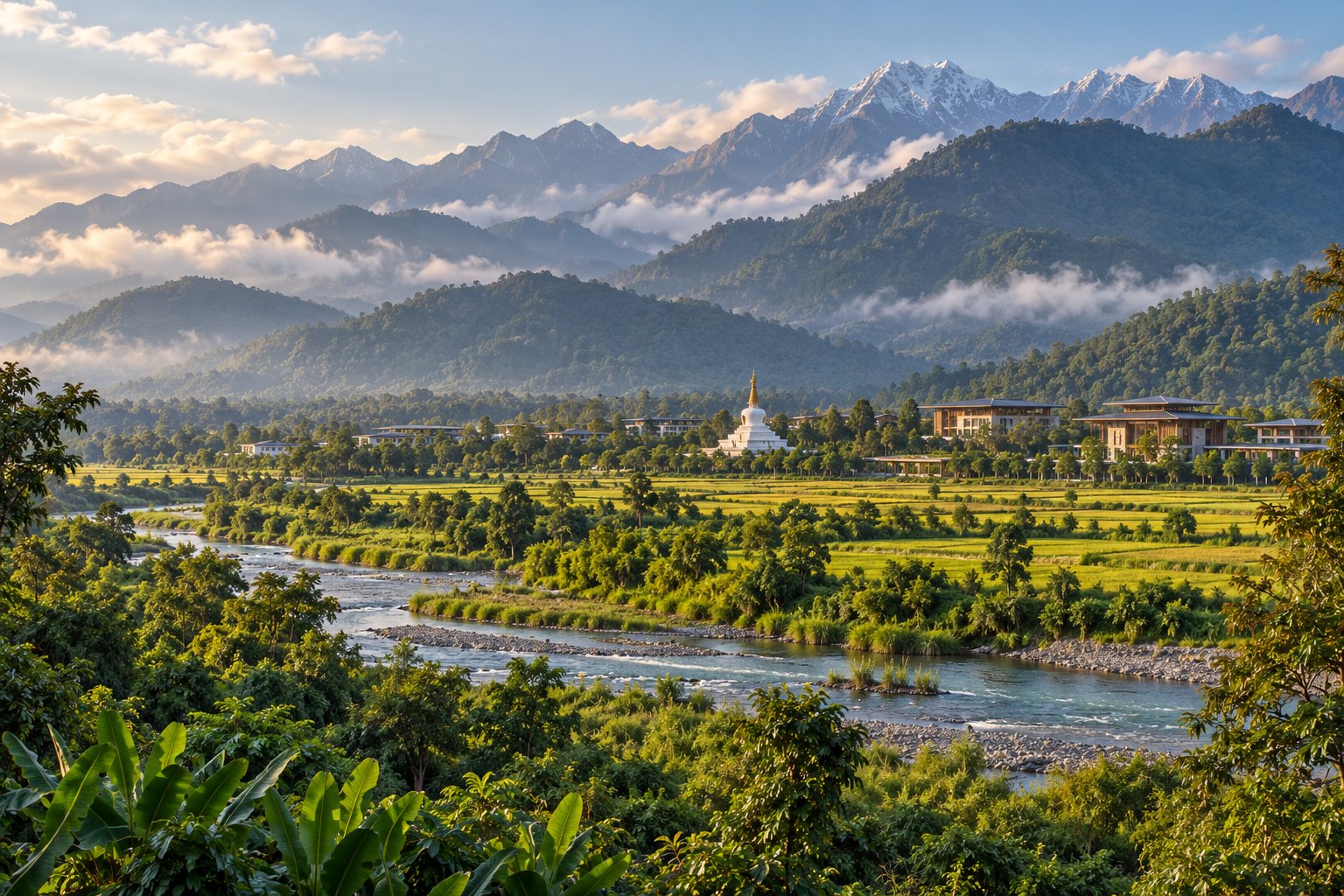
Gelephu Mindfulness City is a self-governing economic zone that Bhutan's King created in February 2024 on the southern plains facing Assam. India backs it with a planned Kokrajhar-Gelephu rail link and a new immigration post at Hatisar. On 1 November 2026, 108 stupas enshrining Buddhist relics, most of Indian origin, were scheduled to mark its spiritual foundation.
Syllabus: Prelims · Geography; GS3 · Infrastructure; GS2 · India & its Neighbourhood
Why this matters for UPSC
GS2 India and its neighbourhood: India-Bhutan relations and cross-border connectivity. Prelims can ask Gelephu's location and rail links; Mains, connectivity diplomacy.
In short
Gelephu Mindfulness City is a highly autonomous Special Administrative Region that Bhutan created by Royal Charter in 2024 on its border with Assam, and India is its main gateway.
Gelephu will thrive only if India turns rail and check-post plans into working links while respecting Bhutan's autonomy over its new city.
Why it matters
Investors and visitors reaching Gelephu from India come through Assam, so the city's growth depends on Indian roads, check posts and, in time, Indian railways. A working check post at Hatisar and a line from Kokrajhar would cut the time and cost of reaching the city, and could bring trade and jobs to Assam's border districts as well. For Bhutan, the city is a bet that a separate, business-friendly legal system can create work for young people while keeping Buddhist values at its core. For India, backing the project ties a close neighbour's largest economic plan to Indian transport and goodwill. Shared Buddhist heritage, seen in the relics sent for the stupas, gives that partnership a cultural base as well as an economic one.
Prelims pointers
- Thimphu is Bhutan's capital; Gelephu lies about 240 km south-southeast of it, beside the Chirang district of Assam.
- The India-Bhutan Treaty of Friendship and Cooperation was signed in 1949 and revised in February 2007; formal diplomatic relations began in 1968.
- Look-alikes: the Kokrajhar-Gelephu rail link reaches the Bhutan-Assam border, while the Banarhat-Samtse link reaches the Bhutan-West Bengal border.
- Darranga in Assam has had a working Immigration Check Post since 2024; upgrading the Land Customs Station at Dadgiri to an Integrated Check Post is under discussion.
- Punatsangchhu-II (1020 MW) is running and exports power to India; Punatsangchhu-I (1200 MW), still being built, is the bigger joint project.
- A jangchub chorten, or stupa of enlightenment, commemorates the Buddha's enlightenment; once consecrated, it is held equal to the living Buddha.
- India's development partnership with Bhutan dates from Bhutan's First Five Year Plan of 1961; India now supports Bhutan's 13th Five Year Plan.
Practise a UPSC-style question
With reference to Gelephu Mindfulness City, consider the following statements:
1. It was established by a Royal Charter in February 2024 as a Special Administrative Region.
2. It covers about one-tenth of Bhutan's total area.
3. It is governed directly by the ministries of the Royal Government of Bhutan like any other district.
Which of the statements given above is/are correct?
- (a) 1 and 2 only
- (b) 2 and 3 only
- (c) 1 and 3 only
- (d) 1, 2 and 3
Show the answer
Answer: (a) 1 and 2 only
Answer: (a) 1 and 2 only. The city was created by Royal Charter and spans about 10% of Bhutan, but it governs itself.
Statement 1: correct. GMC's official site says it was established by Royal Charter in February 2024 as a highly autonomous Special Administrative Region.
Statement 2: correct. GMC spans 4,046 sq km, which its site puts at about 10% of Bhutan.
Statement 3: incorrect. The charter gives GMC full executive and legislative powers and an independent judiciary, separate from the Royal Government of Bhutan.
Eliminate: statement 3 misstates who governs the city. Out: (b), (c), (d).
Trap: Wrong scope. A city inside Bhutan sounds as if it must be run by the national ministries, but the charter places it outside their ordinary control.
Remember: GMC is a self-governing Special Administrative Region within Bhutan, with its own courts.
More Explainers
- Crypto in Indian law: virtual digital assets, tax and PMLA cover Economy
- The collegium system for appointing and transferring higher court judges Polity
- Protected Area, Restricted Area and Inner Line Permits Polity
- Scheduled Tribe seats in Assemblies: Article 332 and Goa's 2025 Act Polity
- Ballot papers and EVMs: where India still votes on paper Polity
- Nuclear fusion, the tokamak and India's role in ITER Sci-Tech
- Gilgit-Baltistan, CPEC and India's sovereignty objection World & IR
- India-Nepal electricity trade: how Nepal sells power to India World & IR
- Infant mortality and child malnutrition among Scheduled Tribes National
- Genocide Convention, 1948: the legal test and who can judge it World & IR
- Chola bronzes: lost-wax casting and Nataraja iconography National
- PMMSY, PM-MKSSY, FIDF and KCC: how India funds its fish value chain Economy