
Nuclear fusion, the tokamak and India's role in ITER
Why in news: Reported on 31 October 2026: Bengaluru startup Pranos Fusion has built PRAGYA, a small tokamak to test plasma control and superconducting magnets.
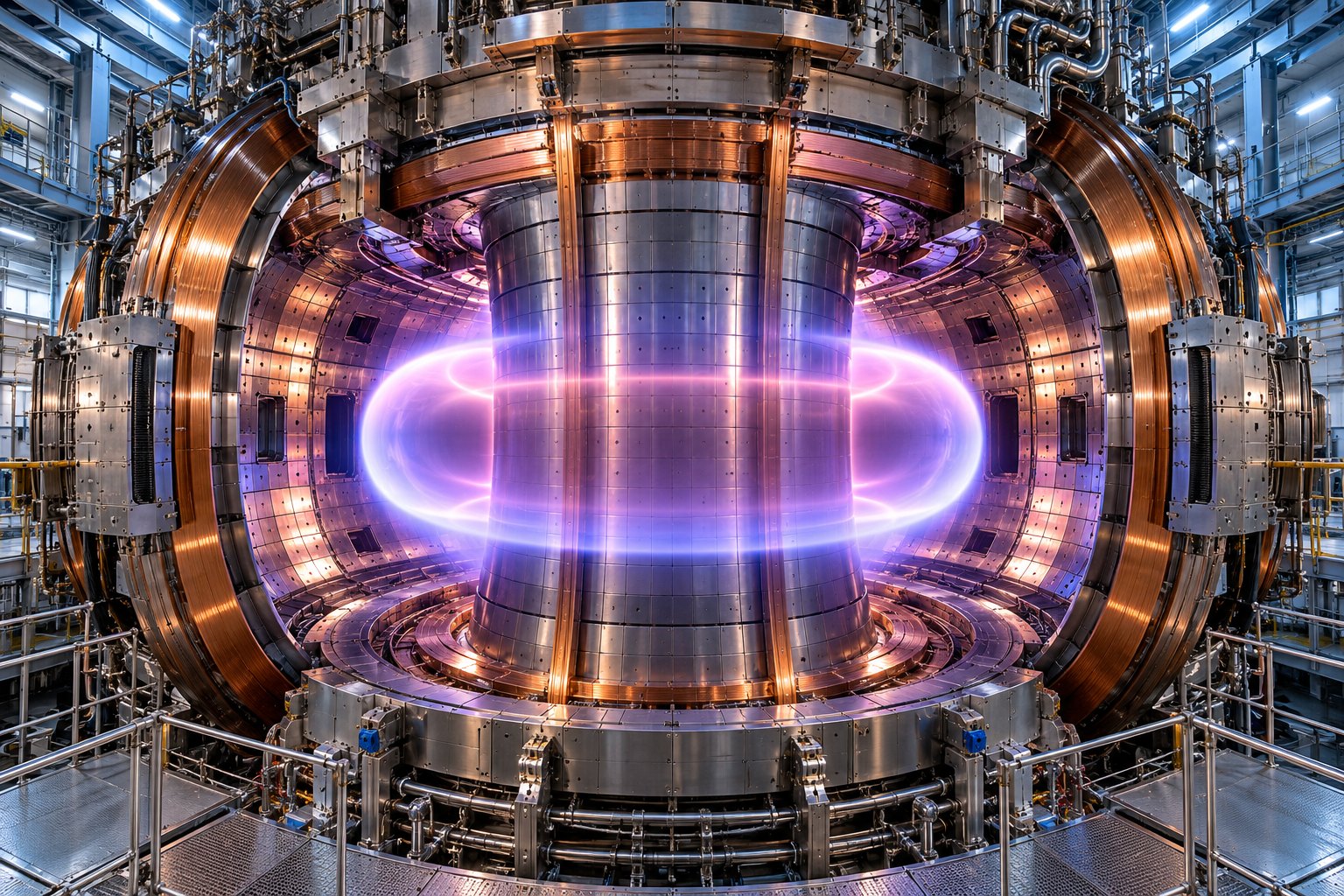
Nuclear fusion releases energy when light nuclei such as deuterium and tritium merge into helium, the process that powers the Sun. A tokamak uses magnets to hold this fuel, heated to about 100 million degrees Celsius, as plasma. India runs its own tokamaks and is one of ITER's seven Members. A Bengaluru startup has now built a small private tokamak.
Syllabus: Prelims · Science & Technology; GS3 · Infrastructure; GS3 · Science & Technology
Why this matters for UPSC
GS3 science and technology: nuclear energy and India's fusion research. Prelims can ask ITER's Members and site; Mains, fusion's place in India's energy mix.
In short
Nuclear fusion joins light nuclei to release energy, as in the Sun. Tokamaks confine it with magnets; it promises clean power but remains decades from commercial use.
India should keep building tokamak skills through ITER and IPR, treating fusion as a long-term complement to fission and renewables, not a near-term fix.
Why it matters
A family switching on a light in 2060 could be using fusion power if the machines tested today succeed. Fusion runs on forms of hydrogen, gives off no carbon dioxide and is not a chain reaction, so a runaway is very unlikely. That suits a country that wants clean and steady electricity for a growing economy. The catch is time: India's own statement to the IAEA says the breakthroughs needed for commercial use still look a few decades away. Until then, building parts for ITER trains Indian engineers and firms, so a home industry for magnets, vacuum vessels and cooling systems is ready when fusion power plants become possible.
Prelims pointers
- Fission splits heavy nuclei such as uranium in a chain reaction; fusion joins light nuclei and is not a chain reaction.
- The deuterium-tritium reaction gives the highest energy gain at the lowest temperature of any laboratory fusion reaction, per the ITER Organization.
- Magnetic confinement, as in a tokamak, holds plasma with magnetic fields; inertial confinement compresses fuel with lasers, as at the US National Ignition Facility.
- JET, the European tokamak in Britain, set the magnetic-confinement fusion-power record in 1997: 16 MW from 24 MW of heating (Q=0.67).
- The ITER Organization was licensed as a nuclear operator in France in 2012; the European Union takes part in ITER through Euratom.
- The United Kingdom stopped taking part in ITER after Brexit and its withdrawal from Euratom.
- ITER will test breeding tritium from lithium inside its vacuum vessel, because the world's tritium supply cannot fuel future power plants.
Practise a UPSC-style question
With reference to nuclear fusion, consider the following statements:
1. Fusion joins light nuclei such as deuterium and tritium, producing helium and a neutron.
2. Like fission, fusion in a reactor proceeds as a self-sustaining chain reaction.
3. In a tokamak, magnetic fields keep the hot plasma away from the walls of the vessel.
Which of the statements given above is/are correct?
- (a) 1 and 2 only
- (b) 2 and 3 only
- (c) 1 and 3 only
- (d) 1, 2 and 3
Show the answer
Answer: (c) 1 and 3 only
Answer: (c) 1 and 3 only. Fusion merges light nuclei and a tokamak holds the plasma with magnets.
Statement 1: correct. Deuterium and tritium, two isotopes of hydrogen, fuse into helium and a fast neutron.
Statement 2: incorrect. Fission splits uranium nuclei in a chain reaction; fusion merges nuclei and is not a chain reaction.
Statement 3: correct. Strong magnets in a tokamak hold plasma near 100 million degrees Celsius clear of the walls.
Eliminate: statement 2 describes fission, not fusion. Out: (a), (b), (d).
Trap: Swapped attribution. The chain reaction belongs to fission; pinning it on fusion makes a familiar phrase sound right.
Remember: Fission splits heavy nuclei in a chain; fusion joins light nuclei with no chain reaction.
More Explainers
- Crypto in Indian law: virtual digital assets, tax and PMLA cover Economy
- The collegium system for appointing and transferring higher court judges Polity
- Protected Area, Restricted Area and Inner Line Permits Polity
- Scheduled Tribe seats in Assemblies: Article 332 and Goa's 2025 Act Polity
- Ballot papers and EVMs: where India still votes on paper Polity
- Gelephu Mindfulness City: Bhutan's special zone on the Assam border World & IR
- Gilgit-Baltistan, CPEC and India's sovereignty objection World & IR
- India-Nepal electricity trade: how Nepal sells power to India World & IR
- Infant mortality and child malnutrition among Scheduled Tribes National
- Genocide Convention, 1948: the legal test and who can judge it World & IR
- Chola bronzes: lost-wax casting and Nataraja iconography National
- PMMSY, PM-MKSSY, FIDF and KCC: how India funds its fish value chain Economy