
Chola bronzes: lost-wax casting and Nataraja iconography
Why in news: Chola bronzes of Nataraja and Sivagami from the 12th century AD, unearthed at Nagapattinam by the TNSDA, were reported on 30 October 2026.
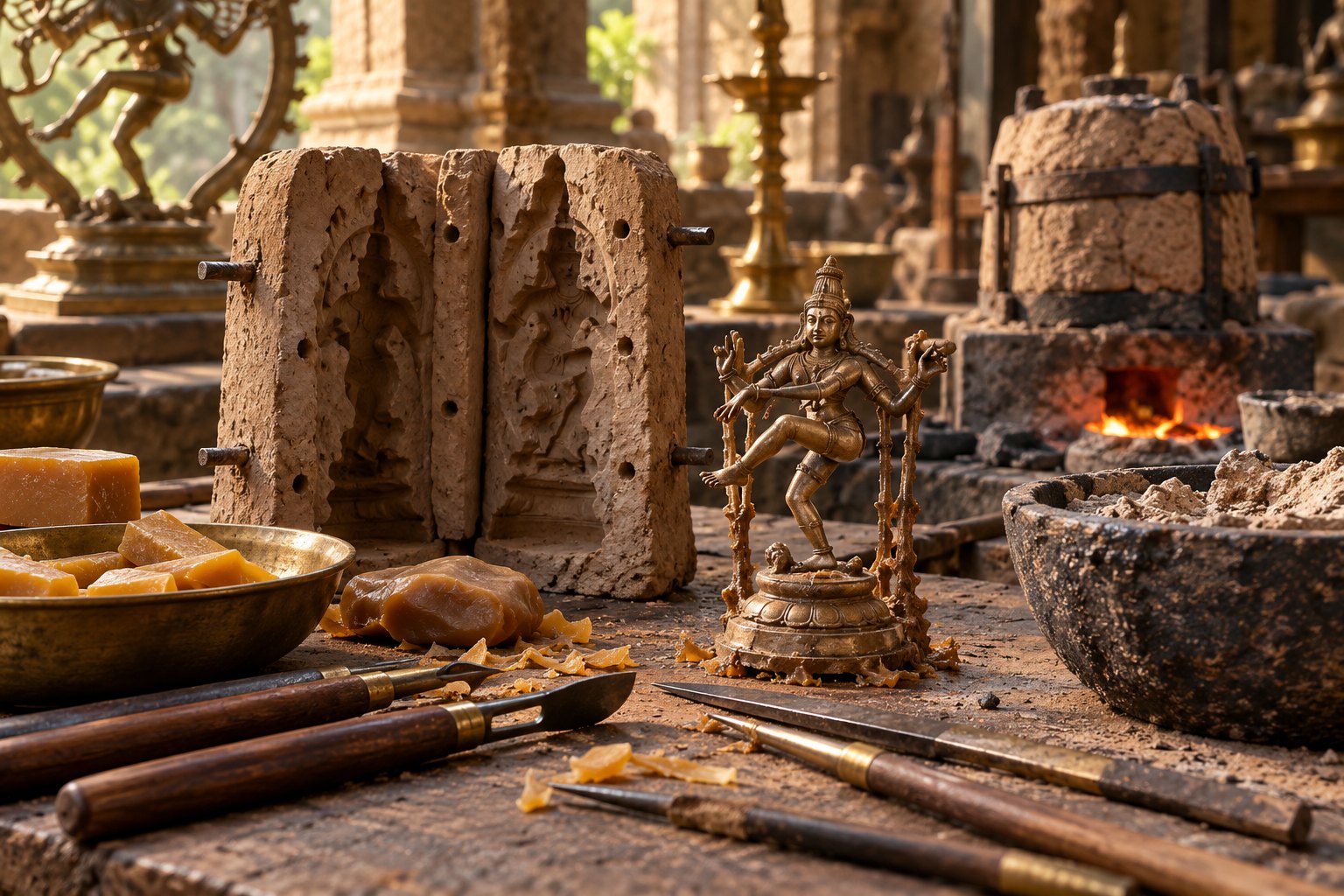
Chola bronzes are images of deities cast in metal by the lost-wax, or cire-perdu, process. The finest were made in Tamil Nadu between the tenth and twelfth centuries, and Shiva as Nataraja is their best-known form. Excavations at Nagapattinam have now yielded 12th-century bronzes of Nataraja and Sivagami.
Syllabus: GS1 · Art & Culture; Prelims · History & Culture
Why this matters for UPSC
GS1 Indian culture: Chola bronzes, the lost-wax process and Nataraja iconography. Prelims asks casting steps and Nataraja's symbols; Mains, Chola art and living crafts.
In short
Chola bronzes are temple images of deities cast by the lost-wax process in Tamil Nadu, finest between the tenth and twelfth centuries, with Nataraja as their crowning form.
Chola bronzes join technique and belief; keeping the Swamimalai Sthapathis' skill alive matters as much as protecting the old images found in the ground.
Why it matters
A Sthapathi family at Swamimalai earns its living from a method that Tamil Nadu's temples have used for centuries. Because Swamimalai bronze icons carry a Geographical Indication tag, the name can mark work from that place, which helps the craftsmen keep their market against imitations. For historians, a dated find in the ground matters more than a museum piece of unknown origin: it shows what was made, where and when, so styles can be tied to periods. Each image also carries meaning in its pose and hands, so a reader who knows the symbols can read the beliefs of the age that made it. Heritage, livelihood and faith meet in one craft.
Prelims pointers
- Pallava bronzes of the eighth and ninth centuries came before the Chola peak; the finest Chola images date from the tenth to the twelfth century (NCERT).
- NCERT dates the finest Chola bronzes to the tenth-twelfth century; Tamil Nadu Tourism dates the Chola dynasty's reign to the 9th-13th century AD.
- NCERT associates Nataraja's dancing position with the end of the cosmic world.
- NCERT lists lost-wax metalwork in Himachal Pradesh, Odisha, Bihar, Madhya Pradesh and West Bengal, each region with a slightly different technique.
- Look-alike: NCERT calls the alloy of copper, zinc and tin bronze; some images are instead cast in five metals: gold, silver, copper, brass and lead.
- Bronze casting is still practised in South India, particularly in Kumbakonam, and Swamimalai lies in Kumbakonam in Thanjavur district.
Practise a UPSC-style question
With reference to the lost-wax process of bronze casting, consider the following statements:
1. The weight of metal used is about twice the weight of the wax model.
2. The wax model is covered with a paste of clay, sand and cow-dung before casting.
Which of the statements given above is/are correct?
- (a) 1 only
- (b) 2 only
- (c) Both 1 and 2
- (d) Neither 1 nor 2
Show the answer
Answer: (b) 2 only
Answer: (b) 2 only. The clay coat is right, but the metal weighs far more than twice the wax.
Statement 1: incorrect. NCERT says the metal used weighs ten times the wax, which is weighed before the process begins.
Statement 2: correct. A thick paste of equal parts clay, sand and cow-dung covers the wax model, per NCERT.
Eliminate: statement 1 is wrong, since the metal is ten times the wax. Out: (a), (c).
Eliminate: statement 2 is right, so neither cannot be the answer. Out: (d).
Trap: Near-miss figure. The ratio of metal to wax is changed from ten times to twice, a figure that sounds reasonable.
Remember: Lost-wax metal weighs ten times the wax; the coat is clay, sand and cow-dung.
In the news
More Explainers
- Crypto in Indian law: virtual digital assets, tax and PMLA cover Economy
- The collegium system for appointing and transferring higher court judges Polity
- Protected Area, Restricted Area and Inner Line Permits Polity
- Scheduled Tribe seats in Assemblies: Article 332 and Goa's 2025 Act Polity
- Ballot papers and EVMs: where India still votes on paper Polity
- Gelephu Mindfulness City: Bhutan's special zone on the Assam border World & IR
- Nuclear fusion, the tokamak and India's role in ITER Sci-Tech
- Gilgit-Baltistan, CPEC and India's sovereignty objection World & IR
- India-Nepal electricity trade: how Nepal sells power to India World & IR
- Infant mortality and child malnutrition among Scheduled Tribes National
- Genocide Convention, 1948: the legal test and who can judge it World & IR
- PMMSY, PM-MKSSY, FIDF and KCC: how India funds its fish value chain Economy