
The RTE Act's 25 per cent quota in private schools, explained
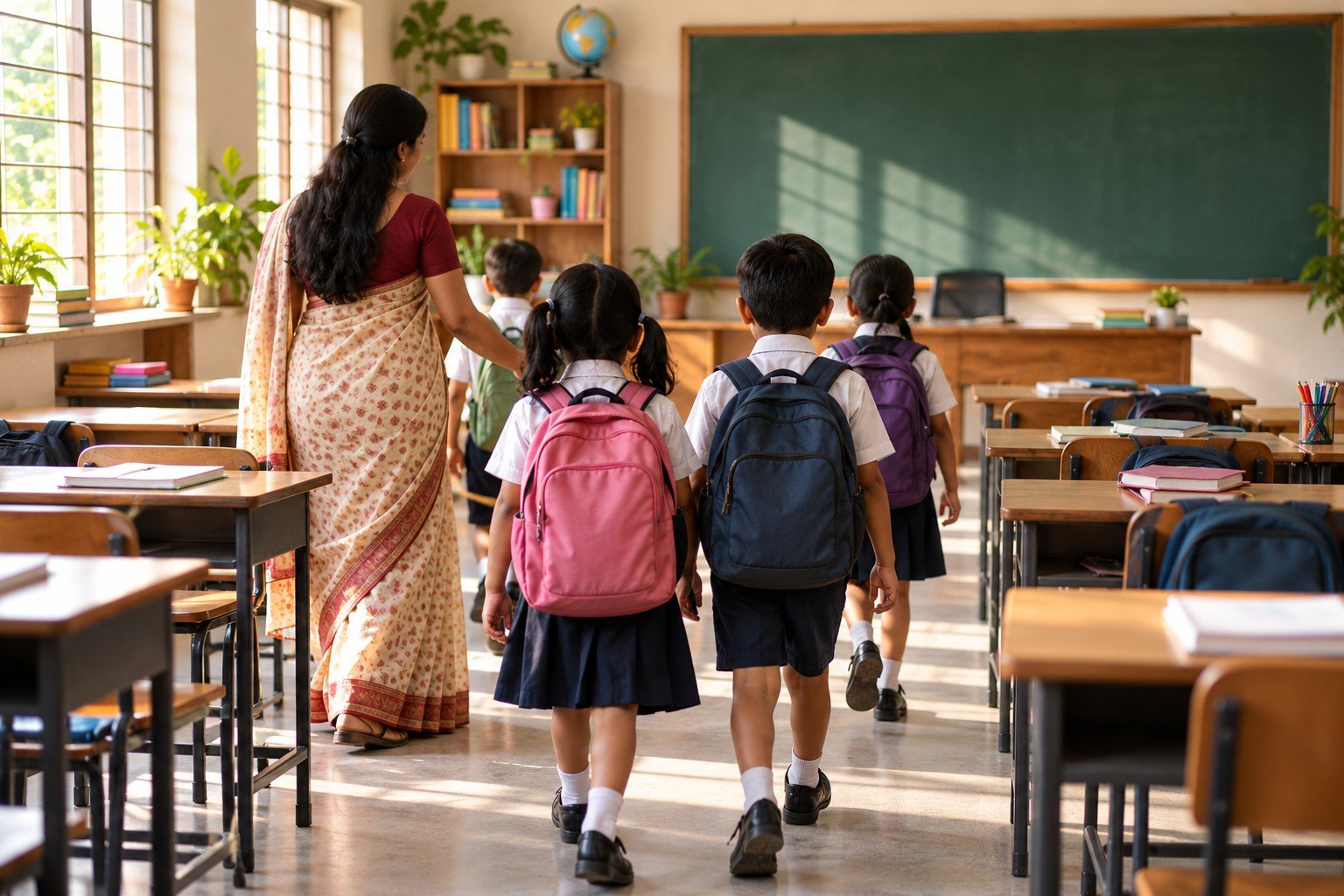
Section 12(1)(c) of the Right of Children to Free and Compulsory Education Act, 2009 (RTE Act) binds private unaided and specified-category schools. They must fill at least a quarter of their entry class with poorer and disadvantaged children from nearby, free till class VIII. States repay unaided schools. An opinion piece of 27 October 2026 reopened debate on the quota.
Syllabus: GS2 · Constitution; Prelims · Polity & Governance; GS2 · Welfare of Vulnerable Sections
Why this matters for UPSC
GS2 education and Fundamental Rights: Prelims can ask which schools section 12(1)(c) binds, Article 21A's age band and what Pramati (2014) held; Mains, whether private schools should share the State's duty to educate.
In short
Section 12(1)(c) of the Right of Children to Free and Compulsory Education Act, 2009 makes private schools share the Article 21A duty, reserving entry seats for poorer neighbourhood children.
The quota works only with prompt reimbursement and real inclusion; Article 21A needs quota children retained till class VIII, not merely admitted.
Why it matters
A rickshaw puller's daughter who could never afford a private school's fees can walk into its first class and stay there, free, until she finishes elementary school. Her classmates grow up beside a child from a home unlike theirs, which a fee wall would otherwise prevent. For the school, each such seat is income it must recover from the government, so slow or short payments squeeze small private schools and test their willingness. For States, the bill grows as every new batch moves up a class. The quota thus sits where a child's right to schooling, a private owner's freedom to run a business and the public purse meet.
Prelims pointers
- Government schools must teach every admitted child free; aided schools must teach free a share matching aid to recurring costs, never below 25 per cent.
- Under the RTE Act, elementary education runs from class I to class VIII, and a 'child' means one aged six to fourteen.
- Section 13 fines, at most: ten times any capitation fee taken; Rs 25,000 for a first screening procedure and Rs 50,000 for each repeat.
- Article 15(5), added by the Constitution (Ninety-third Amendment) Act, 2005, allows special admission provisions for backward classes, SCs and STs in private institutions, aided or unaided, except minority ones.
- Entry 25 of List III covers education; the Constitution (Forty-second Amendment) Act, 1976 placed it there, deleting entry 11 of the State List.
- Article 45, a Directive Principle, now covers early childhood care and education until six; Article 51A(k) makes schooling a child aged six to fourteen a parent's duty.
- Section 11 lets the appropriate Government arrange free pre-school education for children above three, to ready them for elementary school.
- Parents who choose a private school outside the quota cannot claim its fees from the government under the RTE Act.
Practise a UPSC-style question
With reference to the Right of Children to Free and Compulsory Education Act, 2009, consider the following statements:
1. Private unaided schools are reimbursed the full fee they charge, even where it exceeds the State's per-child expenditure.
2. Kendriya Vidyalayas, Navodaya Vidyalayas and Sainik Schools fall in the Act's 'specified category' of schools.
3. An aided school must teach free a share of pupils matching its aid's share of recurring costs, at least 25 per cent.
Which of the statements given above is/are correct?
- (a) 1 and 2 only
- (b) 2 and 3 only
- (c) 1 and 3 only
- (d) 1, 2 and 3
Show the answer
Answer: (b) 2 and 3 only
Answer: (b) 2 and 3 only. The Act pays the lower of two amounts and names its specified-category schools.
Statement 1: incorrect. Section 12(2) repays an unaided school at the State's per-child expenditure or the fee charged, whichever is less, and never above a government school's per-child cost.
Statement 2: correct. Section 2(p) defines a specified-category school as a Kendriya Vidyalaya, Navodaya Vidyalaya, Sainik School or another notified school of distinct character.
Statement 3: correct. Section 12(1)(b) ties an aided school's free seats to its annual recurring aid over its annual recurring expenses, subject to a minimum of 25 per cent.
Eliminate: statement 1 is the surest call, since the Act pays the lower amount, not the full fee. Out: (a), (c), (d).
Trap: Sounds right. Paying the school its own fee looks fair, but section 12(2) caps the payment at the State's per-child cost.
Remember: Section 12(2) pays the lower of the State's per-child cost and the school's fee.
More Explainers
- Crypto in Indian law: virtual digital assets, tax and PMLA cover Economy
- The collegium system for appointing and transferring higher court judges Polity
- Protected Area, Restricted Area and Inner Line Permits Polity
- Scheduled Tribe seats in Assemblies: Article 332 and Goa's 2025 Act Polity
- Ballot papers and EVMs: where India still votes on paper Polity
- Gelephu Mindfulness City: Bhutan's special zone on the Assam border World & IR
- Nuclear fusion, the tokamak and India's role in ITER Sci-Tech
- Gilgit-Baltistan, CPEC and India's sovereignty objection World & IR
- India-Nepal electricity trade: how Nepal sells power to India World & IR
- Infant mortality and child malnutrition among Scheduled Tribes National
- Genocide Convention, 1948: the legal test and who can judge it World & IR
- Chola bronzes: lost-wax casting and Nataraja iconography National