
Surangam, kuhl, zabo: India's traditional water-harvesting systems
Why in news: A project to revive surangams in eight grama panchayats of Kasaragod district, Kerala, was reported on 30 October 2026.
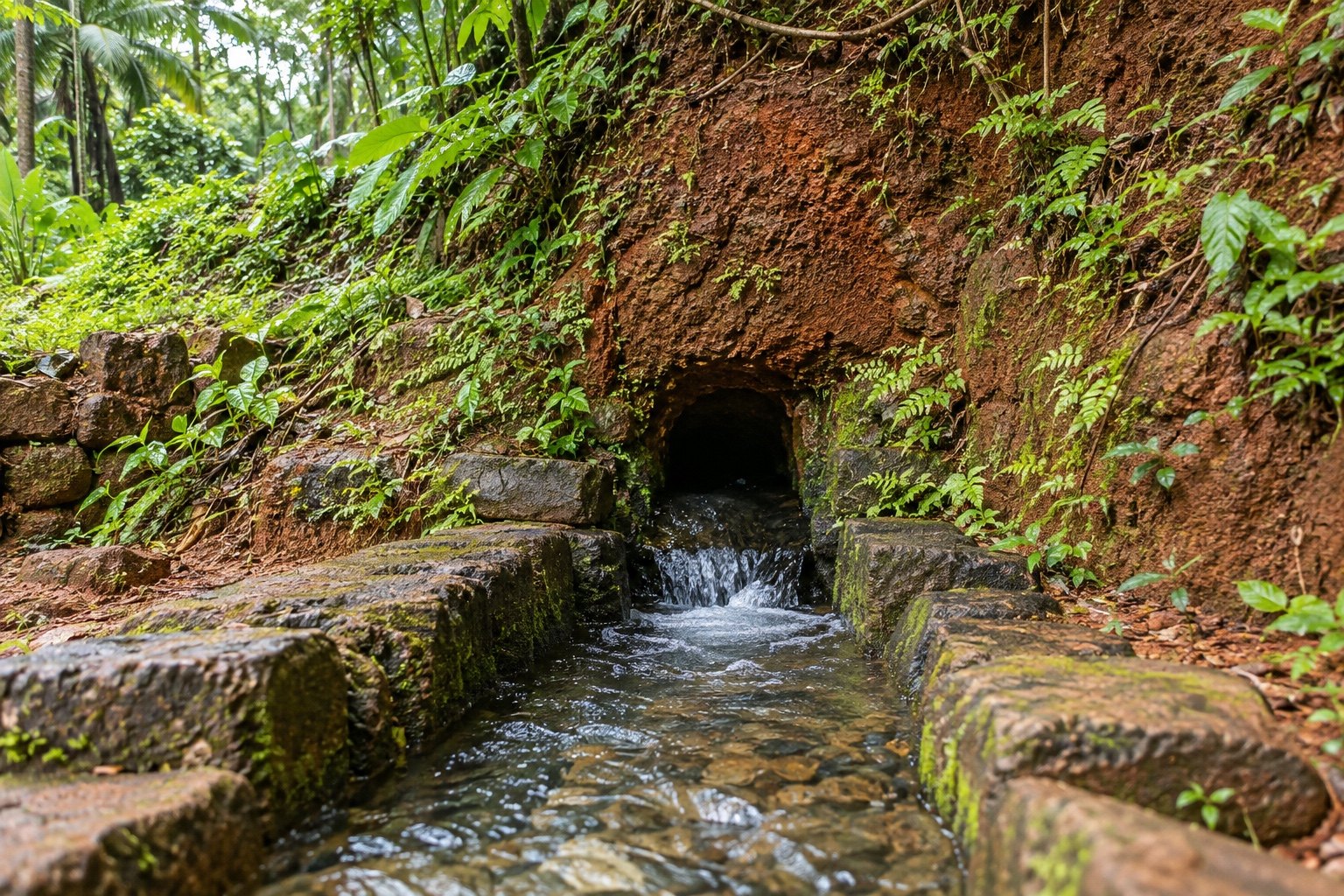
Traditional water-harvesting systems are local structures that store rain or draw out groundwater to suit each region's terrain. Kerala's surangam is a horizontal tunnel dug into a laterite hillside that lets seeping groundwater flow out. Eight grama panchayats in Kasaragod district will revive surangams to aid recharge, using workers of the rural employment mission.
Syllabus: Prelims · Geography; GS3 · Agriculture & Irrigation; GS1 · Resources & Industry Location
Why this matters for UPSC
GS1 geography and GS3 water conservation: traditional harvesting systems and groundwater recharge. Prelims pairs systems like surangam, zabo and khadin with regions; Mains asks how they complement Catch the Rain.
In short
Traditional water-harvesting systems are local structures that catch rain, runoff or groundwater to suit each region's terrain, soil and rainfall; Kerala's surangam taps seepage from laterite hillsides.
Reviving surangams and their regional cousins works best when campaigns fund terrain-specific repair by local communities and verify that each structure actually recharges groundwater.
Why it matters
A farmer in a laterite village of Kasaragod relies on water that seeps steadily out of the hillside. A working surangam delivers that flow with almost no running cost, because the tunnel simply lets the water out. When such tunnels fall out of use, that local supply is lost as rainfall declines and drought risk grows. Reviving old systems stores rain close to where it falls, refills aquifers and gives villages a cheap source they manage themselves. The larger issue is groundwater depletion, which the CGWB ties to heavy pumping and to cities and changing land use that cut natural infiltration.
Prelims pointers
- Tankas in Bikaner, Phalodi and Barmer are underground tanks fed by a pipe from sloping roofs; the first spell of rain is let go to clean roofs and pipes.
- The Jal Jeevan Mission's training material pairs bandhara and tal with Maharashtra, aahar and pein with Bihar, and the Rani ki Vav stepwell with Gujarat.
- A surangam, a horizontal tunnel in Western Ghats laterite, differs from the kul, a channel in the Western Himalayas carrying glacier water to fields.
- The CGWB's 2011 study lists zabo, cheo-oziihi and bamboo-drip irrigation for the northeastern hill ranges, and ahar-pynes, dighis and baolis for the Indo-Gangetic plains.
- The Jal Shakti Abhiyan of 2019, on which Catch the Rain built, covered 1,592 water-stressed blocks in 256 districts, according to PIB.
- Long surangams carry vertical air shafts every 50-60 m; a tunnel may be 0.45-0.70 m wide, 1.8-2.0 m high and up to 300 m long.
Practise a UPSC-style question
Consider the following pairs:
(Traditional water-harvesting system : State)
1. Surangam : Kerala
2. Eri : Tamil Nadu
3. Bandhara : Bihar
4. Kuhal : Himachal Pradesh
How many of the above pairs are correctly matched?
- (a) Only one
- (b) Only two
- (c) Only three
- (d) All four
Show the answer
Answer: (c) Only three
Answer: (c) Only three. Pairs 1, 2 and 4 follow the Ministry of Jal Shakti's list; pair 3 does not.
Pair 1: correctly matched. The Jal Jeevan Mission training material lists surangam for Kerala, and the CGWB places it in Kasaragod.
Pair 2: correctly matched. The same list names eris as the traditional water-harvesting structure of Tamil Nadu.
Pair 3: not correctly matched. Bandhara, with tal, is listed for Maharashtra; Bihar's system is the aahar and pein.
Pair 4: correctly matched. Kuhal is listed for Himachal Pradesh, where kuls carry glacier water to Spiti villages.
Eliminate: Pair 3 is wrong because bandhara belongs to Maharashtra, so all four cannot match. Out: (d).
Eliminate: Pairs 1, 2 and 4 are right, so at least three pairs match. Out: (a), (b).
Trap: Swapped attribution. A real Maharashtra system is pinned on Bihar, which has its own ahar-pyne, to catch a student who knows the names but not their States.
Remember: Surangam Kerala, eri Tamil Nadu, bandhara Maharashtra, ahar-pyne Bihar, kuhal Himachal.
More Explainers
- Crypto in Indian law: virtual digital assets, tax and PMLA cover Economy
- The collegium system for appointing and transferring higher court judges Polity
- Protected Area, Restricted Area and Inner Line Permits Polity
- Scheduled Tribe seats in Assemblies: Article 332 and Goa's 2025 Act Polity
- Ballot papers and EVMs: where India still votes on paper Polity
- Gelephu Mindfulness City: Bhutan's special zone on the Assam border World & IR
- Nuclear fusion, the tokamak and India's role in ITER Sci-Tech
- Gilgit-Baltistan, CPEC and India's sovereignty objection World & IR
- India-Nepal electricity trade: how Nepal sells power to India World & IR
- Infant mortality and child malnutrition among Scheduled Tribes National
- Genocide Convention, 1948: the legal test and who can judge it World & IR
- Chola bronzes: lost-wax casting and Nataraja iconography National