
Snakebite envenoming and antivenom in India
Why in news: IISc Bengaluru and DTU reported in September 2026 a nanobody antivenom that protected mice against Indian cobra and king cobra venoms.
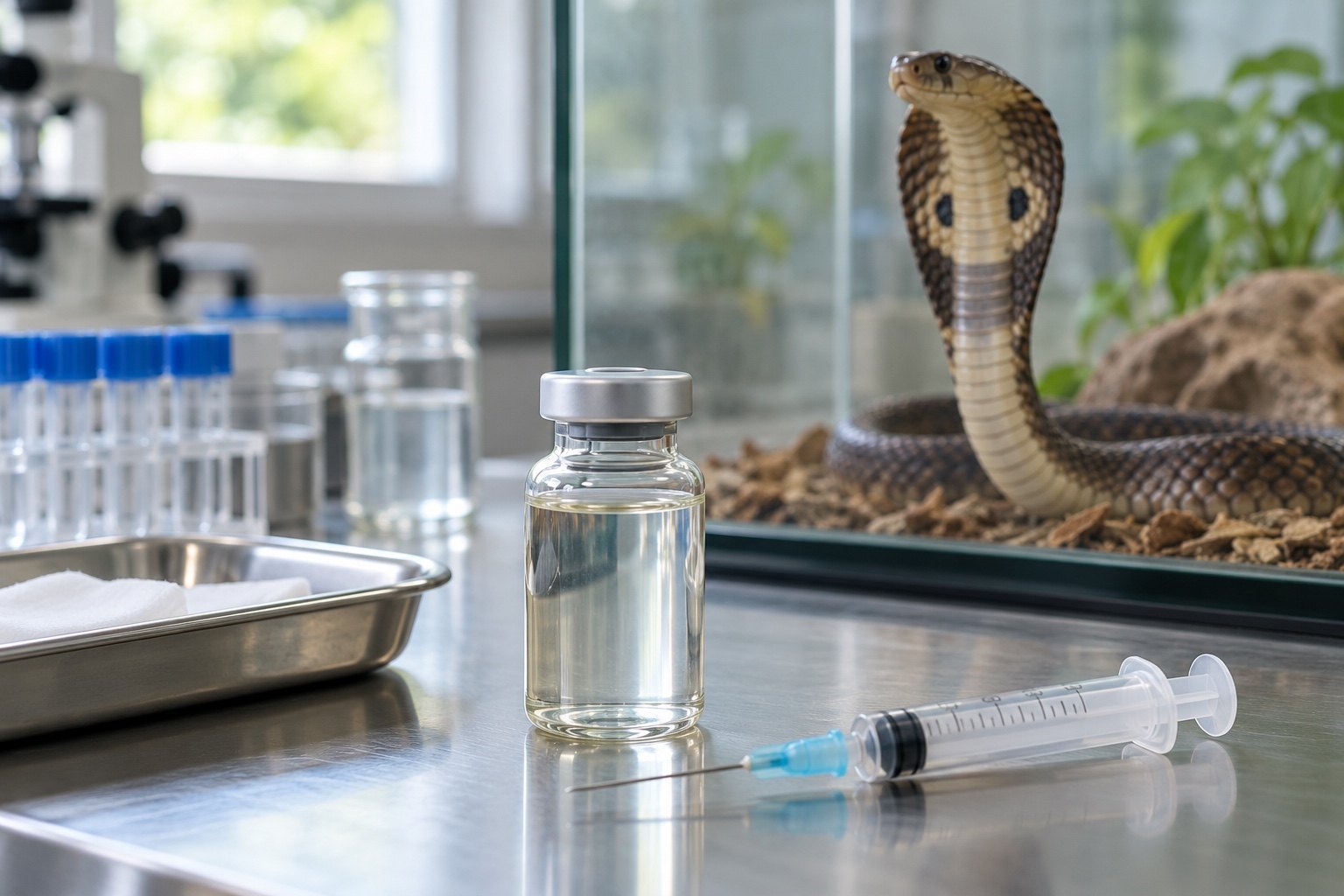
Snakebite envenoming is poisoning by a venomous snake's bite. In India the Big Four cause most bites: the spectacled cobra, common krait, saw-scaled viper and Russell's viper, treated with horse-derived polyvalent antivenom. India's 2024 national action plan aims to halve snakebite deaths by 2030. A new nanobody antivenom has protected mice against Indian cobra venoms.
Syllabus: Prelims · Science & Technology; GS3 · Science & Technology; GS2 · Health, Education & Human Resources
Why this matters for UPSC
Snakebite is a GS2 health and GS3 science topic. Prelims can ask about the Big Four, how polyvalent antivenom is made and WHO's neglected tropical disease list; Mains, about NAPSE, the One Health approach and rural health gaps.
In short
Snakebite envenoming is poisoning by toxins injected in a venomous snake's bite. The World Health Organization lists it as a neglected tropical disease, and India bears nearly half its deaths.
India must pair its plan's surveillance and access goals with region-specific, safer antivenoms, testing new recombinant products carefully before human use.
Why it matters
Snakebite hits farm workers and children hardest, mostly in villages and often at home, and half the deaths come in the monsoon months when field work brings people close to snakes. A family that loses its earner or sees a child lose a limb faces years of hardship. Many die because the nearest centre has no antivenom or no doctor trained to use it, or because the family first goes to a traditional healer. Antivenom that does not match the local snake wastes those precious hours. Better reporting shows where to stock vials and train staff, and cheaper, safer antivenoms could reach small clinics. The larger issue is how a health system serves the rural poor whose illnesses draw little research money.
Prelims pointers
- Big Four species: spectacled cobra (Naja naja), common krait (Bungarus caeruleus), Russell's viper (Daboia russelii) and saw-scaled viper (Echis carinatus).
- Cobras and kraits are elapids; Russell's viper and saw-scaled viper belong to the viper family. King cobras form a separate genus, Ophiophagus, not Naja.
- Albert Calmette produced the world's first antivenom in 1895, using the venom of the Indian cobra.
- Antivenoms are on the WHO List of Essential Medicines and are the most effective treatment for most snakebite effects.
- Public health and sanitation, hospitals and dispensaries is Entry 6 of the State List (List II, Seventh Schedule), so States make diseases notifiable under their own laws.
- Snakebite surveillance in India runs on IDSP-IHIP: health workers file the S (Suspected) form, Medical Officers the P (Presumptive) form.
- Hump-nosed pit viper (Hypnale hypnale): a medically important snake of south-western India and Sri Lanka outside the Big Four.
Practise a UPSC-style question
With reference to the 'Big Four' venomous snakes of India, consider the following statements:
1. The venom of the common krait acts mainly on the nervous system and can kill by stopping breathing.
2. Bites of Russell's viper and saw-scaled viper mainly cause bleeding disorders and can lead to kidney failure.
3. India's polyvalent antivenom is raised against the venoms of the king cobra, common krait, saw-scaled viper and Russell's viper.
Which of the statements given above is/are correct?
- (a) 1 and 2 only
- (b) 2 and 3 only
- (c) 1 and 3 only
- (d) 1, 2 and 3
Show the answer
Answer: (a) 1 and 2 only
Answer: (a) 1 and 2 only. Krait venom is neurotoxic and viper venom haemotoxic, but the antivenom's cobra is the spectacled cobra.
Statement 1: correct. Kraits and cobras carry neurotoxic venom that paralyses the face, eyes and neck; death often comes from respiratory failure.
Statement 2: correct. Viper venom damages blood and blood vessels, causing bleeding disorders and kidney failure that can kill if untreated.
Statement 3: incorrect. The Big Four cobra is the spectacled cobra (Naja naja); India's polyvalent antivenom has no effect on king cobra venom.
Eliminate: Judge statement 3 first: the king cobra is not one of the Big Four, so statement 3 is incorrect. Out: (b), (c), (d).
Trap: Look-alike names. The famous king cobra is swapped in for the spectacled cobra, the Big Four species the antivenom is actually made against.
Remember: Big Four = spectacled cobra, common krait, Russell's viper, saw-scaled viper; cobra and krait neurotoxic, vipers haemotoxic.
More Explainers
- Crypto in Indian law: virtual digital assets, tax and PMLA cover Economy
- The collegium system for appointing and transferring higher court judges Polity
- Protected Area, Restricted Area and Inner Line Permits Polity
- Scheduled Tribe seats in Assemblies: Article 332 and Goa's 2025 Act Polity
- Ballot papers and EVMs: where India still votes on paper Polity
- Gelephu Mindfulness City: Bhutan's special zone on the Assam border World & IR
- Nuclear fusion, the tokamak and India's role in ITER Sci-Tech
- Gilgit-Baltistan, CPEC and India's sovereignty objection World & IR
- India-Nepal electricity trade: how Nepal sells power to India World & IR
- Infant mortality and child malnutrition among Scheduled Tribes National
- Genocide Convention, 1948: the legal test and who can judge it World & IR
- Chola bronzes: lost-wax casting and Nataraja iconography National