
Satellite broadband from LEO constellations and how India regulates satcom
Why in news: Ukrainian forces reported Starshield links on their drones dropping from 13-14 October 2026; Ukraine's Defence Ministry said speeds were restored on 24 October.
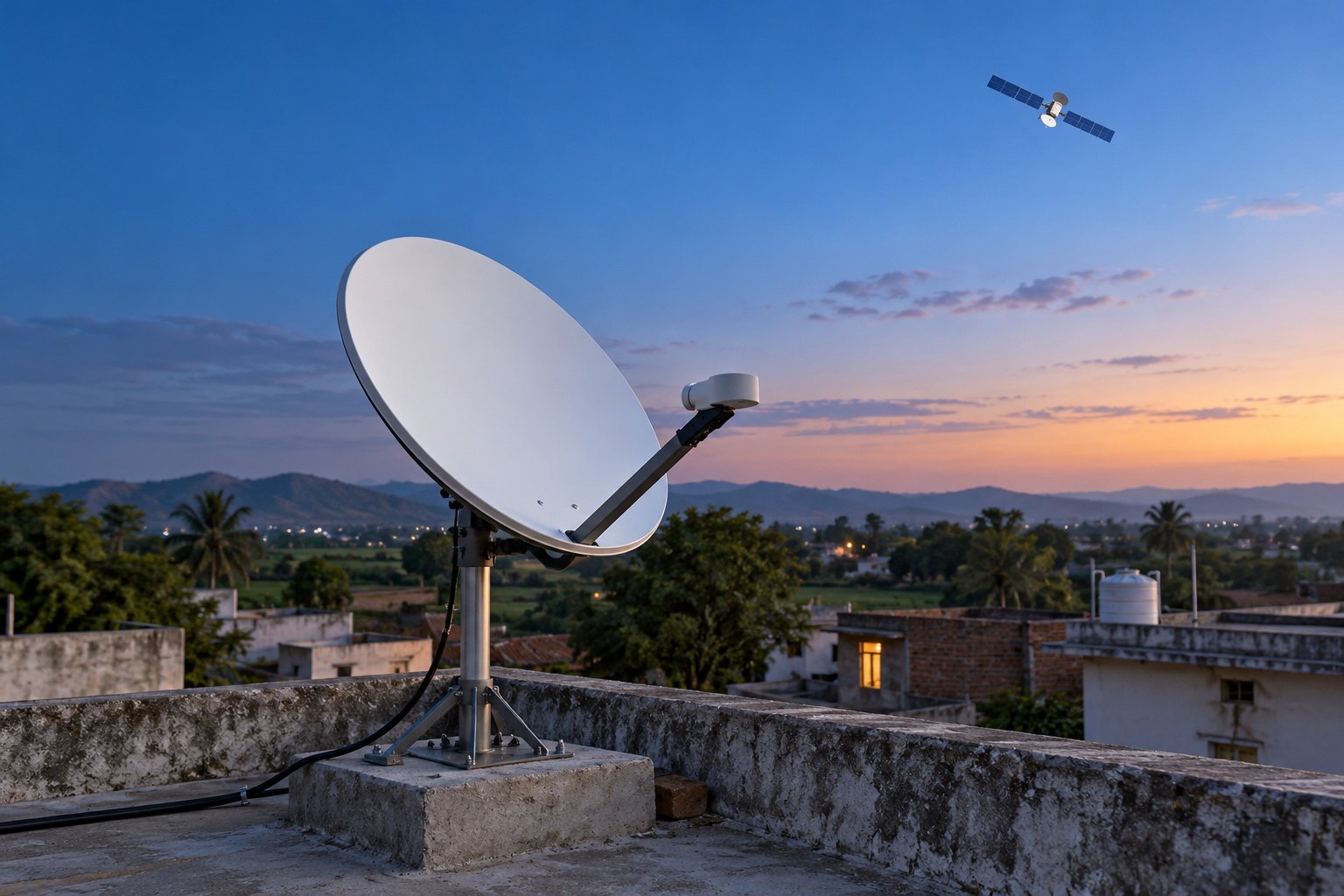
Satellite broadband beams internet from orbiting satellites to a small dish, without cables. Low Earth orbit constellations fly below about 2,000 km, so many satellites must work together. India assigns satcom spectrum administratively under the Telecommunications Act, 2023. Mid-October 2026 restrictions on Starlink and Starshield links used by Ukraine's drones exposed the risk of relying on a private constellation.
Syllabus: GS2 · Government Policies; GS3 · IT, Space, Biotech & IPR; GS3 · Cyber Security & Money Laundering
Why this matters for UPSC
GS3 science and technology (space, communications) and internal security through communication networks. Prelims can ask LEO and geostationary altitudes, the First Schedule of the Telecommunications Act, 2023, IN-SPACe and FDI limits; Mains, the digital divide and strategic dependence.
In short
Satellite broadband delivers internet from orbiting satellites to small ground dishes. Low Earth orbit constellations make it fast and wide-reaching, but India must balance universal access against security and sovereignty.
LEO broadband can close India's last-mile gap if it runs on Indian terms: transparent pricing, gateways and data at home, and indigenous capacity.
Why it matters
A farmer in a hill village or a fishing family on an island often has no fibre line or mobile tower nearby. A satellite dish can bring them the internet without waiting for cables, and it keeps working where ground networks have been damaged. What they pay depends on the charges the government finally sets: TRAI proposed an extra yearly charge on operators for each urban subscriber, with rural and remote users spared. The same technology raises a harder question. When a foreign company owns the satellites, it can slow or cut the service, as Ukraine's soldiers found in October 2026. That is why India wants gateways, user data and lawful interception kept inside the country before any service starts.
Prelims pointers
- Geostationary orbit: satellites move west to east above the equator in 23 hours 56 minutes 4 seconds; three evenly spaced ones give near-global coverage (ESA).
- Low Earth orbit: upper limit about 2,000 km, set by the Van Allen belts; satellites rarely fly below 180 km because of atmospheric drag (ESA).
- Medium Earth orbit lies between LEO and geostationary orbit; navigation constellations such as Europe's Galileo use it (ESA).
- Section 4(1), Telecommunications Act, 2023: the Central Government owns spectrum on behalf of the people and may notify a National Frequency Allocation Plan.
- Section 4(5): the Centre may amend the First Schedule by notification, for public interest, a government function, or where auction is unsuitable; it is laid before each House.
- Indian Space Policy 2023: IN-SPACe authorises space objects, launch pads and TT&C earth stations; their use for telecom follows DoT's rules, for broadcasting the Ministry of Information and Broadcasting's.
- The Wireless Planning and Coordination (WPC) Wing of DoT manages radio spectrum and is India's notifying administration at the International Telecommunication Union.
Practise a UPSC-style question
With reference to satellite orbits, consider the following statements:
1. Geostationary satellites orbit above the poles at about 35,786 km, completing one orbit in a sidereal day.
2. Low Earth orbit is generally taken as altitudes below about 2,000 km, with satellites rarely below 180 km.
3. Communication satellites in low Earth orbit usually work as constellations because each circles Earth in about 90 minutes.
Which of the statements given above is/are correct?
- (a) 1 and 2 only
- (b) 2 and 3 only
- (c) 1 and 3 only
- (d) 1, 2 and 3
Show the answer
Answer: (b) 2 and 3 only
Answer: (b) 2 and 3 only. Geostationary satellites sit above the equator, not the poles.
Statement 1: incorrect. Geostationary satellites fly above the equator, west to east, at 35,786 km, matching Earth's rotation; polar orbits are a kind of low Earth orbit.
Statement 2: correct. ESA puts the upper limit of low Earth orbit at about 2,000 km, set by the Van Allen belts, and satellites generally do not fly below 180 km.
Statement 3: correct. A LEO satellite completes an orbit in about 90 minutes, so many satellites must work together as a constellation for continuous coverage.
Eliminate: statement 1 is wrong because a geostationary satellite must stay over the equator to appear fixed. Out: (a), (c), (d).
Trap: Swapped attribution. The altitude and period are right, but the orbit is pinned on the poles instead of the equator.
Remember: Geostationary means over the equator at 35,786 km; LEO means under about 2,000 km.
More Explainers
- Crypto in Indian law: virtual digital assets, tax and PMLA cover Economy
- The collegium system for appointing and transferring higher court judges Polity
- Protected Area, Restricted Area and Inner Line Permits Polity
- Scheduled Tribe seats in Assemblies: Article 332 and Goa's 2025 Act Polity
- Ballot papers and EVMs: where India still votes on paper Polity
- Gelephu Mindfulness City: Bhutan's special zone on the Assam border World & IR
- Nuclear fusion, the tokamak and India's role in ITER Sci-Tech
- Gilgit-Baltistan, CPEC and India's sovereignty objection World & IR
- India-Nepal electricity trade: how Nepal sells power to India World & IR
- Infant mortality and child malnutrition among Scheduled Tribes National
- Genocide Convention, 1948: the legal test and who can judge it World & IR
- Chola bronzes: lost-wax casting and Nataraja iconography National