
Salt marshes: India's coastal wetlands that break storm waves
Why in news: A Wageningen University & Research study in Nature, reported on 29 October 2026, tested a live salt marsh against waves up to 2 metres.
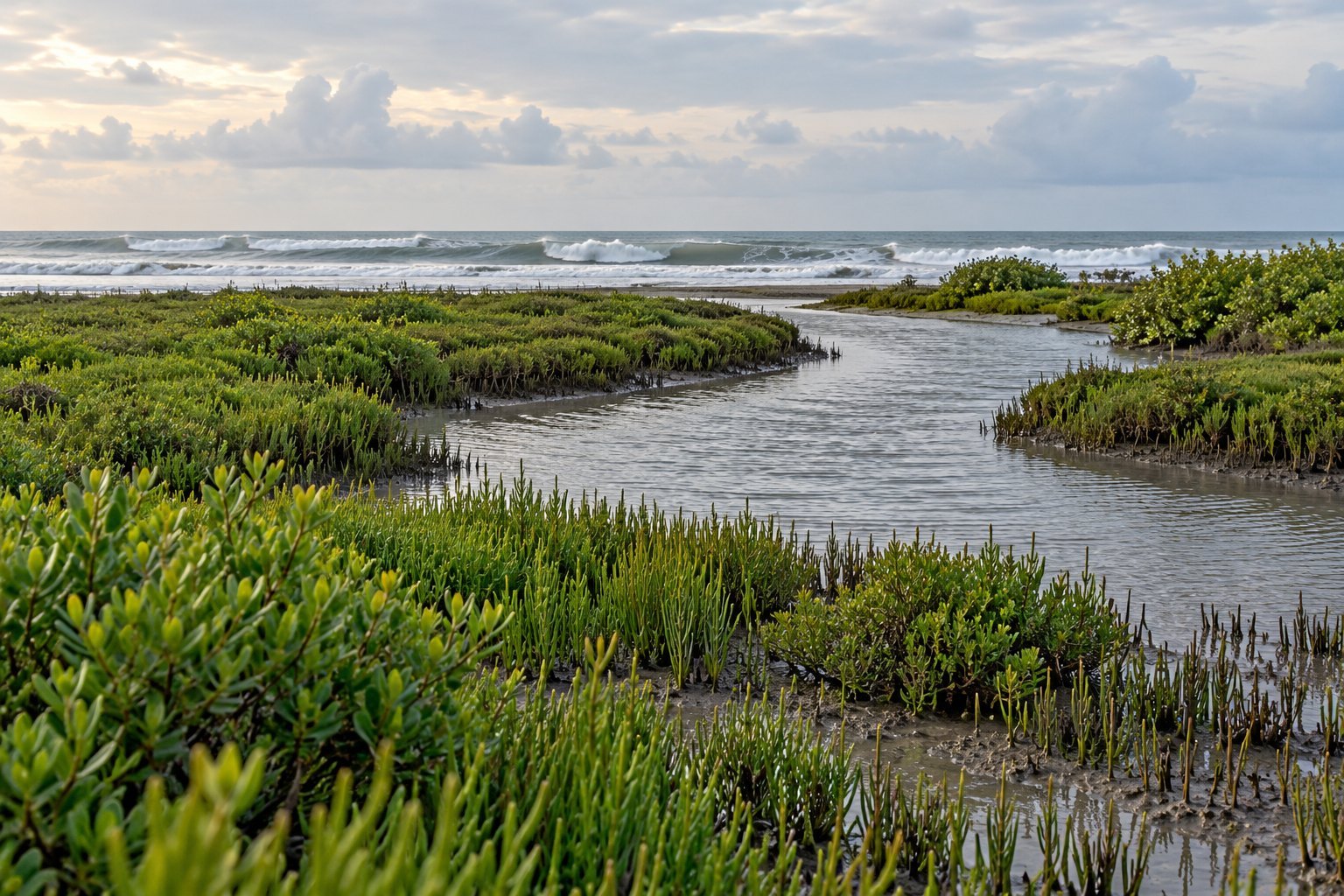
Salt marshes are coastal wetlands in the intertidal zone, where tides flood and drain beds of salt-tolerant plants. Gujarat has India's largest. The Coastal Regulation Zone (CRZ) Notification, 2019 lists them as ecologically sensitive areas. A new study in Nature found a live marsh cut 75 cm waves by 6-22% in a flume.
Syllabus: Prelims · Environment & Ecology; GS1 · Geophysical Phenomena; GS3 · Environment & Conservation
Why this matters for UPSC
GS III conservation and disaster management, and GS I geography. Prelims can ask what CRZ-IA covers, the Ramsar definition and the Wetlands Rules, 2017; Mains, about salt marshes as nature-based coastal defence.
In short
Salt marshes are coastal wetlands in the intertidal zone, dominated by salt-tolerant plants; they buffer coasts against waves, yet aquaculture and construction keep shrinking them.
Salt marshes are cheap, self-repairing coastal defences; India must enforce their CRZ-IA protection and test native species before counting on them against cyclones.
Why it matters
A fisher family in a low Gujarat or Andhra Pradesh village depends on what lies between its huts and the sea. When a cyclone pushes water inland, a living marsh takes some of the force out of the waves before they reach homes and fields, and its roots keep the land from washing away. Once the marsh becomes a shrimp pond or a road embankment, that free shield is gone and the State must pay for sea walls instead. The larger question is whether coastal planning treats such wetlands as defence infrastructure or as waste land waiting for use.
Prelims pointers
- Paragraph 5.1.1 of the CRZ Notification, 2019 lets identified CRZ-IA stretches host eco-tourism such as mangrove walks, tree huts and nature trails.
- CRZ-IA also covers corals and coral reefs, sand dunes, sea grass beds, turtle nesting grounds and horseshoe crab habitats.
- Under the CRZ Notification, 2019, salt pans may be considered only on low-biodiversity salt marshes identified by NCSCM and marked in the Coastal Zone Management Plan.
- Land reclamation, bunding and disturbing the natural course of seawater are prohibited in general across the whole CRZ.
- The Wetlands Rules, 2017 exclude river channels, paddy fields and tanks built for drinking water from the definition of wetland.
- Article 2.1 of the Ramsar Convention lets a listed site include adjacent coastal zones, islands and marine water deeper than six metres.
- The CRZ-IA list also takes in national parks, marine parks, sanctuaries, reserve forests and Biosphere Reserves.
Practise a UPSC-style question
With reference to salt marshes under the Coastal Regulation Zone (CRZ) Notification, 2019, consider the following statements:
1. Traditional fishing is prohibited in salt marshes classified as ecologically sensitive areas.
2. Salt marshes are listed among the ecologically sensitive areas that make up CRZ-IA.
3. Salt pan activities may be considered in salt marshes of less biodiversity identified by NCSCM.
Which of the statements given above is/are correct?
- (a) 1 and 2 only
- (b) 2 and 3 only
- (c) 1 and 3 only
- (d) 1, 2 and 3
Show the answer
Answer: (b) 2 and 3 only
Answer: (b) 2 and 3 only. The notification protects salt marshes but keeps traditional fishing and limited salt pans.
Statement 1: incorrect. The salt-marsh rule of the CRZ Notification, 2019 expressly permits traditional fishing in salt marshes.
Statement 2: correct. Paragraph 2.1.1 of the CRZ Notification, 2019 lists salt marshes as item (vi) of the CRZ-IA ecologically sensitive areas.
Statement 3: correct. Salt marshes with less biodiversity, identified by NCSCM and marked in the Coastal Zone Management Plan, can be considered for salt pans.
Eliminate: statement 1 is wrong, as fishing is allowed, and statement 3 is right. Out: (a), (c), (d).
Trap: Reversed direction. A permitted traditional activity is presented as banned, playing on the idea that a sensitive area must exclude every human use.
Remember: CRZ-IA salt marshes allow cables, traditional fishing, temporary tourism and limited salt pans.
More Explainers
- Crypto in Indian law: virtual digital assets, tax and PMLA cover Economy
- The collegium system for appointing and transferring higher court judges Polity
- Protected Area, Restricted Area and Inner Line Permits Polity
- Scheduled Tribe seats in Assemblies: Article 332 and Goa's 2025 Act Polity
- Ballot papers and EVMs: where India still votes on paper Polity
- Gelephu Mindfulness City: Bhutan's special zone on the Assam border World & IR
- Nuclear fusion, the tokamak and India's role in ITER Sci-Tech
- Gilgit-Baltistan, CPEC and India's sovereignty objection World & IR
- India-Nepal electricity trade: how Nepal sells power to India World & IR
- Infant mortality and child malnutrition among Scheduled Tribes National
- Genocide Convention, 1948: the legal test and who can judge it World & IR
- Chola bronzes: lost-wax casting and Nataraja iconography National