
Right to peaceful assembly: Article 19(1)(b) and designated protest sites
Why in news: A Delhi Police standing order dated 11 October 2026 de-notified Jantar Mantar as a protest site and named Ramlila, Burari and CBD Grounds.
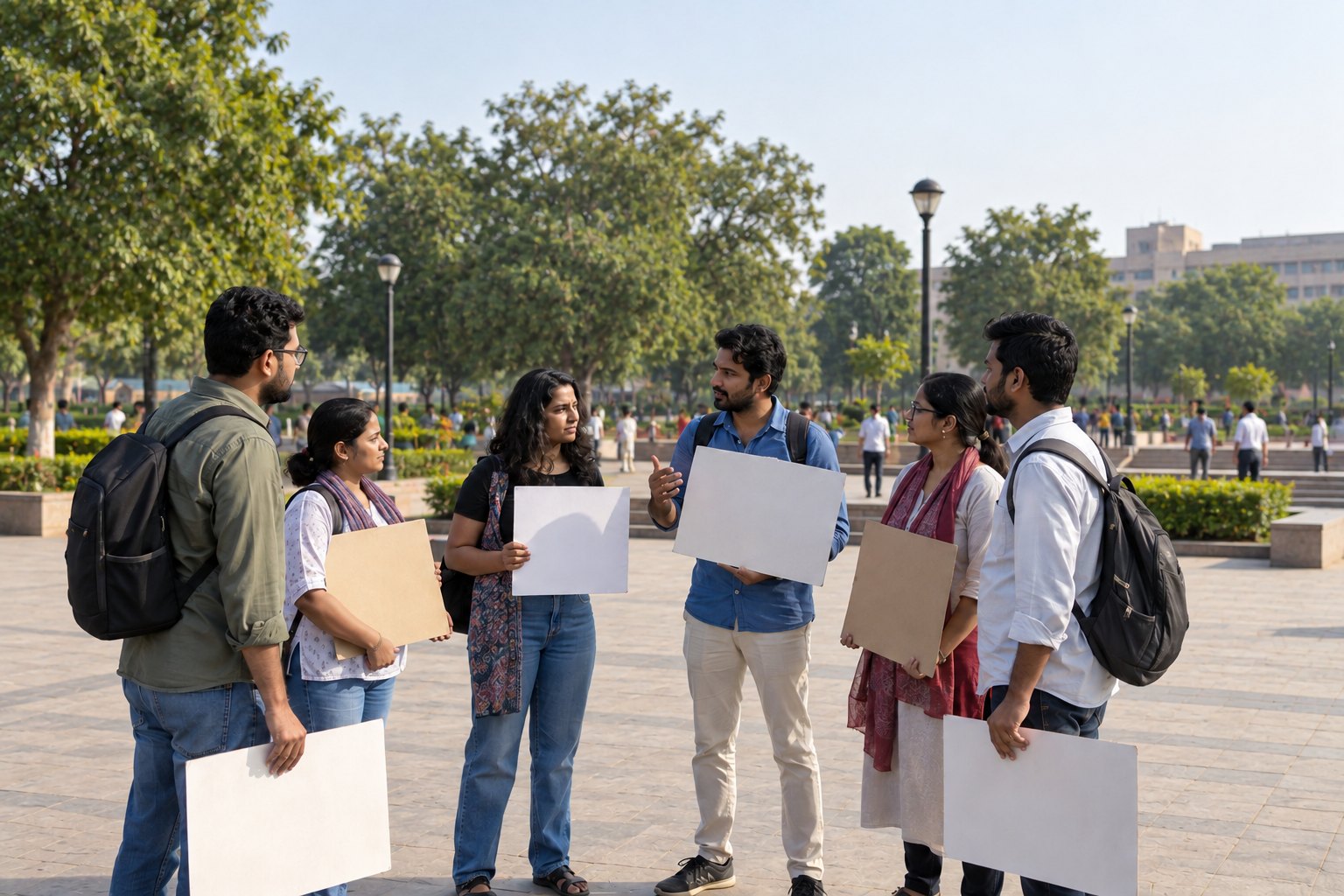
Article 19(1)(b) of the Constitution guarantees citizens the right to assemble peaceably and without arms. Under Article 19(3), the State may restrict it by law for public order or the sovereignty and integrity of India; courts allow regulation, not outright bans. A Delhi Police order dated 11 October 2026 de-notified Jantar Mantar as a protest site.
Syllabus: GS2 · Constitution; Prelims · Current Affairs & IR; Prelims · Polity & Governance
In short
Article 19(1)(b) guarantees citizens the right to assemble peaceably and without arms; Article 19(3) permits reasonable restrictions, so the State may regulate protest but not extinguish it.
Designated sites are legitimate regulation, but Jantar Mantar's replacements must keep protest visible enough for dissent to reach those it addresses.
Why it matters
A group of farmers, teachers or students who want the government to hear them goes where Parliament and the ministries are. Jantar Mantar lies close to Parliament; the three new grounds are reported to be about 4 km to 18 km away from Jantar Mantar. A distant venue makes crowds easier to manage, but a protest no one sees loses its point. That is the heart of the issue: the State may choose and regulate places, yet a right usable only where nobody notices risks becoming empty. The larger question is how a democracy balances dissent with public order, and how the courts check police decisions that touch a fundamental right.
Prelims pointers
- Article 19 freedoms are guaranteed to citizens; foreign nationals cannot claim them.
- Article 19(1)(b) carries two limits in its own text: the assembly must be peaceable and without arms.
- Grounds compared: Article 19(2) (speech) has eight grounds; Article 19(3) (assembly) has two: public order, and sovereignty and integrity of India; Article 19(4) (association) adds morality.
- Constitution (Sixteenth Amendment) Act, 1963 added "sovereignty and integrity of India" to Articles 19(2), 19(3) and 19(4).
- Article 19(3) saves restrictions imposed by an existing law or a new law; the restriction must be reasonable, which courts test for proportionality.
- Section 168 of the Bharatiya Nagarik Suraksha Sanhita (formerly Section 149 CrPC): police must, as far as they can, prevent cognisable offences.
- Article 358: Article 19 is suspended automatically during a National Emergency proclaimed on the ground of war or external aggression, not armed rebellion.
Practise a UPSC-style question
With reference to the right of assembly under the Constitution of India, consider the following statements:
1. Article 19(1)(c) guarantees citizens the right to assemble peaceably and without arms.
2. Foreign nationals living in India cannot claim the freedom of assembly guaranteed by Article 19.
Which of the statements given above is/are correct?
- (a) 1 only
- (b) 2 only
- (c) Both 1 and 2
- (d) Neither 1 nor 2
Show the answer
Answer: (b) 2 only
1 is incorrect: the right to assemble peaceably and without arms is in Article 19(1)(b); Article 19(1)(c) is the right to form associations or unions. 2 is correct: the freedoms of Article 19 are guaranteed to citizens, so a foreign national cannot claim them.
In the news
More Explainers
- State Legislative Councils: Articles 168-172 and the graduates' and teachers' seats Polity
- Whales and dolphins in Indian waters: legal protection, IUCN status and strandings Environment
- The Aligarh Movement, AMU and the Article 30 minority test Polity
- Environmental clearance by States: SEIAA, SEAC and the EIA Notification, 2006 Environment
- Software vulnerabilities: CVE, CVSS, coordinated disclosure and CERT-In's role Sci-Tech
- Drug trafficking law in India: NDPS Act, PIT-NDPS, NCB and NCORD National
- Choosing the UN Secretary-General: Article 97, UNSC veto and straw polls World & IR
- UN Convention against Torture, and why India has not ratified it Polity
- NavIC: why India's navigation constellation cannot give a standalone position Sci-Tech
- International Energy Agency: membership, 90-day oil stocks and India's status World & IR
- PM Surya Ghar: Muft Bijli Yojana and the rooftop solar subsidy Economy
- HFSS foods: FSSAI's draft limits and front-of-pack warning labels National