
Whales and dolphins in Indian waters: legal protection, IUCN status and strandings
Why in news: A science feature on 22 October 2026 traced whale strandings on Gujarat's coast and argued that few are now systematically recorded.
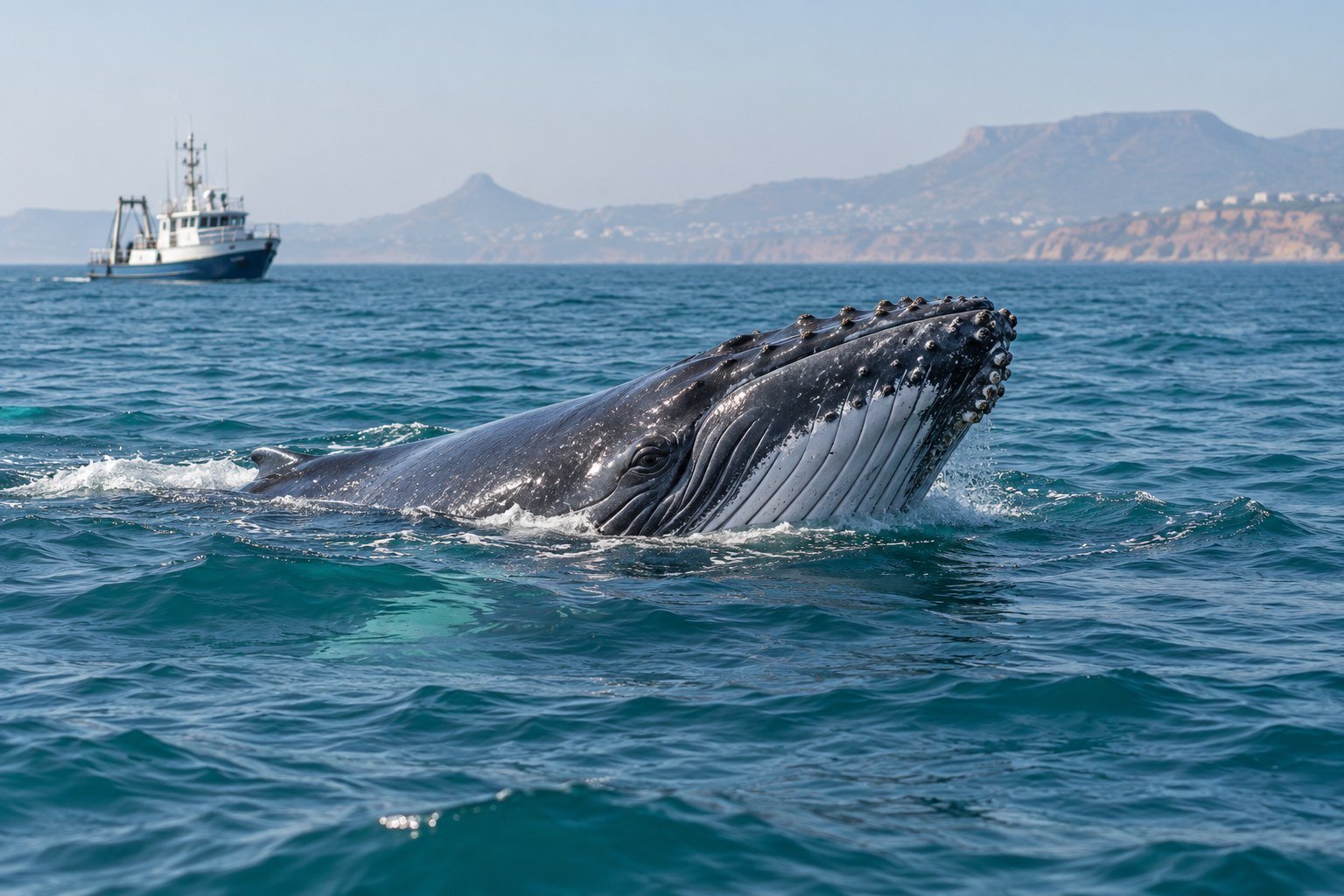
Cetaceans, the whales, dolphins and porpoises, number 30 to 35 species in the waters of the Indian subcontinent. Under the Wild Life (Protection) Act, 1972, as amended in 2022, 30 named species are in Schedule I and every other cetacean is in Schedule II. A 22 October 2026 feature traced decades of whale strandings on Gujarat's coast.
Syllabus: Prelims · Environment & Ecology; GS3 · Environment & Conservation; GS3 · Disaster Management
Why this matters for UPSC
Cetaceans are a GS3 topic on biodiversity conservation and disaster response. Prelims asks a species' IUCN status and its Schedule under the Wild Life (Protection) Act, 1972; Mains, bycatch, strandings and the 2021 stranding guidelines.
In short
Cetaceans, the whales, dolphins and porpoises, number 30 to 35 species in the Indian subcontinent's waters; the Wild Life (Protection) Act, 1972 protects all of them.
India's cetaceans are protected on paper; funding the proposed stranding centres and trained responders would turn every stranding into evidence.
Why it matters
A fisher who finds a dolphin tangled in a net, or a villager who sees a whale on the beach, is the first link in protecting these animals. Freeing one can cost a fisher a cut net, and a carcass left unreported is lost to science, because some species have never been seen alive and many are hard to tell apart at sea. Each stranding that is photographed, measured and examined can show what is killing them, whether nets, ship strikes or noise, and where. Without such records India cannot tell whether its whales and dolphins are recovering or quietly declining, and protection on paper cannot be aimed at the real threats. The larger issue is the health of seas on which millions of coastal people depend.
Prelims pointers
- Section 9, Wild Life (Protection) Act, 1972: no one may hunt a Schedule I or II animal except as sections 11 and 12 allow; 'hunting' includes capturing and injuring.
- Section 51: an offence involving a Schedule I animal carries three to seven years' imprisonment and a fine of at least Rs 25,000.
- Whale shark: a fish, listed in Schedule I Part E (Fishes). The dugong, a sirenian, sits in Schedule I Part A (Mammals) with the dolphins and whales.
- Global IUCN status: blue whale Endangered; Indo-Pacific bottlenose dolphin and false killer whale Near Threatened; Bryde's whale, spinner dolphin and short-finned pilot whale Least Concern.
- Humpback whale: listed in Appendix I of CITES and of CMS (the Convention on Migratory Species); the Arabian Sea lies in the International Whaling Commission's Indian Ocean Sanctuary.
- Fin, minke and sei whales are named in Schedule I, yet MMRCNI finds no confirmed record of them in the northern Indian Ocean.
- Section 11: the Chief Wild Life Warden may permit hunting a Schedule I animal that endangers human life or is disabled or diseased beyond recovery.
Practise a UPSC-style question
With reference to the Wild Life (Protection) Act, 1972, as amended in 2022, consider the following statements:
1. Cetacean species that Schedule I does not name are covered by Schedule II.
2. The whale shark is listed in Part A (Mammals) of Schedule I.
3. The dugong is listed in Schedule I of the Act.
Which of the statements given above is/are correct?
- (a) 1 and 2 only
- (b) 2 and 3 only
- (c) 1 and 3 only
- (d) 1, 2 and 3
Show the answer
Answer: (c) 1 and 3 only
Answer: (c) 1 and 3 only. Unnamed cetaceans fall in Schedule II and the dugong is in Schedule I; the whale shark is listed as a fish.
Statement 1: correct. Schedule II Part A, entry 10, covers all species of the infraorder Cetacea other than those listed in Schedule I.
Statement 2: incorrect. The whale shark is a fish; the 2022 Schedule I lists it in Part E (Fishes), not in Part A (Mammals).
Statement 3: correct. The dugong, a marine mammal, is entry 82 of Schedule I Part A (Mammals), listed between the dolphins and the elephant.
Eliminate: Statement 2 is wrong, because a whale shark is a shark, so every option with 2 goes. Out: (a), (b), (d).
Trap: Look-alike names. 'Whale shark' sounds like a whale, so a student files it with the mammals, but it is a fish in Part E.
Remember: Named cetaceans and the dugong: Schedule I Part A; other cetaceans: Schedule II; whale shark: Schedule I Part E.
More Explainers
- State Legislative Councils: Articles 168-172 and the graduates' and teachers' seats Polity
- The Aligarh Movement, AMU and the Article 30 minority test Polity
- Environmental clearance by States: SEIAA, SEAC and the EIA Notification, 2006 Environment
- Software vulnerabilities: CVE, CVSS, coordinated disclosure and CERT-In's role Sci-Tech
- Drug trafficking law in India: NDPS Act, PIT-NDPS, NCB and NCORD National
- Choosing the UN Secretary-General: Article 97, UNSC veto and straw polls World & IR
- UN Convention against Torture, and why India has not ratified it Polity
- NavIC: why India's navigation constellation cannot give a standalone position Sci-Tech
- International Energy Agency: membership, 90-day oil stocks and India's status World & IR
- PM Surya Ghar: Muft Bijli Yojana and the rooftop solar subsidy Economy
- HFSS foods: FSSAI's draft limits and front-of-pack warning labels National
- HTT-40 basic trainer and the IAF's pilot-training pipeline Defence