
HFSS foods: FSSAI's draft limits and front-of-pack warning labels
Why in news: FSSAI published draft HFSS limits for school food on 7 August 2026, and its Supreme Court affidavits since August propose front-of-pack warnings.
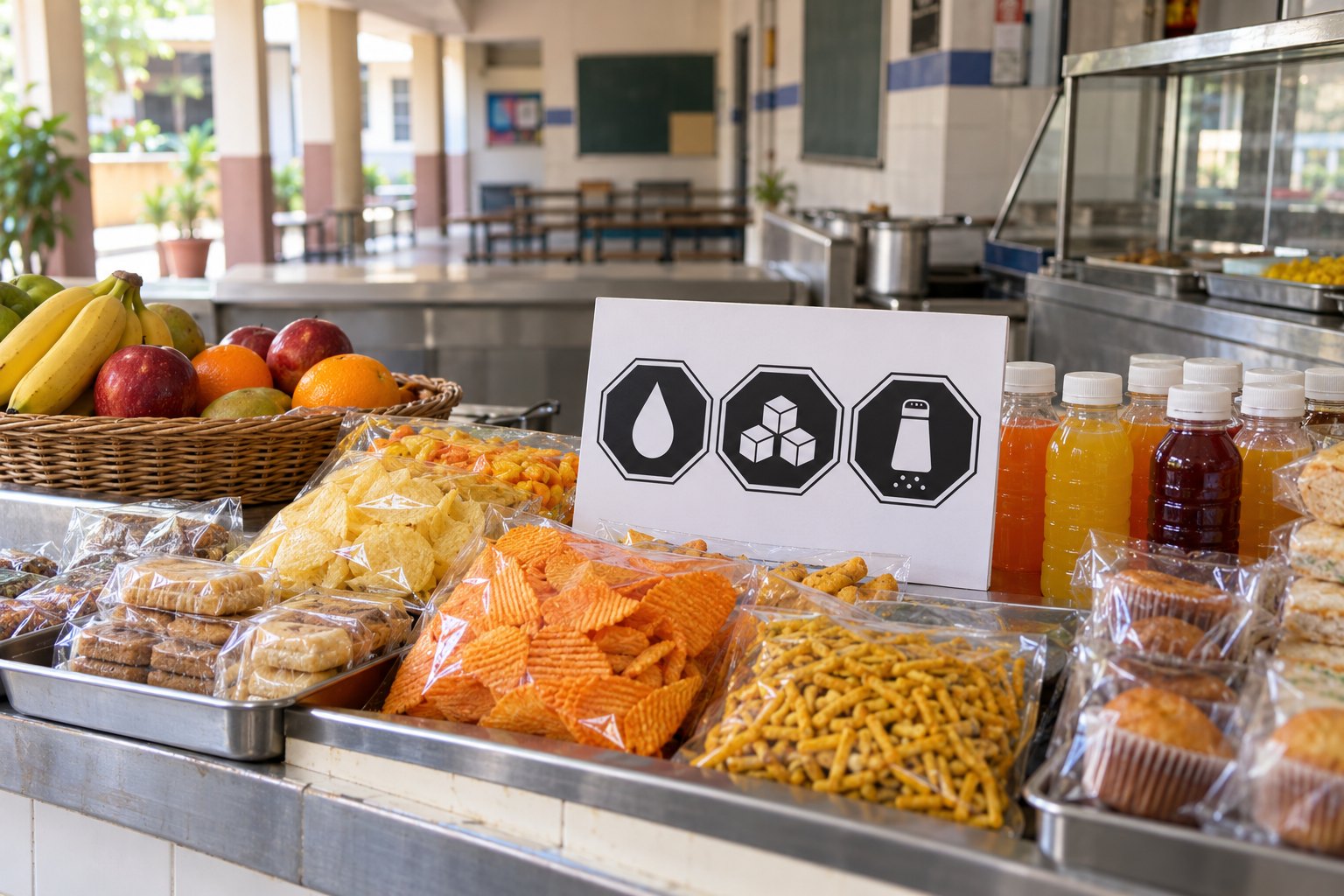
Foods high in fat, sugar and salt (HFSS) are processed foods whose nutrient content crosses limits a regulator fixes. The Food Safety and Standards Authority of India (FSSAI) restricts their sale to children on school campuses. It has now proposed numeric limits for school food and, before the Supreme Court, front-of-pack warnings.
Syllabus: Prelims · Current Affairs & IR; GS3 · Food Processing; GS2 · Statutory & Regulatory Bodies
Why this matters for UPSC
GS2 health and regulatory bodies: Prelims can ask what the Food Safety and Standards Act, 2006 provides and how FSSAI makes regulations; Mains, whether front-of-pack labelling can curb non-communicable diseases.
In short
HFSS foods are processed foods high in added fat, added sugar or salt; FSSAI, under the Food Safety and Standards Act, 2006, has proposed numeric limits and warning labels.
HFSS rules will protect children only when the draft limits and warnings become binding on fixed dates, enforced in canteens and on shelves alike.
Why it matters
A child buying chips or a cola at a school canteen rarely knows how much fat, sugar or salt it carries. Clear limits let a school, a food inspector or a parent say which items cross the line, and so which can be kept off the counter. A warning on the front of the pack does the same for any shopper in seconds, without reading the small table on the back. The larger issue is the rising burden of non-communicable diseases such as diabetes, obesity and heart disease, which the petitioners in the Supreme Court tie to such foods. Food companies bear the cost: they may change recipes or carry a red warning on their packs.
Prelims pointers
- FSS Act, 2006 (34 of 2006), Second Schedule: repeals the Prevention of Food Adulteration Act, 1954 and food orders such as the Milk and Milk Products Order, 1992.
- Section 92, FSS Act: FSSAI makes regulations with the Central Government's previous approval and only after previous publication of the draft.
- Section 30, FSS Act: the State's Commissioner of Food Safety may prohibit making or selling an article of food, in public health interest, for up to one year.
- Section 70, FSS Act: the Centre or a State may set up a Food Safety Appellate Tribunal; its one Presiding Officer is or has been a District Judge.
- Section 14, FSS Act: FSSAI's Scientific Committee, of Scientific Panel chairpersons and six independent experts, gives scientific opinions to the Food Authority.
- Dietary Guidelines for Indians, 2024: issued by ICMR-National Institute of Nutrition (ICMR-NIN), a nutrition institute of the Indian Council of Medical Research.
- Section 3(1)(zf), FSS Act: misbranded food includes food promoted with false, misleading or deceptive claims on the label or through advertisement.
- School-food regulations: the FSS (Safe food and balanced diets for children in school) Regulations, 2020 were notified in the Gazette on 4 September 2020.
Practise a UPSC-style question
With reference to the Food Safety and Standards Act, 2006, consider the following statements:
1. A State's Commissioner of Food Safety may prohibit the sale of an article of food in the interest of public health for up to three years.
2. The Presiding Officer of a Food Safety Appellate Tribunal must be, or have been, a District Judge.
Which of the statements given above is/are correct?
- (a) 1 only
- (b) 2 only
- (c) Both 1 and 2
- (d) Neither 1 nor 2
Show the answer
Answer: (b) 2 only
Answer: (b) 2 only. The Act caps a State prohibition at one year, and the tribunal is headed by a District Judge.
Statement 1: incorrect. Section 30 of the FSS Act, 2006 lets the Commissioner of Food Safety prohibit an article of food for a period not exceeding one year, not three.
Statement 2: correct. Section 70 provides a one-person Food Safety Appellate Tribunal whose Presiding Officer is or has been a District Judge.
Eliminate: Statement 2 is correct, as section 70 names a District Judge. Out: (a), (d).
Eliminate: Statement 1 is incorrect, since the cap is one year. Out: (c).
Trap: Near-miss figure. The duration of a State prohibition is moved from one year to three years so it still sounds plausible.
Remember: State food prohibition under section 30 lasts up to one year; tribunal head is a District Judge.
More Explainers
- State Legislative Councils: Articles 168-172 and the graduates' and teachers' seats Polity
- Whales and dolphins in Indian waters: legal protection, IUCN status and strandings Environment
- The Aligarh Movement, AMU and the Article 30 minority test Polity
- Environmental clearance by States: SEIAA, SEAC and the EIA Notification, 2006 Environment
- Software vulnerabilities: CVE, CVSS, coordinated disclosure and CERT-In's role Sci-Tech
- Drug trafficking law in India: NDPS Act, PIT-NDPS, NCB and NCORD National
- Choosing the UN Secretary-General: Article 97, UNSC veto and straw polls World & IR
- UN Convention against Torture, and why India has not ratified it Polity
- NavIC: why India's navigation constellation cannot give a standalone position Sci-Tech
- International Energy Agency: membership, 90-day oil stocks and India's status World & IR
- PM Surya Ghar: Muft Bijli Yojana and the rooftop solar subsidy Economy
- HTT-40 basic trainer and the IAF's pilot-training pipeline Defence