
Supreme Court: detain peaceful protesters only by procedure established by law
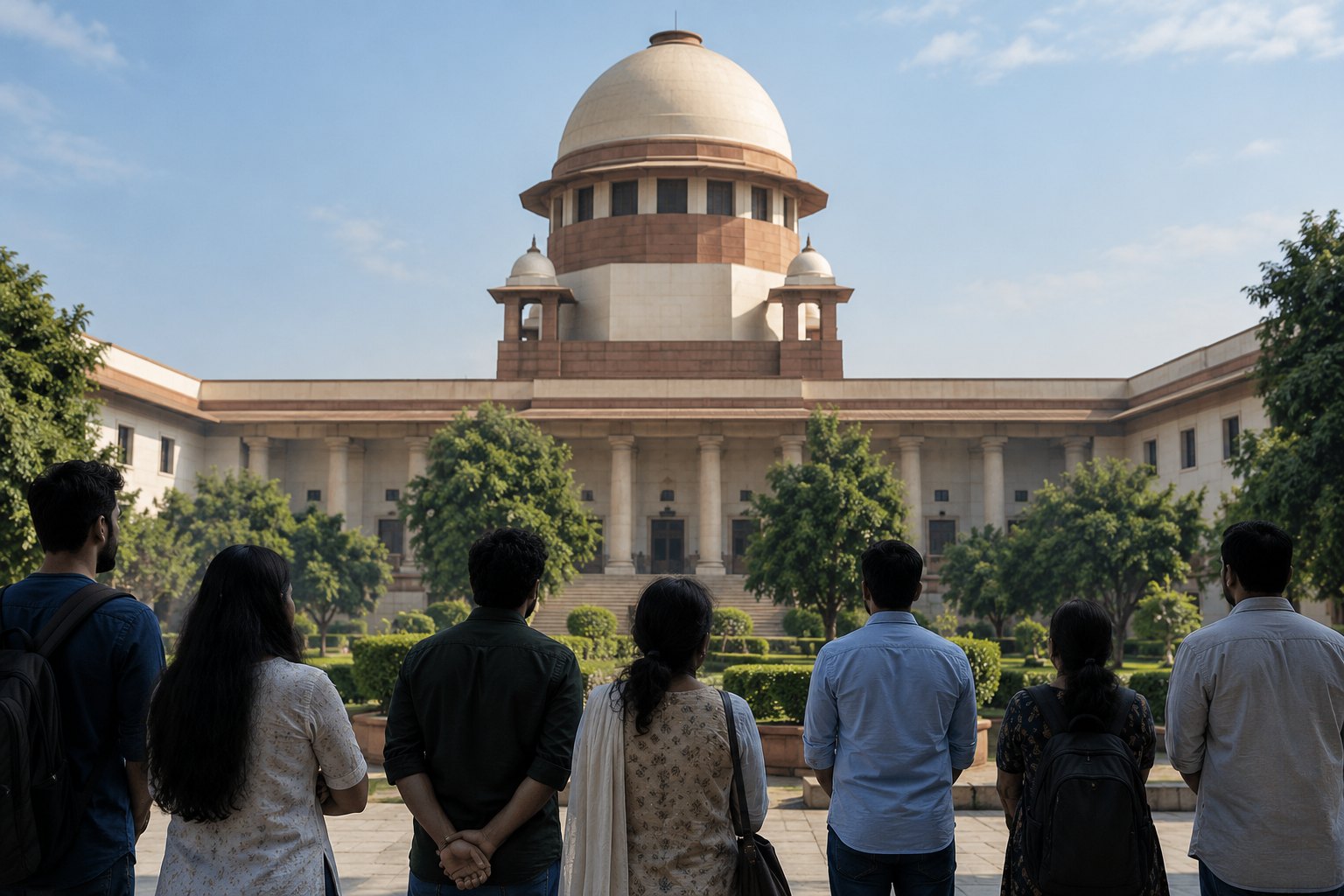
A two-judge Supreme Court Bench, at a special Sunday sitting on 11 October 2026, directed in an interim order that peaceful, unarmed protesters in Delhi be detained only by procedure established by law. It ordered a Section 163 BNSS prohibitory notice around the Supreme Court taken down, and Metro, rail and internet kept normal. The case returns on 13 October.
Syllabus: GS2 · Constitution; Prelims · Polity & Governance; GS2 · Executive & Judiciary
Why it matters
A lawyer or litigant walking to the Supreme Court should not have to pass a prohibitory cordon to reach a judge; the Court ordered the Section 163 notice around its complex removed for that reason. A person standing peacefully away from the restricted zone gains a working rule: the police must follow a procedure set by law before detaining them, and authorities must explain the circumstances, manner and justification of the 10 October detentions. Commuters get normal Metro and rail services unless public order demands regulation. The larger question, which the Bench said it would weigh, is how far police action can go before regulating a protest becomes prohibiting it.
Prelims pointers
- BNSS Section 163 (formerly CrPC Section 144): a District, Sub-divisional or specially empowered Executive Magistrate may order curbs in urgent cases of nuisance or apprehended danger.
- Section 163 grounds: preventing obstruction or injury to persons lawfully employed, danger to human life, health or safety, disturbance of public tranquillity, a riot or an affray.
- Section 163 reach: a written order stating material facts may bind one person, the residents of an area, or the public visiting a place; in an emergency, ex parte.
- Section 163 duration: at most two months; the State Government may extend it by notification for up to six months more. Disobedience is punishable under the Bharatiya Nyaya Sanhita, 2023.
- Article 21: no person shall be deprived of life or personal liberty except according to procedure established by law. It protects citizens and foreign nationals alike.
- A.K. Gopalan (1950): any procedure a valid law lays down suffices. Maneka Gandhi (1978): it must be fair, just and reasonable, guarding against arbitrary laws too.
- 'Procedure established by law' came from the Constitution of Japan; 'due process of law', under which courts test a law's own fairness, comes from the US Constitution.
- Article 32 is itself a fundamental right; Article 226 lets High Courts issue writs for fundamental rights and 'for any other purpose', a wider remit.
Practise a UPSC-style question
With reference to Section 163 of the Bharatiya Nagarik Suraksha Sanhita, 2023, consider the following statements:
1. It corresponds to Section 144 of the Code of Criminal Procedure, 1973.
2. It provides for urgent cases of nuisance or apprehended danger where immediate prevention or a speedy remedy is desirable.
3. An order under it may be directed to the public generally when they frequent or visit a particular place.
Which of the statements given above is/are correct?
- (a) 1 and 2 only
- (b) 2 and 3 only
- (c) 1 and 3 only
- (d) 1, 2 and 3
Show the answer
Answer: (d) 1, 2 and 3
1 is correct: when the BNSS replaced the CrPC from 1 July 2024, Section 163 took over the prohibitory-order power of Section 144. 2 is correct: the section covers urgent cases of nuisance or apprehended danger, where the Magistrate finds immediate prevention or a speedy remedy desirable. 3 is correct: an order may bind a particular person, the residents of an area, or the public generally when frequenting or visiting a particular place.
Explainers on this topic
More from the 11 October 2026 edition
- INS Sahyadri reaches Vladivostok for India-Russia naval exercise INDRA 2026 Defence
- Special Notified Zones: DGFT redefines who may trade rough diamonds Economy
- C-STROKE ischaemic stroke atlas released; IIT Madras brain-mapping centre dedicated Sci-Tech
- Draft National Steel Policy: 604 MT capacity, cleaner steel by 2047 Economy
- India, UK navies hold Exercise KONKAN-26 off Plymouth Defence
- Delhi internet suspensions: how the Telecommunications Act, 2023 governs shutdowns Polity
- Right to protest: Supreme Court lets authorities regulate, not halt, Delhi transit Polity
- DGTR opens anti-dumping probe into Penicillin G imports from China Economy
- NBA disburses Rs 2.02 crore Access and Benefit-Sharing funds to States Environment
- Magnitude 7.7 earthquake strikes Panama on the Pacific Ring of Fire World & IR
- Navy's Next Generation Offshore Patrol Vessel 'Shreyas' launched at GRSE, Kolkata Defence