
PM Surya Ghar: Muft Bijli Yojana and the rooftop solar subsidy
Why in news: Scheme data as of 15 October 2026 show West Bengal's rooftop installations up nearly seven-fold since May 2026, to 10,146.
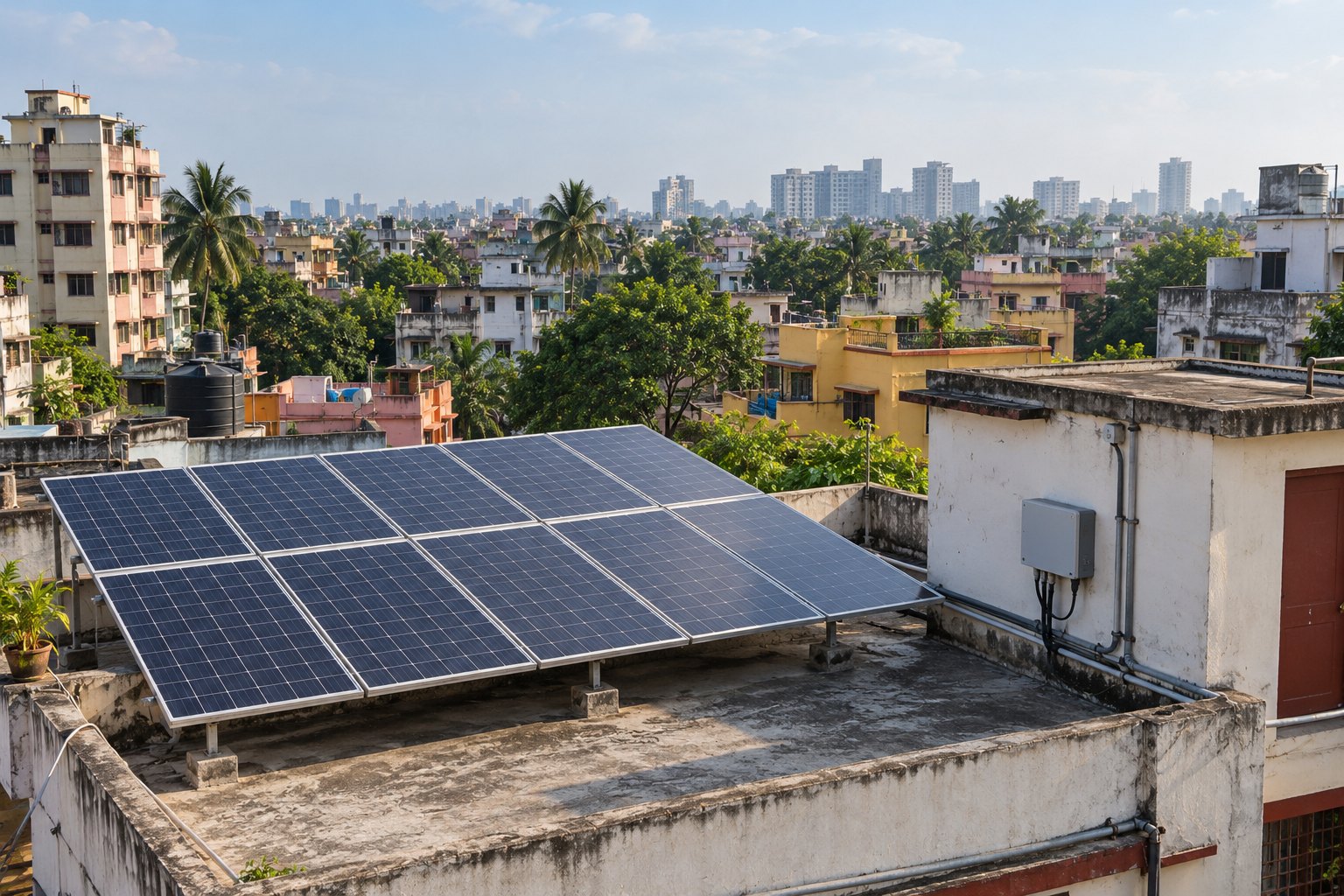
PM Surya Ghar: Muft Bijli Yojana, approved by the Union Cabinet on 29 February 2024 with Rs 75,021 crore, subsidises rooftop solar for one crore homes, with up to 300 free units a month. The Ministry of New and Renewable Energy runs it till March 2027. West Bengal's installations have risen nearly seven-fold since May 2026.
Syllabus: Prelims · Environment & Ecology; GS3 · Infrastructure; GS2 · Government Policies
Why this matters for UPSC
PM Surya Ghar: Muft Bijli Yojana serves GS3 energy infrastructure and GS2 government schemes. Prelims asks its ministry, subsidy cap, Domestic Content Requirement and implementing agencies; Mains, rooftop solar's role in energy security and delivery through State DISCOMs.
In short
PM Surya Ghar: Muft Bijli Yojana is the Centre's Rs 75,021 crore scheme, run by the Ministry of New and Renewable Energy, to subsidise rooftop solar on one crore homes.
Rooftop solar is now mass-market; reaching one crore homes by March 2027 depends on State DISCOMs and on drawing in poorer households.
Why it matters
A family that pays a large electricity bill every month can put solar panels on its roof, get a fixed part of the cost back from the Centre, and borrow the rest from a bank without pledging property. Once the panels run, the family draws less power from the grid; in many months the bill falls to zero, and any extra power it sends to the grid earns it money from the DISCOM. For the country, millions of small rooftop plants add clean electricity without new land for power stations, ease State tariff subsidies and build demand for solar panels made in India. The larger issue is whether a Central scheme delivered through State utilities can reach every State evenly.
Prelims pointers
- Implementation: REC Limited is the National Programme Implementation Agency; DISCOMs or State power departments are the State Implementation Agencies.
- Monitoring: a Steering Committee under the Cabinet Secretary; a Mission Directorate in MNRE; State committees under the Chief Secretary, district committees under the District Magistrate.
- Eligibility: CFA only for residential connections; none for government, commercial or industrial consumers. Housing societies get it for common facilities up to 500 kWp.
- Benchmark cost: Rs 50,000 per kW for the first 2 kW, Rs 45,000 beyond; special category States Rs 55,000 and Rs 49,500, with CFA of Rs 33,000 and Rs 19,800.
- Incentives to DISCOMs (guidelines of 18 July 2024): Rs 4,950 crore; 5% of benchmark cost for 10-15% capacity over the base, 10% beyond 15%.
- Model Solar Village: one per district, Rs 800 crore in all; Rs 1 crore to the revenue village (over 5,000 people, 2,000 in special category States) with most renewable capacity.
- Electricity (Rights of Consumers) Rules, 2020: rooftop solar systems up to 10 kW are deemed accepted without the DISCOM's technical feasibility approval.
Practise a UPSC-style question
With reference to PM Surya Ghar: Muft Bijli Yojana, consider the following statements:
1. The scheme is implemented by the Ministry of New and Renewable Energy through a Mission Directorate.
2. NABARD has been designated the National Programme Implementation Agency for the scheme.
Which of the statements given above is/are correct?
- (a) 1 only
- (b) 2 only
- (c) Both 1 and 2
- (d) Neither 1 nor 2
Show the answer
Answer: (a) 1 only
Answer: (a) 1 only. MNRE runs the scheme; REC Limited, not NABARD, is its national agency.
Statement 1: correct. The scheme guidelines place implementation with a Mission Directorate in the Ministry of New and Renewable Energy, headed by an officer not below Joint Secretary.
Statement 2: incorrect. REC Limited is the National Programme Implementation Agency; DISCOMs are the State Implementation Agencies.
Eliminate: Statement 2 names the wrong agency, since REC Limited runs the National Portal. Out: (b), (c).
Eliminate: Statement 1 is right, since the Mission Directorate in MNRE is responsible for implementation. Out: (d).
Trap: Swapped attribution. Another national body is put in place of REC Limited, the agency the guidelines actually name.
Remember: PM Surya Ghar = MNRE scheme; REC Limited is the NPIA, DISCOMs the SIAs.
More Explainers
- State Legislative Councils: Articles 168-172 and the graduates' and teachers' seats Polity
- Whales and dolphins in Indian waters: legal protection, IUCN status and strandings Environment
- The Aligarh Movement, AMU and the Article 30 minority test Polity
- Environmental clearance by States: SEIAA, SEAC and the EIA Notification, 2006 Environment
- Software vulnerabilities: CVE, CVSS, coordinated disclosure and CERT-In's role Sci-Tech
- Drug trafficking law in India: NDPS Act, PIT-NDPS, NCB and NCORD National
- Choosing the UN Secretary-General: Article 97, UNSC veto and straw polls World & IR
- UN Convention against Torture, and why India has not ratified it Polity
- NavIC: why India's navigation constellation cannot give a standalone position Sci-Tech
- International Energy Agency: membership, 90-day oil stocks and India's status World & IR
- HFSS foods: FSSAI's draft limits and front-of-pack warning labels National
- HTT-40 basic trainer and the IAF's pilot-training pipeline Defence