
Right to protest: Supreme Court lets authorities regulate, not halt, Delhi transit
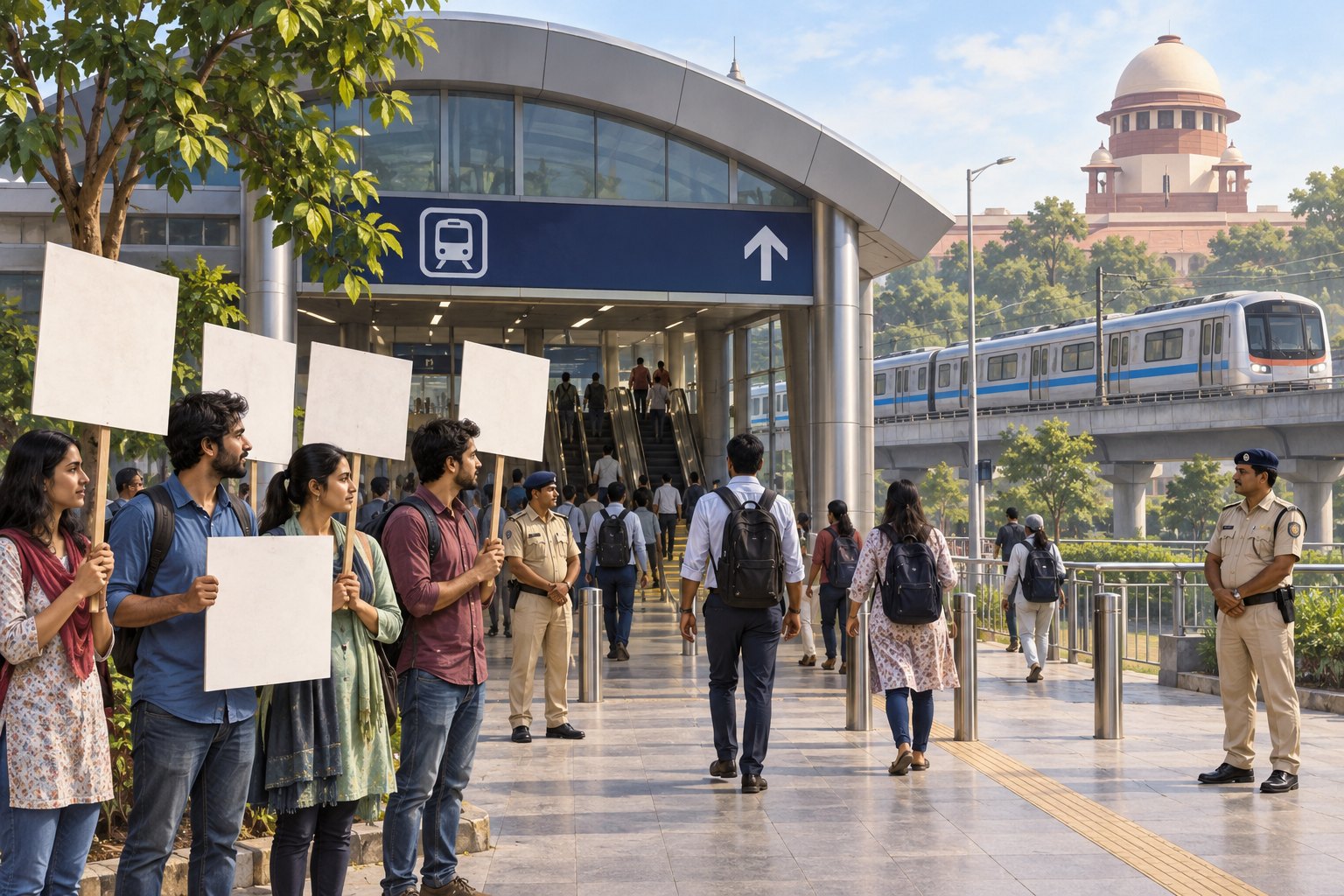
The Supreme Court on 9 October 2026 ordered that authorities may regulate, not halt, Metro and rail services before a Delhi protest; the Delhi Metro cut station closures from 57 to 45. The Union home ministry suspended mobile internet near temporary jails at eight locations on 10 October. A plea against the detentions was listed for a special Sunday sitting.
Syllabus: GS2 · Constitution; Prelims · Polity & Governance; GS3 · Cyber Security & Money Laundering
Why it matters
Picture a commuter who takes the Metro to an office, a hospital or a college in central Delhi. A blanket shutdown would have cut that trip off; the order barred a total halt and let services run in a regulated way. The same balance arises at every large protest. Protesters have a fundamental right to gather and speak, and other residents have a right to move freely and reach essential services. The Constitution lets the State restrict protest for public order, but each step, from closing stations to suspending the internet or arresting organisers in advance, must be the least restrictive one that works and must stay open to review by the courts.
Prelims pointers
- Article 19(1): (a) speech and expression, (b) assembling peaceably and without arms, (d) moving freely throughout India. These freedoms belong to citizens, not foreign nationals.
- Article 19(2): eight grounds to restrict speech, among them security of the State, friendly relations with foreign States, public order, contempt of court, defamation and incitement to an offence.
- Article 19(3): assembly may be restricted only for the sovereignty and integrity of India or public order. Article 19(5), on movement: the general public's interest or Scheduled Tribes.
- Article 22(1)-(2): an arrested person must be told the grounds, may consult a lawyer of choice, and must reach the nearest magistrate within 24 hours, excluding travel time.
- Article 22(3)-(7): preventive detention. Clauses (1) and (2) do not apply; detention beyond three months needs an Advisory Board's report. Preventive detention for public order is in the Concurrent List.
- BNSS Section 170: police may arrest without warrant to prevent a cognisable offence (24-hour limit). Section 126: an executive magistrate may require a peace bond of up to one year.
- Telecommunications Act, 2023, Section 20: the Centre or a State may suspend telecom services, on grounds including public order. Anuradha Bhasin (2020): suspension orders must be temporary, proportionate and published.
- Ramlila Maidan (2012): peaceful protest is a fundamental right. Mazdoor Kisan Shakti Sangathan (2018): no blanket ban at Jantar Mantar. Amit Sahni (2020): public ways cannot be occupied indefinitely.
Practise a UPSC-style question
With reference to reasonable restrictions under Article 19 of the Constitution of India, consider the following statements:
1. Article 19(3) permits reasonable restrictions on the right to assemble peaceably and without arms in the interests of public order.
2. Article 19(3) permits reasonable restrictions on the right to assemble peaceably and without arms in the interests of friendly relations with foreign States.
3. Article 19(2) lists incitement to an offence among the grounds for restricting freedom of speech and expression.
Which of the statements given above is/are correct?
- (a) 1 and 2 only
- (b) 2 and 3 only
- (c) 1 and 3 only
- (d) 1, 2 and 3
Show the answer
Answer: (c) 1 and 3 only
1 is correct: Article 19(3) allows restrictions on peaceful assembly in the interests of the sovereignty and integrity of India or public order. 2 is incorrect: friendly relations with foreign States is a ground in Article 19(2), which covers speech, not in Article 19(3), which covers assembly. 3 is correct: incitement to an offence is one of the eight grounds in Article 19(2).
Explainers on this topic
More from the 11 October 2026 edition
- INS Sahyadri reaches Vladivostok for India-Russia naval exercise INDRA 2026 Defence
- Special Notified Zones: DGFT redefines who may trade rough diamonds Economy
- C-STROKE ischaemic stroke atlas released; IIT Madras brain-mapping centre dedicated Sci-Tech
- Draft National Steel Policy: 604 MT capacity, cleaner steel by 2047 Economy
- India, UK navies hold Exercise KONKAN-26 off Plymouth Defence
- Supreme Court: detain peaceful protesters only by procedure established by law Polity
- Delhi internet suspensions: how the Telecommunications Act, 2023 governs shutdowns Polity
- DGTR opens anti-dumping probe into Penicillin G imports from China Economy
- NBA disburses Rs 2.02 crore Access and Benefit-Sharing funds to States Environment
- Magnitude 7.7 earthquake strikes Panama on the Pacific Ring of Fire World & IR
- Navy's Next Generation Offshore Patrol Vessel 'Shreyas' launched at GRSE, Kolkata Defence