
Choosing the UN Secretary-General: Article 97, UNSC veto and straw polls
Why in news: The Security Council's sixth straw poll for the next Secretary-General, on 16 October 2026, was the race's first with colour-coded ballots.
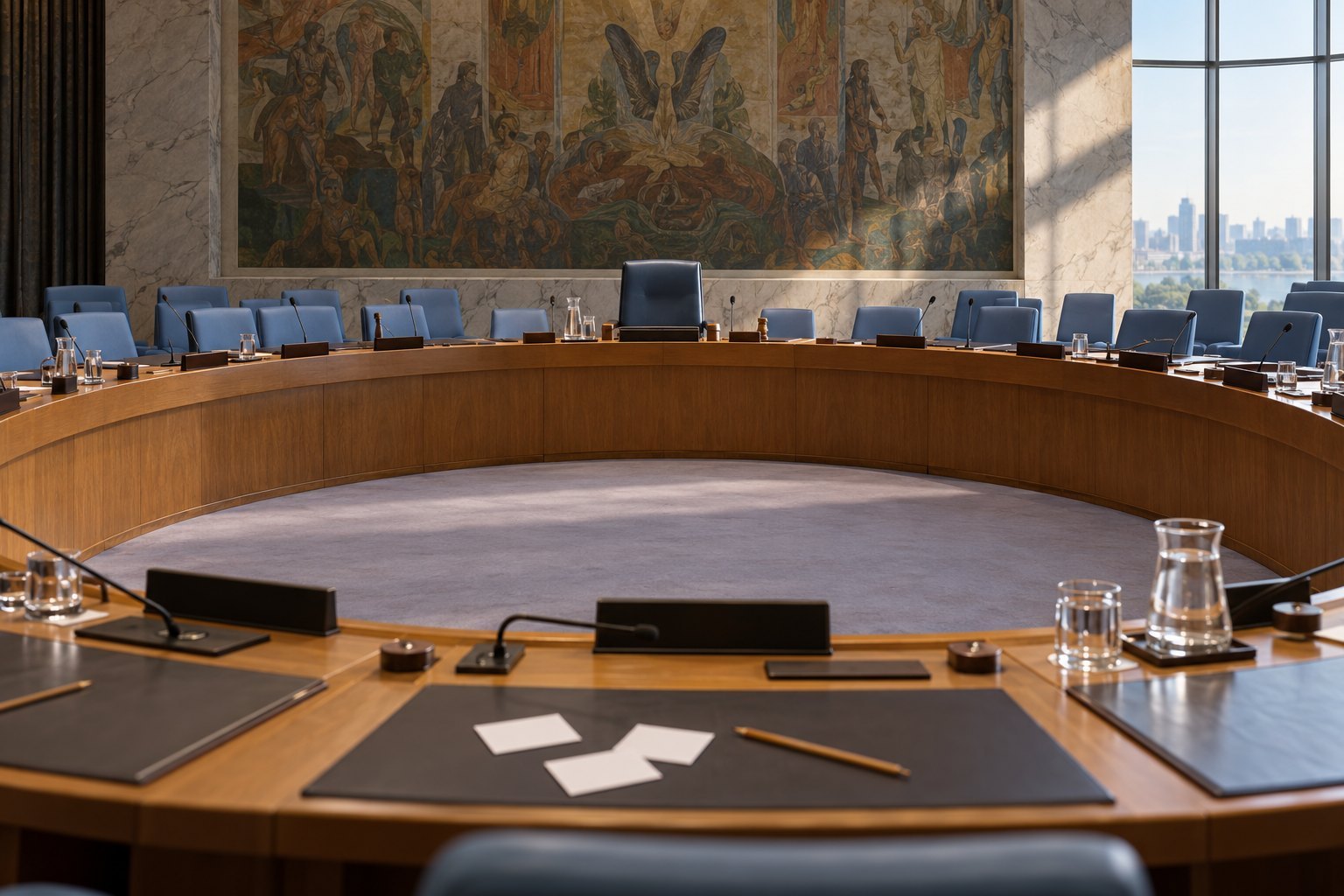
Under Article 97 of the UN Charter, the UN General Assembly appoints the Secretary-General on the UN Security Council's recommendation, which any of its five permanent members can veto. The Council narrows the field through informal straw polls. On 16 October 2026 it held the sixth poll of the race to succeed António Guterres, the first with colour-coded ballots.
Syllabus: Prelims · Current Affairs & IR; GS2 · International Institutions
Why this matters for UPSC
GS2 international institutions: Prelims asks what Articles 97, 99 and 27 of the UN Charter provide and where the five-year term comes from; Mains, whether the permanent members' veto weakens the General Assembly and the Secretary-General's independence.
In short
Article 97 of the UN Charter splits the choice of the Secretary-General: the Security Council recommends, subject to the permanent members' veto, and the General Assembly appoints.
Article 97 can stand as written; published polls, more than one name and a single term would make the choice more open and independent.
Why it matters
People living through war, and governments seeking a mediator, depend on how freely the UN's top official can act. The Secretary-General runs the organisation's staff, reports on its work every year and can raise a threat to peace with the Security Council without waiting for any government to ask. Because any one of five powers can block a candidate, the winner must suit all five, and former Secretary-General Ban Ki-moon has argued that the hope of a second term keeps office-holders dependent on them. India and most other members get a say only on the single name the Council sends. The larger question is whether a body founded in 1945 can choose its leader in a way all 193 members trust.
Prelims pointers
- Article 97, UN Charter: the Secretariat is a Secretary-General and staff; the General Assembly appoints the Secretary-General upon the Security Council's recommendation.
- Article 98: the Secretary-General acts as such at meetings of the General Assembly, Security Council, Economic and Social Council and Trusteeship Council, and reports yearly to the Assembly.
- Article 99: the Secretary-General may bring to the Security Council's attention any matter that, in his opinion, may threaten international peace and security.
- Article 100: the Secretary-General and staff seek no instructions from any government; each Member undertakes not to seek to influence them.
- Article 27: procedural Council decisions need nine affirmative votes; all other decisions need nine, including the concurring votes of the permanent members.
- Resolution 11(I), 1946: Council nomination with the permanent members' concurrence; Assembly appointment by simple majority of those present and voting unless it chooses two-thirds; secret ballot.
- Resolution 69/321 (2015): the two Presidents solicit candidates by joint letter, circulate their CVs and the Assembly holds informal dialogues; it invited women candidates.
- Resolution 79/327 (2025): one candidate per Member State; vision statement and funding disclosure at nomination; CVs on a public list; a nominee may be withdrawn at any time.
Practise a UPSC-style question
With reference to the Secretary-General of the United Nations under the UN Charter, consider the following statements:
1. Under Article 99, the Secretary-General may bring to the Security Council's attention any matter that may threaten international peace and security.
2. Under Article 97, the Security Council appoints the Secretary-General on the recommendation of the General Assembly.
Which of the statements given above is/are correct?
- (a) 1 only
- (b) 2 only
- (c) Both 1 and 2
- (d) Neither 1 nor 2
Show the answer
Answer: (a) 1 only
Answer: (a) 1 only. Article 99 is stated correctly, but Article 97 gives the appointment to the Assembly, not the Council.
Statement 1: correct. Article 99 lets the Secretary-General raise with the Security Council any matter which in his opinion may threaten international peace and security.
Statement 2: incorrect. Article 97 runs the other way: the General Assembly appoints the Secretary-General upon the recommendation of the Security Council.
Eliminate: Judge statement 2 first: the Council recommends and the Assembly appoints, so statement 2 is incorrect. Out: (b), (c).
Eliminate: Statement 1 is the Article 99 power to alert the Council, so it is correct. Out: (d).
Trap: Reversed direction. Both organs and both roles are real, but the statement swaps who recommends and who appoints.
Remember: Article 97: the Council recommends, the Assembly appoints. Article 99: the Secretary-General can alert the Council.
More Explainers
- State Legislative Councils: Articles 168-172 and the graduates' and teachers' seats Polity
- Whales and dolphins in Indian waters: legal protection, IUCN status and strandings Environment
- The Aligarh Movement, AMU and the Article 30 minority test Polity
- Environmental clearance by States: SEIAA, SEAC and the EIA Notification, 2006 Environment
- Software vulnerabilities: CVE, CVSS, coordinated disclosure and CERT-In's role Sci-Tech
- Drug trafficking law in India: NDPS Act, PIT-NDPS, NCB and NCORD National
- UN Convention against Torture, and why India has not ratified it Polity
- NavIC: why India's navigation constellation cannot give a standalone position Sci-Tech
- International Energy Agency: membership, 90-day oil stocks and India's status World & IR
- PM Surya Ghar: Muft Bijli Yojana and the rooftop solar subsidy Economy
- HFSS foods: FSSAI's draft limits and front-of-pack warning labels National
- HTT-40 basic trainer and the IAF's pilot-training pipeline Defence