
Jal Shakti Abhiyan: Catch the Rain and groundwater recharge
Why in news: A PIB backgrounder of 26 October 2026 reviewed Catch the Rain and Jal Sanchay Jan Bhagidari, citing over 1.55 crore recharge and storage structures.
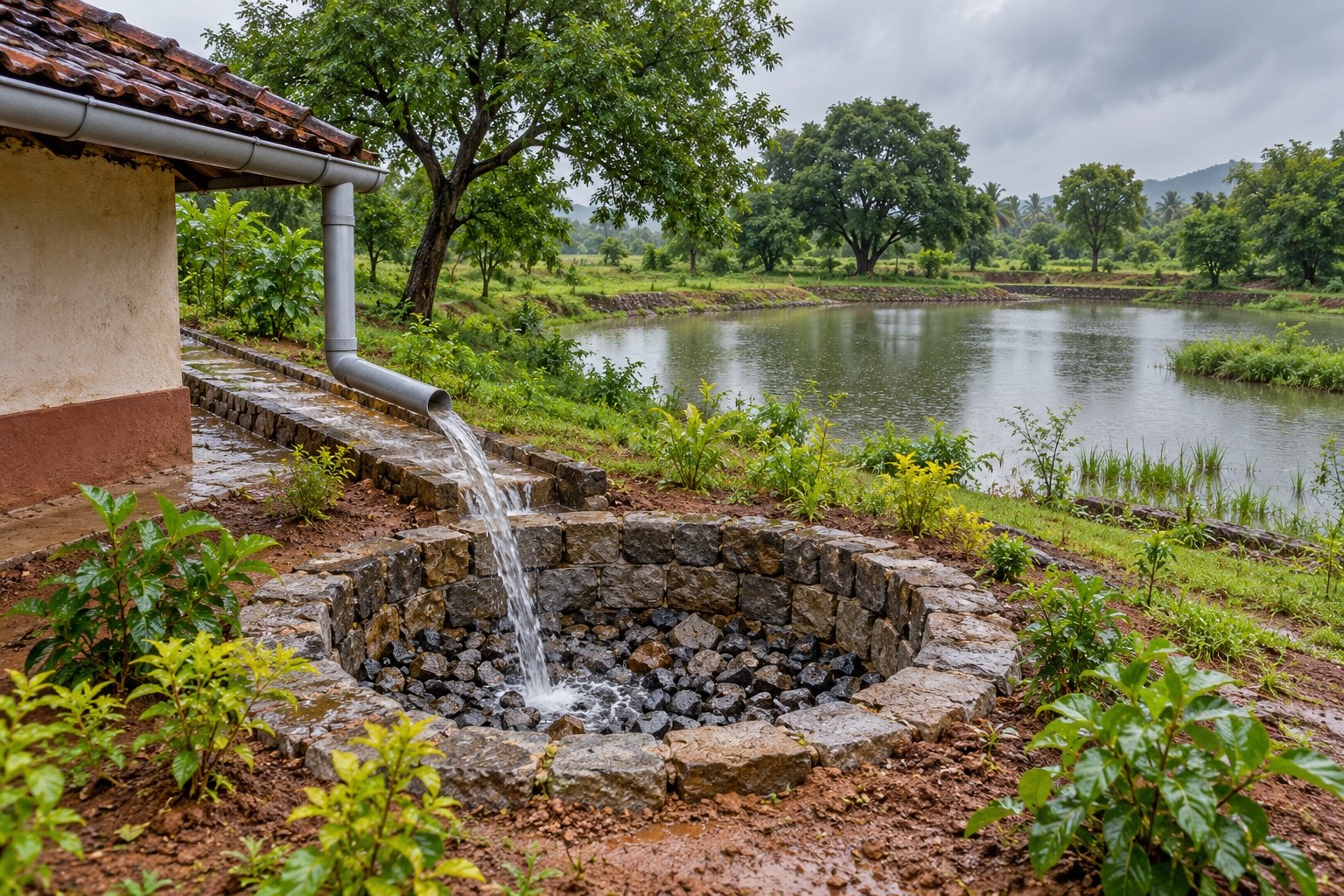
Jal Shakti Abhiyan: Catch the Rain is the Ministry of Jal Shakti's nationwide campaign to harvest rainwater and recharge groundwater through rainwater harvesting systems, recharge pits, revived water bodies and tree planting. Launched on World Water Day in 2021, it now runs merged with Jal Sanchay Jan Bhagidari. A PIB backgrounder of 26 October 2026 reviewed its progress.
Syllabus: Prelims · Environment & Ecology; GS2 · Government Policies; GS1 · Resources & Industry Location
Why this matters for UPSC
GS1 Mains asks about groundwater depletion and water harvesting; GS3 about conservation. Prelims can ask which ministry runs Jal Shakti Abhiyan, what Jal Sanchay Jan Bhagidari's 3Cs are, and how CGWB categorises over-exploited blocks.
In short
Jal Shakti Abhiyan: Catch the Rain is a Ministry of Jal Shakti campaign that turns rainwater harvesting and groundwater recharge into a people's movement, built through convergence of existing schemes.
Catch the Rain has made recharge a mass habit; its next test is verified water levels, with maintained structures and curbs on over-pumping.
Why it matters
Most Indian villages and many towns drink and irrigate from wells and tube wells. When more water is pumped out than the rain puts back, wells go dry, farmers dig deeper at higher cost and drinking water fails in summer. Catch the Rain tries to reverse that at the smallest scale: a recharge pit beside a school, a cleaned village pond, a dead borewell turned into an inlet for rainwater. Because the work is local and cheap, a panchayat or a housing society can do it without waiting for a dam or a canal. The larger issue is water security as climate variability and water demand both rise, which makes every stored monsoon shower matter more.
Prelims pointers
- Central Ground Water Authority (CGWA): constituted under section 3(3) of the Environment (Protection) Act, 1986, to regulate groundwater development; it grants No Objection Certificates for extraction.
- Stage of Ground Water Extraction: below 70% Safe, 70-90% Semi-critical, 90-100% Critical, above 100% Over-exploited, in CGWB's annual assessment units (blocks, taluks, mandals).
- Master Plan for Artificial Recharge to Groundwater 2020: prepared by CGWB with the States; a macro plan of recharge structures suited to each terrain.
- Atal Bhujal Yojana: a Central Sector Scheme of Rs 6,000 crore, half a World Bank loan, piloted in seven States: Gujarat, Haryana, Karnataka, Madhya Pradesh, Maharashtra, Rajasthan, Uttar Pradesh.
- Mission Amrit Sarovar: launched on 24 April 2022; each pond needs at least 1 acre of pondage holding about 10,000 cubic metres.
- Per Drop More Crop and Repair, Renovation and Restoration of Water Bodies are both components of the Pradhan Mantri Krishi Sinchayee Yojana (PMKSY).
- National Aquifer Mapping and Management Programme (NAQUIM): CGWB's study mapping India's aquifers, about 25 lakh sq km, with district groundwater management plans.
Practise a UPSC-style question
With reference to Jal Shakti Abhiyan: Catch the Rain, consider the following statements:
1. The first Jal Shakti Abhiyan, of 2019, covered rural and urban areas of every district.
2. It is organised by the National Water Mission under the Ministry of Jal Shakti.
3. Jal Shakti Kendras set up under it serve as district-level knowledge and facilitation hubs.
Which of the statements given above is/are correct?
- (a) 1 and 2 only
- (b) 2 and 3 only
- (c) 1 and 3 only
- (d) 1, 2 and 3
Show the answer
Answer: (b) 2 and 3 only
Answer: (b) 2 and 3 only. The 2019 Abhiyan was limited to water-stressed blocks.
Statement 1: incorrect. Jal Shakti Abhiyan 2019 worked in 1,592 water-stressed blocks of 256 districts; nationwide rural and urban coverage came with Catch the Rain from 2021.
Statement 2: correct. PIB's 2025 release says the campaign is organised by the National Water Mission, Ministry of Jal Shakti.
Statement 3: correct. Jal Shakti Kendras in the districts share harvesting techniques and give technical guidance to communities and administrations.
Eliminate: statement 1 is wrong, since the 2019 campaign was confined to water-stressed blocks. Out: (a), (c), (d).
Trap: Wrong scope. Statement 1 gives the 2019 campaign the nationwide reach that only the 2021 Catch the Rain edition had.
Remember: JSA 2019 = 256 water-stressed districts; Catch the Rain 2021 onward = the whole country.
More Explainers
- Crypto in Indian law: virtual digital assets, tax and PMLA cover Economy
- The collegium system for appointing and transferring higher court judges Polity
- Protected Area, Restricted Area and Inner Line Permits Polity
- Scheduled Tribe seats in Assemblies: Article 332 and Goa's 2025 Act Polity
- Ballot papers and EVMs: where India still votes on paper Polity
- Gelephu Mindfulness City: Bhutan's special zone on the Assam border World & IR
- Nuclear fusion, the tokamak and India's role in ITER Sci-Tech
- Gilgit-Baltistan, CPEC and India's sovereignty objection World & IR
- India-Nepal electricity trade: how Nepal sells power to India World & IR
- Infant mortality and child malnutrition among Scheduled Tribes National
- Genocide Convention, 1948: the legal test and who can judge it World & IR
- Chola bronzes: lost-wax casting and Nataraja iconography National