
Inter-State Council under Article 263, the Centre-State forum
Why in news: An opinion article in The Indian Express on 29 October 2026 argued for reviving the Inter-State Council.
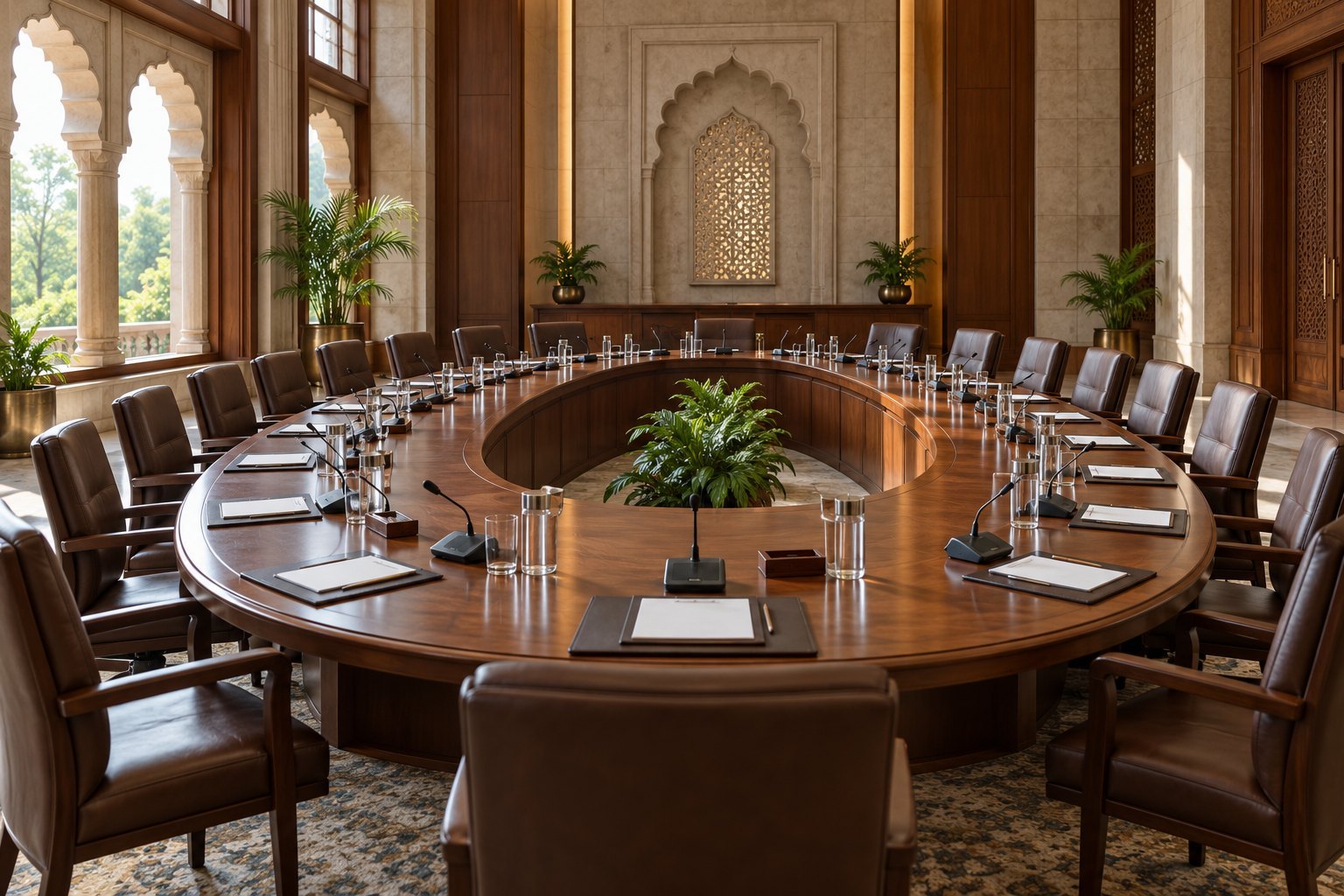
The Inter-State Council is a recommendatory Centre-State forum, set up under Article 263 of the Constitution by a Presidential Order of May 1990. Chaired by the Prime Minister, it brings Chief Ministers and Union Ministers together on shared concerns. Its revival is back in debate: the Secretariat lists eleven meetings, the last on 16 July 2016.
Syllabus: GS2 · Federalism & Local Government; GS2 · Separation of Powers; Prelims · Polity & Governance
Why this matters for UPSC
GS2 federalism and Centre-State relations. Prelims can ask what Article 263 provides, who sits on the Council and how Zonal Councils differ. Mains can ask whether the Council serves cooperative federalism and what the Sarkaria and Punchhi Commissions proposed.
In short
The Inter-State Council is a recommendatory forum of the Union and the States, created in 1990 by Presidential Order under Article 263 to discuss common concerns and co-ordinate policy.
Article 263 already supplies the forum; the Council now needs a fixed calendar, statutory follow-up and a Secretariat with real independence to earn States' trust.
Why it matters
A Chief Minister who disagrees with a Union plan on policing, schooling or welfare delivery has few regular rooms in which to argue it face to face with the Prime Minister and other Chief Ministers. The Inter-State Council is meant to be that room. When it meets, frictions can be talked through in private and settled by agreement before they harden into court cases or public stand-offs. When it does not, decisions that States must carry out are taken with less of their input, and quarrels drift toward litigation. Citizens feel the cost as delayed projects, clashing rules across State borders and slower delivery of schemes that need both governments to pull together.
Prelims pointers
- Under clause (a) of Article 263, a council may inquire into and advise on inter-State disputes; the Sarkaria Commission read this as giving no power to adjudicate them.
- The Sarkaria Commission wanted the National Development Council kept separate, formalised by a Presidential order under Article 263 and renamed the National Economic and Development Council.
- Under the 1990 Order, a Prime Minister unable to preside over a Council meeting may nominate a Union Minister of Cabinet rank to preside.
- Part III of the States Reorganisation Act, 1956 provides a Zonal Council for each of five zones; each is an advisory body whose remit includes linguistic minorities and inter-State transport.
- The Sarkaria Commission wanted a General Body meeting at least twice a year and a Standing Committee meeting at least four times a year, both in camera.
- The Punchhi Commission (report of 30 March 2010, 273 recommendations) sought thrice-yearly meetings, statutory follow-up of decisions and a professional Secretariat for the Council.
Practise a UPSC-style question
With reference to Article 263 of the Constitution of India, consider the following statements:
1. It empowers Parliament to establish an Inter-State Council by law.
2. A council under it may be charged with inquiring into and advising upon disputes between States.
3. The order setting up such a council defines its duties, organisation and procedure.
Which of the statements given above is/are correct?
- (a) 1 and 2 only
- (b) 2 and 3 only
- (c) 1 and 3 only
- (d) 1, 2 and 3
Show the answer
Answer: (b) 2 and 3 only
Answer: (b) 2 and 3 only. Article 263 works through an order of the President, and that order fixes the council's duties.
Statement 1: incorrect. Article 263 lets the President establish the council by order; Parliament does not create it by law.
Statement 2: correct. Clause (a) of Article 263 covers inquiring into and advising upon disputes that may have arisen between States.
Statement 3: correct. Article 263 lets the President's order define the nature of the council's duties, its organisation and its procedure.
Eliminate: Be sure of statement 1 first: the President acts by order under Article 263, so it is incorrect. Out: (a), (c), (d).
Trap: Swapped attribution. The power is pinned on Parliament, which creates many bodies by statute, while Article 263 places it with the President acting by order.
Remember: Inter-State Council: President's order under Article 263; Zonal Councils: States Reorganisation Act, 1956.
More Explainers
- Crypto in Indian law: virtual digital assets, tax and PMLA cover Economy
- The collegium system for appointing and transferring higher court judges Polity
- Protected Area, Restricted Area and Inner Line Permits Polity
- Scheduled Tribe seats in Assemblies: Article 332 and Goa's 2025 Act Polity
- Ballot papers and EVMs: where India still votes on paper Polity
- Gelephu Mindfulness City: Bhutan's special zone on the Assam border World & IR
- Nuclear fusion, the tokamak and India's role in ITER Sci-Tech
- Gilgit-Baltistan, CPEC and India's sovereignty objection World & IR
- India-Nepal electricity trade: how Nepal sells power to India World & IR
- Infant mortality and child malnutrition among Scheduled Tribes National
- Genocide Convention, 1948: the legal test and who can judge it World & IR
- Chola bronzes: lost-wax casting and Nataraja iconography National