
Immersive technologies (XR) and India's AVGC-XR push
Why in news: A PIB backgrounder of 26 October 2026 set out India's immersive technology push, ahead of ESTIC-2026 (27-29 October), which has an Immersive Tech track.
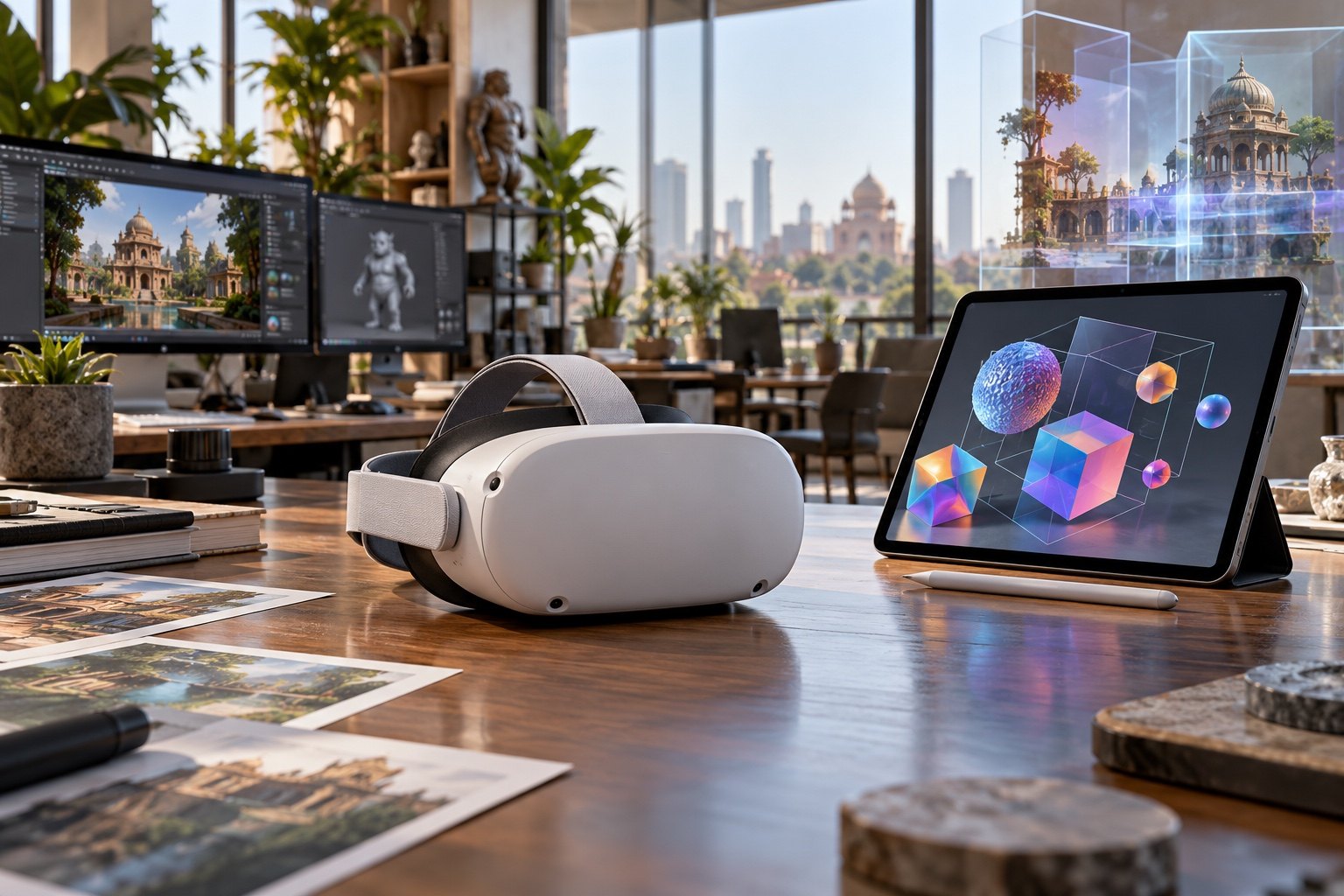
Immersive technologies make digital content feel present: Virtual Reality builds a wholly digital world, Augmented Reality lays digital information over real surroundings, and Mixed Reality lets digital objects interact with them. Together they form Extended Reality (XR). A PIB backgrounder of 26 October 2026 sets out India's support for them under the AVGC-XR framework.
Syllabus: GS3 · Indian Economy & Growth; GS3 · Government Budgeting; GS3 · Science & Technology
Why this matters for UPSC
GS3 science and technology covers awareness in IT and computers and new technology in everyday life. Prelims can ask how VR, AR, MR and a digital twin differ and what IICT is; Mains, how the Union Budget backs the AVGC-XR sector.
In short
Immersive technologies create interactive digital experiences that engage several senses; Extended Reality (XR) covers Virtual, Augmented and Mixed Reality, which differ in how much real world remains.
XR's value reaches learning, heritage and planning; India's new labs and institute need affordable devices, trained teachers and safety standards to deliver it.
Why it matters
A student in a village school who will never visit a science laboratory or a national museum can walk through a virtual one, and the history lesson turns into a place to explore. A city planner can test a new metro station on a digital twin before money is spent on concrete. A health worker can rehearse a risky procedure in simulation before facing a patient. Each of these needs devices, content and people trained to make it, which is why the government is funding labs in schools and an institute for creative technology. If devices and teachers reach only city schools, the same tools could widen the gap between urban and rural students.
Prelims pointers
- VR mainly engages sight and sound; haptic devices add the sense of touch to a virtual or interactive experience.
- IICT is a joint venture of the Government of India, the Government of Maharashtra, FICCI and CII; the two governments together hold 48% of its equity.
- GENESIS (Gen-Next Support for Innovative Startups) is a Ministry of Electronics and Information Technology scheme for tech startups in Tier-II and Tier-III cities.
- WaveX is the media-tech startup accelerator of the Ministry of Information and Broadcasting under its WAVES initiative; WAVES 2025 was held in Mumbai.
- JATAN is the Ministry of Culture's software for digitising museum artefacts; digitised collections are on the Museums of India repository.
- Sangam: Digital Twin is a Department of Telecommunications initiative combining digital twins with 5G, IoT and AI for infrastructure planning.
- The Media and Entertainment Skills Council (MESC) leads skilling in animation, VFX, gaming and post-production.
Practise a UPSC-style question
With reference to immersive technologies, consider the following statements:
1. In Augmented Reality, the user's real surroundings stay visible while digital information is laid over them.
2. Virtual Reality keeps the physical world in view and adds digital objects that respond to it.
3. Mixed Reality allows digital objects to interact with the user's physical surroundings.
Which of the statements given above is/are correct?
- (a) 1 and 2 only
- (b) 2 and 3 only
- (c) 1 and 3 only
- (d) 1, 2 and 3
Show the answer
Answer: (c) 1 and 3 only
Answer: (c) 1 and 3 only. AR overlays the real world and MR lets digital objects interact with it; VR replaces the real world.
Statement 1: correct. Augmented Reality adds directions, information or objects to real surroundings, which the user still sees.
Statement 2: incorrect. Virtual Reality creates a completely digital environment around the user; keeping the room in view and making objects respond to it describes Mixed Reality.
Statement 3: correct. Mixed Reality combines physical and digital worlds so that digital objects interact with the surroundings.
Eliminate: Be surest of statement 2: VR is wholly digital, so it is incorrect. Out: (a), (b), (d).
Trap: Look-alike names. The features of Mixed Reality are pinned on Virtual Reality, whose name sounds just as general.
Remember: VR replaces the world, AR adds to it, MR mixes with it; XR covers all three.
More Explainers
- Crypto in Indian law: virtual digital assets, tax and PMLA cover Economy
- The collegium system for appointing and transferring higher court judges Polity
- Protected Area, Restricted Area and Inner Line Permits Polity
- Scheduled Tribe seats in Assemblies: Article 332 and Goa's 2025 Act Polity
- Ballot papers and EVMs: where India still votes on paper Polity
- Gelephu Mindfulness City: Bhutan's special zone on the Assam border World & IR
- Nuclear fusion, the tokamak and India's role in ITER Sci-Tech
- Gilgit-Baltistan, CPEC and India's sovereignty objection World & IR
- India-Nepal electricity trade: how Nepal sells power to India World & IR
- Infant mortality and child malnutrition among Scheduled Tribes National
- Genocide Convention, 1948: the legal test and who can judge it World & IR
- Chola bronzes: lost-wax casting and Nataraja iconography National