
Fund for responding to Loss and Damage (FRLD): origin and working
Why in news: On 22 October 2026, at its first extraordinary meeting, the FRLD Board provisionally set aside USD 21.6 million for Nepal after August's floods.
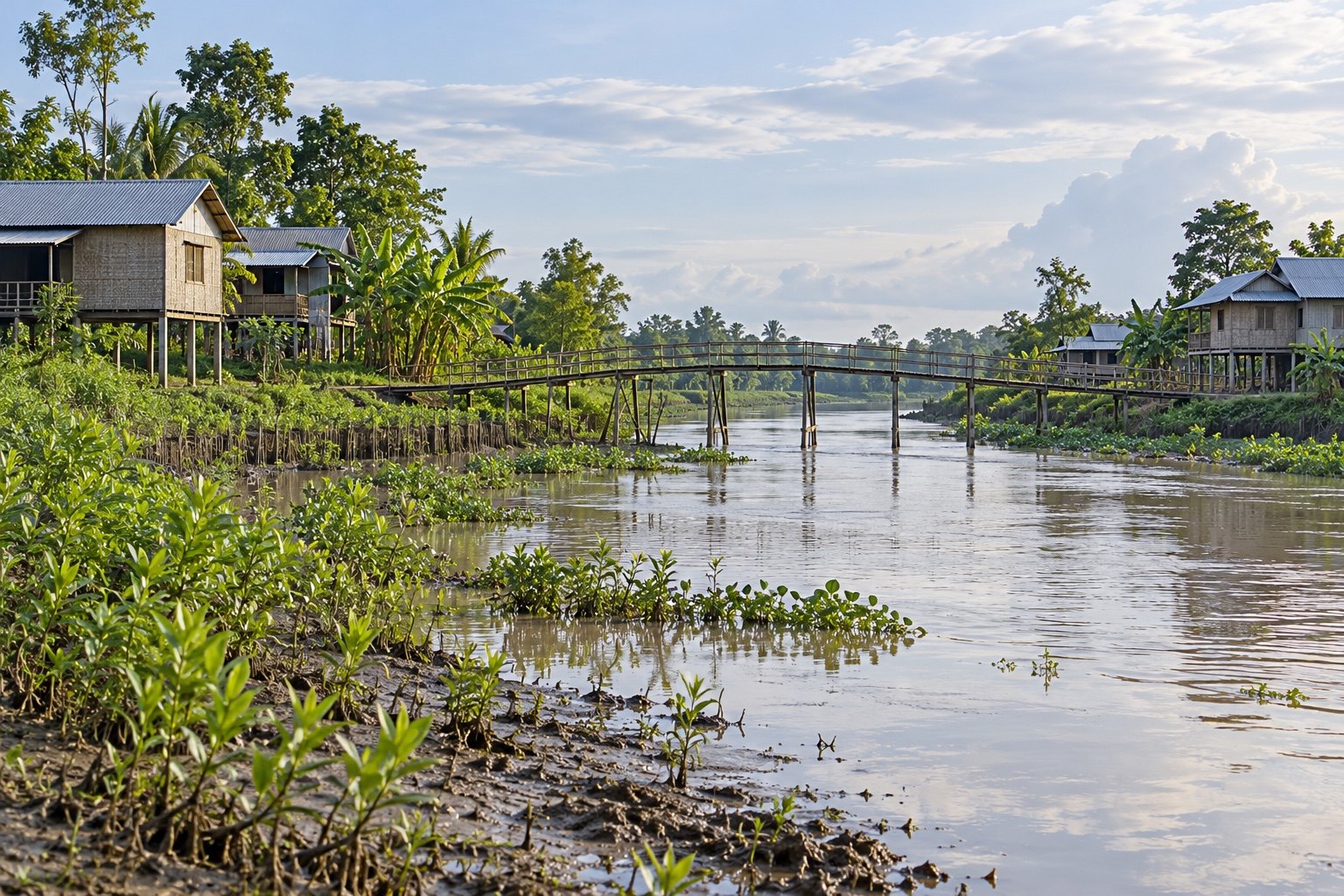
The Fund for responding to Loss and Damage (FRLD) is a climate fund under the UNFCCC, set up at COP27 in 2022 and operationalised at COP28 in 2023. It helps particularly vulnerable developing countries respond to economic and non-economic loss and damage from climate change. On 22 October 2026 its Board provisionally set aside USD 21.6 million for Nepal.
Syllabus: Prelims · Environment & Ecology; GS3 · Environment & Conservation; GS3 · Disaster Management
Why this matters for UPSC
GS3 environment and GS2 international institutions. Prelims can ask what the Fund for responding to Loss and Damage is, which country hosts its Board, who is its trustee and what Article 8 of the Paris Agreement says. Mains can ask about climate finance and justice.
In short
Loss and damage is climate harm that adaptation cannot fully avert; the Fund for responding to Loss and Damage (FRLD) finances vulnerable developing countries' response to it.
The FRLD has turned a long-standing demand into a working fund; its credibility now rests on paying in cash, quickly, at the scale disasters demand.
Why it matters
Picture a family in a Himalayan valley whose house and fields vanish under a glacier-fed flood, or an islander whose well turns salty as the sea rises. Their governments often lack the money to rebuild quickly, though their countries did least to warm the planet. Loss and damage finance is meant to pay for rebuilding homes, restoring livelihoods and supporting people after such shocks. Whether it works shows up in two plain tests: how fast money arrives after a disaster, and whether rich countries keep the fund full. That makes it a practical test of climate justice, not only a slogan at climate talks.
Prelims pointers
- Article 8 of the Paris Agreement: lists eight areas of cooperation on loss and damage, among them early warning systems, emergency preparedness, risk insurance and non-economic losses.
- Warsaw International Mechanism: its executive committee is accountable to the COP and reports to it every year; the Paris Agreement also places the mechanism under the CMA.
- Santiago network: its secretariat is hosted by a consortium of the UN Office for Disaster Risk Reduction (UNDRR) and UNOPS, for an initial five-year term.
- FRLD Board seats: 12 for developed countries; 3 each for African, Asia-Pacific and Latin American and Caribbean States; 2 for SIDS; 2 for LDCs; 1 other developing country.
- World Bank's FRLD role: interim trustee and host of the secretariat for four years under decision 1/CP.28; an independent assessment then informs continuation or a stand-alone institution.
- FRLD finance rules: open to particularly vulnerable developing countries; grants and highly concessional loans; replenishment every four years; a minimum allocation floor for LDCs and SIDS.
- Access entities: requests may go through entities accredited to the Adaptation Fund, the Global Environment Facility or the Green Climate Fund.
Practise a UPSC-style question
With reference to the Fund for responding to Loss and Damage (FRLD), consider the following statements:
1. It was set up by a decision at COP27 and operationalised by a decision at COP28.
2. Its Board has an equal number of members from developed and developing countries.
3. The World Bank serves as its interim trustee and hosts its secretariat.
Which of the statements given above is/are correct?
- (a) 1 and 2 only
- (b) 2 and 3 only
- (c) 1 and 3 only
- (d) 1, 2 and 3
Show the answer
Answer: (c) 1 and 3 only
Answer: (c) 1 and 3 only. The Board is weighted towards developing countries; the rest is correct.
Statement 1: correct. Decision 2/CP.27 at Sharm el-Sheikh (2022) decided to establish the Fund, and decision 1/CP.28 at Dubai (2023) operationalised it.
Statement 2: incorrect. The Board has 26 members: 12 from developed countries and 14 from developing countries, including SIDS and LDCs.
Statement 3: correct. Decision 1/CP.28 invited the World Bank to act as interim trustee and to host the Fund's secretariat for four years.
Eliminate: Be sure of statement 2 first: the Board has 12 developed and 14 developing-country members, not equal numbers. Out: (a), (b), (d).
Trap: Near-miss figure. A 26-seat Board looks as if it could split 13 and 13, but the split is 12 to 14 in favour of developing countries.
Remember: FRLD: decided at COP27, operationalised at COP28; Board of 26 (12 developed, 14 developing); World Bank interim trustee.
In the news
More Explainers
- Crypto in Indian law: virtual digital assets, tax and PMLA cover Economy
- The collegium system for appointing and transferring higher court judges Polity
- Protected Area, Restricted Area and Inner Line Permits Polity
- Scheduled Tribe seats in Assemblies: Article 332 and Goa's 2025 Act Polity
- Ballot papers and EVMs: where India still votes on paper Polity
- Gelephu Mindfulness City: Bhutan's special zone on the Assam border World & IR
- Nuclear fusion, the tokamak and India's role in ITER Sci-Tech
- Gilgit-Baltistan, CPEC and India's sovereignty objection World & IR
- India-Nepal electricity trade: how Nepal sells power to India World & IR
- Infant mortality and child malnutrition among Scheduled Tribes National
- Genocide Convention, 1948: the legal test and who can judge it World & IR
- Chola bronzes: lost-wax casting and Nataraja iconography National