
Chola-era bronzes of Nataraja and Sivakami found in Nagapattinam excavation
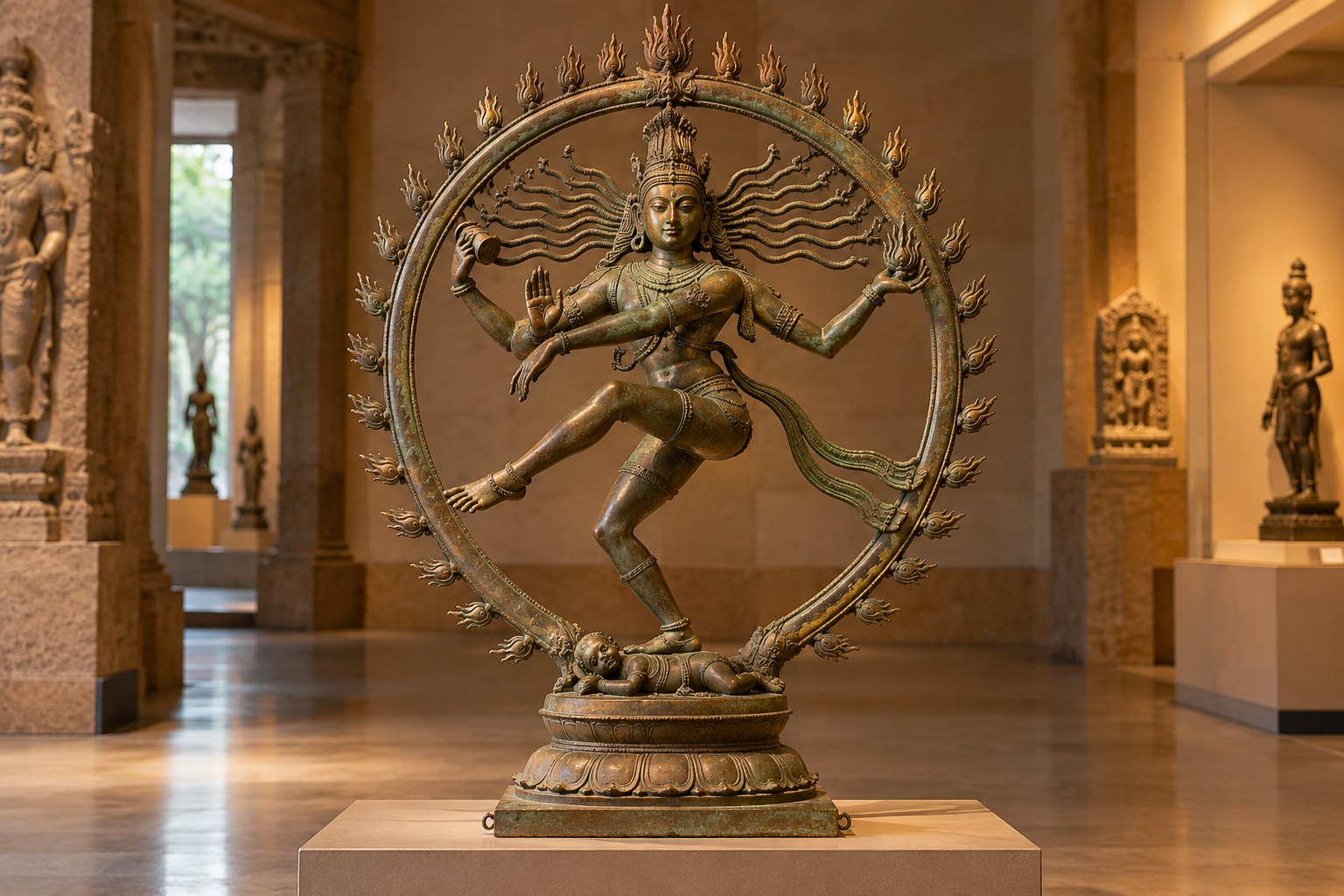
Chola-period bronze alloy idols of Nataraja and Goddess Sivakami have come to light in the ongoing excavation of the Tamil Nadu State Department of Archaeology (TNSDA) in Nagapattinam. The pair lay one metre down, each with its pedestal, and is estimated to date to the 12th century AD. The Nataraja stands 110 cm tall; the Sivakami, 82 cm.
Syllabus: GS1 · Art & Culture; Prelims · History & Culture
Why this matters for UPSC
GS1 Indian culture: Chola bronzes, the lost-wax process and Nataraja iconography. Prelims can ask about postures and casting; Mains, about protecting temple bronzes.
Why it matters
A student of Indian art mostly meets Chola bronzes in museums, cut off from the places that made them. Idols dug up in a recorded excavation keep that link: the spot, the depth and the objects around them can be studied together. That lets historians say more about how a Chola town worshipped and which workshops served it. A find that is measured and photographed at once is also harder to sell quietly abroad, because a documented object can be traced and claimed back. For the bronze casters still working in Tamil Nadu, such finds keep alive the models their craft follows.
Prelims pointers
- The Dancing Girl from Mohenjodaro, of about 2500 BCE, is perhaps the earliest Indian bronze sculpture.
- Bronze images in the traditional style are still made in South India, notably at Kumbakonam and Swamimalai in Tamil Nadu.
- Sembiyan Mahadevi, a widowed Chola queen, was a leading patron of bronze images in the tenth century.
- In the Chola Nataraja, the main right hand shows abhaya hasta, the upper right holds a damaru, and the upper left carries a flame.
- Tribhanga, a body bent at head, torso and hip, appears in standing bronzes and is a special feature of Odissi dance, whose other basic stance is chauka.
- Swamimalai Bronze Icons is a registered GI handicraft of Tamil Nadu; Swamimalai lies in Thanjavur district.
Practise a UPSC-style question
With reference to the lost-wax process of metal casting, consider the following statements:
1. A wax model of the image is coated with clay paste, and firing melts the wax out.
2. India knew lost-wax casting as early as the Indus Valley Civilisation.
3. Swamimalai Bronze Icons, made by this method, is a registered Geographical Indication of Tamil Nadu.
Which of the statements given above is/are correct?
- (a) 1 and 2 only
- (b) 2 and 3 only
- (c) 1 and 3 only
- (d) 1, 2 and 3
Show the answer
Answer: (d) 1, 2 and 3
Answer: (d) 1, 2 and 3. All three statements describe the method, its antiquity and its living centre correctly.
Statement 1: correct. A beeswax model is covered with clay, sand and cow-dung paste; firing melts the wax and molten metal takes its shape (NCERT).
Statement 2: correct. NCERT records that the lost-wax process was learnt as far back as the Indus Valley Culture.
Statement 3: correct. The IP India register lists Swamimalai Bronze Icons as a registered GI handicraft from Tamil Nadu.
Eliminate: statement 1 is the textbook method, so it is correct. Out: (b).
Eliminate: statement 3 is correct, as the GI register shows. Out: (a).
Eliminate: statement 2 is correct too, as NCERT shows. Out: (c).
Trap: Outdated fact. A student who links lost wax only with the Cholas may wrongly reject statement 2, though the method is far older.
Remember: Lost wax is as old as the Indus Valley; the Cholas perfected it, and Swamimalai still uses it.
Explainers on this topic
More from the 1 November 2026 edition
- BIMSTEC's seven members hold inaugural maritime security exercise World & IR
- Landslide in Odisha's Ganjam after Cyclone Arnab rain; NDRF joins search National
- CBD COP17 closes in Yerevan; Cali Fund design unresolved, Ecuador next host Environment
- Felling for Karjat pumped storage project paused after tribal villages protest Environment
- Bihar tender seeks cottages and helipad inside Bhimbandh Wildlife Sanctuary Environment
- CAQM orders curbs on construction and 50% office attendance in Delhi-NCR Environment
- Supreme Court directs MeitY to curb misuse of live-streamed court hearings Polity
- World Bank's India poverty brief applies 2021 PPP lines to surveys Economy
- Supreme Court: a soured consensual relationship cannot be recast as rape Polity
- CCS clears eight next-generation corvettes for Navy at GRSE, Goa Shipyard Defence
- ISRO's GSLV-F18 places NavIC satellite NVS-03 in its intended orbit Sci-Tech
- UN Commission of Inquiry finds genocidal acts in Gaza continued after ceasefire World & IR