
Carbon allotropes: from diamond and graphene to the new diamondiyne
Why in news: Researchers from University of Gothenburg, Chalmers and Stockholm University reported making diamondiyne, a 3D sp-sp3 carbon allotrope, in Angewandte Chemie on 14 September 2026.
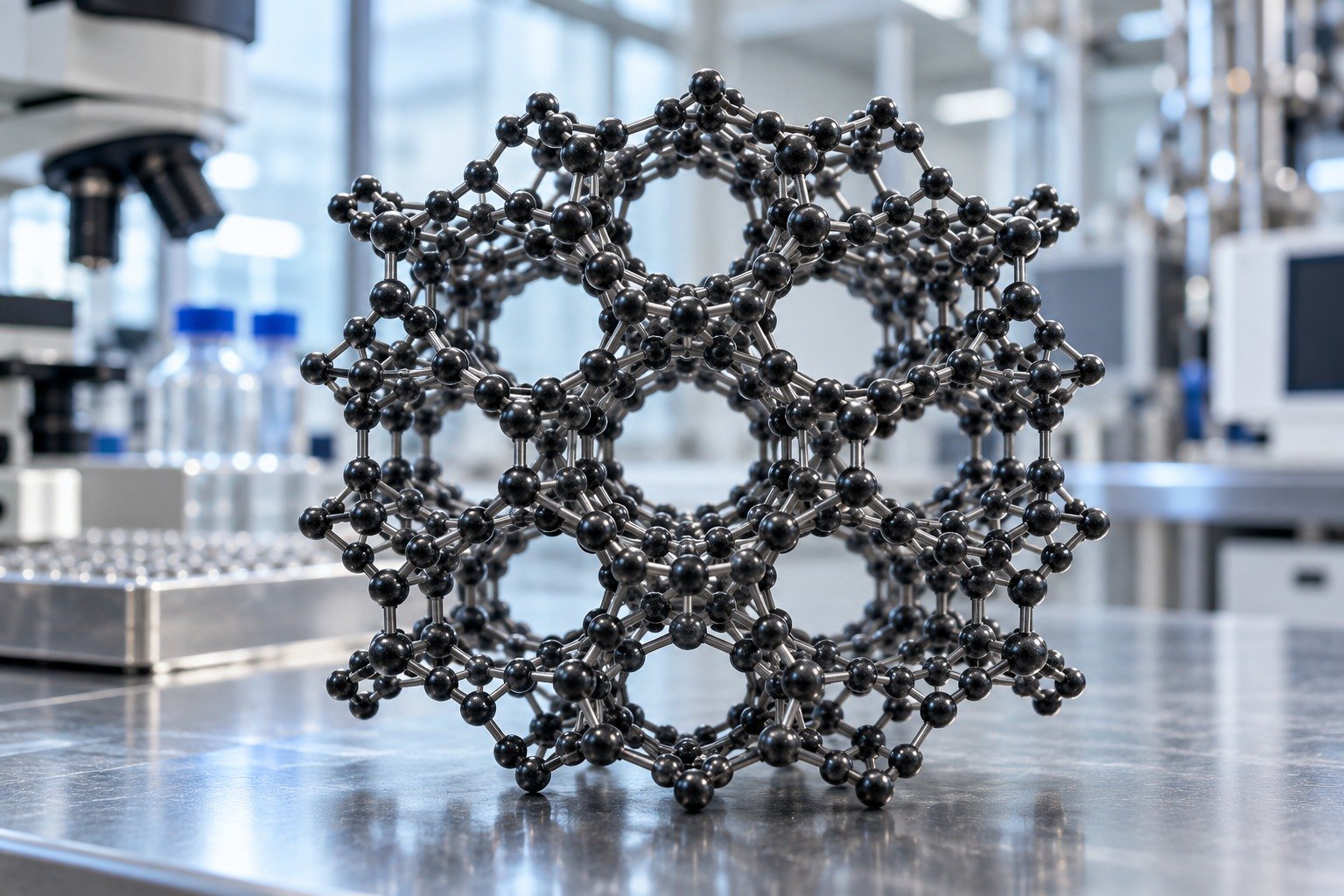
Carbon allotropes are forms of one element whose atoms bond differently. Tetrahedral sp3 bonds make diamond hard and non-conducting. Flat sp2 layers make graphite soft and conducting. Fullerenes, nanotubes and graphene came later. Swedish researchers have now reported making diamondiyne, a porous three-dimensional carbon predicted about 35 years ago.
Syllabus: Prelims · Science & Technology; GS3 · Science & Technology; GS3 · IT, Space, Biotech & IPR
Why this matters for UPSC
GS III science and technology covers nanotechnology and new materials, and Prelims General Science covers carbon's forms. Prelims can ask how sp3 and sp2 bonding make diamond hard and graphite conducting; Mains, why structure decides a material's use.
In short
Carbon allotropes are forms of pure carbon that differ only in how their atoms bond; the hybridisation and geometry of those bonds, not composition, decide hardness, conductivity and use.
Diamondiyne confirms an old prediction, but until its properties are measured it should be taught as a proven structure, not yet a proven material.
Why it matters
A student first meets carbon allotropes as a puzzle: why does one element give a gemstone that cuts glass and a pencil lead that marks paper? The answer, how the atoms are joined, is also how chemists look for new materials. Graphene showed that rearranging carbon can give a sheet that is strong, conducting and transparent at once, and possible uses in faster electronics, touch screens and light composites are being tested. Diamondiyne adds a porous, cage-like carbon that might one day hold other atoms inside, but nobody has yet measured whether it is hard, conducting or useful. Reading such news well means keeping a confirmed synthesis apart from the uses that might follow it.
Prelims pointers
- Graphite is carbon's most common form; diamond, formed under high pressure, is a metastable form of carbon.
- Graphene's carbon-carbon distance is 0.142 nm; it absorbs only about 2.3% of visible light, yet not even helium passes through it.
- C60 has 60 carbon atoms in 20 hexagons and 12 pentagons, the pattern of a football and of Buckminster Fuller's geodesic dome.
- Fullerenes were found in 1985 by Curl, Kroto and Smalley by laser-vaporising carbon into helium; bulk C60 came in 1990 from a carbon arc.
- Single-walled carbon nanotubes have been known since 1993; their ends are half-spherical, like fullerenes.
- Geim and Novoselov of the University of Manchester isolated graphene in 2004 by peeling graphite with adhesive tape.
- In ethyne, sp-hybridised carbons give a linear molecule; a triple bond is one sigma bond and two pi bonds.
- Graphite serves as electrodes, lubricant, crucibles and pencil lead; diamond cuts and grinds rock and glass and draws wire.
Practise a UPSC-style question
With reference to the allotropes of carbon, consider the following statements:
1. In diamond, each carbon atom is sp3 hybridised and bonded tetrahedrally to four other carbon atoms.
2. In graphite, each carbon atom is sp hybridised and bonded to two other carbon atoms in a chain.
3. The layers of graphite are held together by weak van der Waals forces, so they slide easily.
Which of the statements given above is/are correct?
- (a) 1 and 2 only
- (b) 2 and 3 only
- (c) 1 and 3 only
- (d) 1, 2 and 3
Show the answer
Answer: (c) 1 and 3 only
Answer: (c) 1 and 3 only. Diamond is sp3 and graphite sp2, with weak forces between graphite's layers.
Statement 1: correct. Each diamond carbon is sp3 hybridised and linked to four others by strong covalent bonds in a tetrahedral, three-dimensional network.
Statement 2: incorrect. Graphite's carbon is sp2 hybridised and linked to three other carbons in a flat hexagonal layer, not two in a chain.
Statement 3: correct. Graphite's layers are held by weak van der Waals forces, which is why graphite is soft and slippery.
Eliminate: Statement 2 is incorrect, since graphite carbon bonds to three neighbours. Out: (a), (b), (d).
Trap: Near-miss figure. The hybridisation state is shifted from sp2 to sp and the bond count from three to two.
Remember: Diamond sp3, four bonds, 3D; graphite sp2, three bonds, layers held by van der Waals forces.
More Explainers
- Crypto in Indian law: virtual digital assets, tax and PMLA cover Economy
- The collegium system for appointing and transferring higher court judges Polity
- Protected Area, Restricted Area and Inner Line Permits Polity
- Scheduled Tribe seats in Assemblies: Article 332 and Goa's 2025 Act Polity
- Ballot papers and EVMs: where India still votes on paper Polity
- Gelephu Mindfulness City: Bhutan's special zone on the Assam border World & IR
- Nuclear fusion, the tokamak and India's role in ITER Sci-Tech
- Gilgit-Baltistan, CPEC and India's sovereignty objection World & IR
- India-Nepal electricity trade: how Nepal sells power to India World & IR
- Infant mortality and child malnutrition among Scheduled Tribes National
- Genocide Convention, 1948: the legal test and who can judge it World & IR
- Chola bronzes: lost-wax casting and Nataraja iconography National