
Additive manufacturing: how 3D printing works, and India's NSAM
Why in news: Over 1.54 lakh people have been trained under NSAM, and its next phase, NSAM 2.0, is being conceptualised, the government said on 7 October 2026.
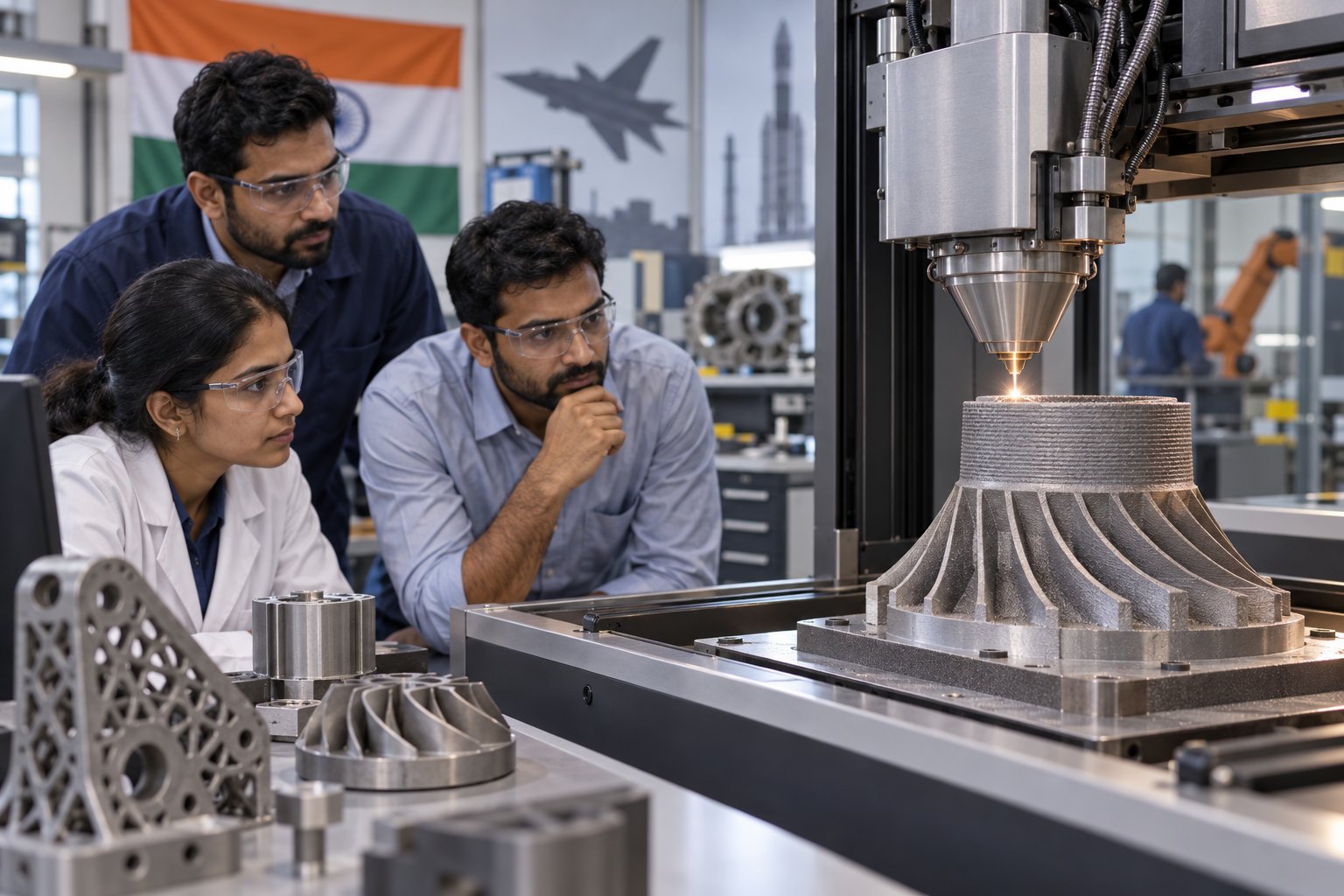
Additive manufacturing, or 3D printing, builds an object layer by layer from a digital design instead of cutting it from a solid block. India's National Strategy for Additive Manufacturing (NSAM), released by the Ministry of Electronics and Information Technology in February 2022, targets 5% of the global market. Its next phase, NSAM 2.0, is now being drawn up.
Syllabus: GS3 · Liberalisation & Industry; GS3 · Indian Achievements in S&T; GS3 · IT, Space, Biotech & IPR
In short
Additive manufacturing, or 3D printing, builds an object layer by layer from a digital file; India's National Strategy for Additive Manufacturing (2022) aims to build the technology at home.
NSAM has built skills and start-ups; its second phase must make machines, materials and design rights Indian, with certification keeping printed parts safe.
Why it matters
A patient who needs a bone graft could get one shaped to their own scan instead of a standard size, and a remote army unit could print a spare part instead of waiting weeks for supply. That is the promise of building parts straight from a digital file: less material wasted, complex shapes made in one piece, and production close to where the part is needed. For India the stakes are imports and jobs: home-grown machines, materials and software would cut reliance on foreign suppliers in aerospace, medical devices and electronics. The larger question is whether India can move from using new manufacturing technologies to making them.
Prelims pointers
- Additive versus subtractive: AM adds material layer by layer from a digital file; subtractive methods such as CNC milling cut material away from a solid block.
- STL file: describes a 3D model's surface as a mesh of triangles; slicing software turns the model into layer-by-layer instructions for the printer.
- ISO/ASTM 52900 groups AM into seven families: binder jetting, directed energy deposition, material extrusion, material jetting, powder bed fusion, sheet lamination and vat photopolymerisation.
- Fused deposition modelling extrudes melted thermoplastic filament; stereolithography cures liquid resin with ultraviolet light; selective laser sintering fuses polymer powder with a laser.
- Materials: polylactic acid (PLA) is a biodegradable thermoplastic from renewable plant sources such as starch; water-soluble polyvinyl alcohol (PVA) prints supports that dissolve away.
- NSAM: released by MeitY in February 2022, aligned with Make in India and Atmanirbhar Bharat; NSAM 2.0 is its next phase.
- Atal Tinkering Labs: school labs under NITI Aayog's Atal Innovation Mission, giving students of Classes VI to XII 3D printers, robotics and IoT kits.
- Bioprinting builds tissue-like structures from bio-inks containing living cells; 4D printing uses smart materials whose printed shape changes over time with heat or moisture.
Practise a UPSC-style question
Consider the following statements about the National Strategy for Additive Manufacturing (NSAM):
1. It was released by the Department for Promotion of Industry and Internal Trade under the Ministry of Commerce and Industry.
2. It aims to capture about 5% of the global additive manufacturing market.
Which of the statements given above is/are correct?
- (a) 1 only
- (b) 2 only
- (c) Both 1 and 2
- (d) Neither 1 nor 2
Show the answer
Answer: (b) 2 only
1 is incorrect: NSAM was released by the Ministry of Electronics and Information Technology (MeitY) in February 2022. 2 is correct: NSAM aims to capture 5% of the global additive manufacturing market and add nearly US$1 billion to India's GDP.
In the news
More Explainers
- State Legislative Councils: Articles 168-172 and the graduates' and teachers' seats Polity
- Whales and dolphins in Indian waters: legal protection, IUCN status and strandings Environment
- The Aligarh Movement, AMU and the Article 30 minority test Polity
- Environmental clearance by States: SEIAA, SEAC and the EIA Notification, 2006 Environment
- Software vulnerabilities: CVE, CVSS, coordinated disclosure and CERT-In's role Sci-Tech
- Drug trafficking law in India: NDPS Act, PIT-NDPS, NCB and NCORD National
- Choosing the UN Secretary-General: Article 97, UNSC veto and straw polls World & IR
- UN Convention against Torture, and why India has not ratified it Polity
- NavIC: why India's navigation constellation cannot give a standalone position Sci-Tech
- International Energy Agency: membership, 90-day oil stocks and India's status World & IR
- PM Surya Ghar: Muft Bijli Yojana and the rooftop solar subsidy Economy
- HFSS foods: FSSAI's draft limits and front-of-pack warning labels National