
PMAY-G 2.0: 3 lakh Andhra houses, 3D concrete-printed pilot in Guntur
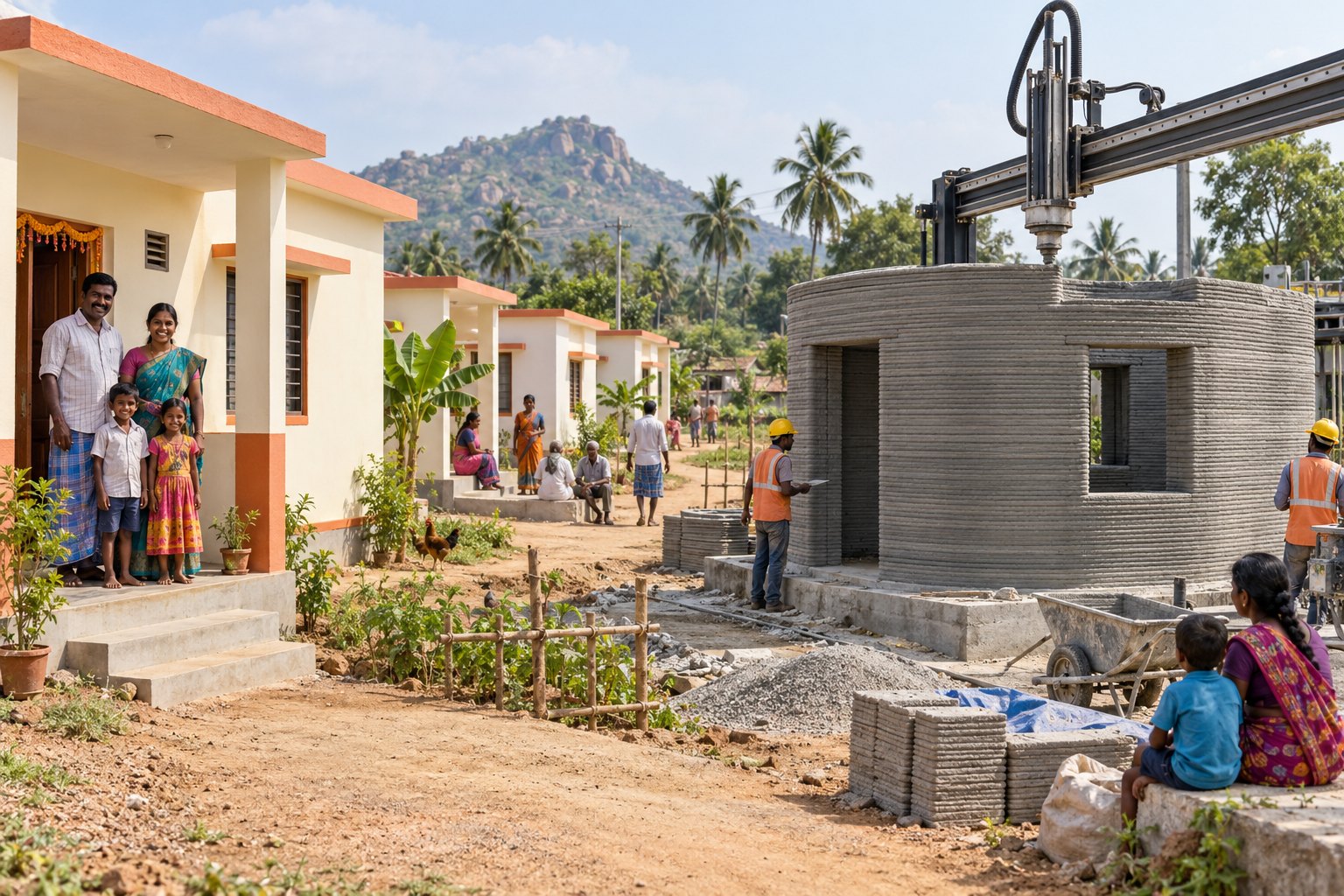
The Union Ministry of Rural Development on 4 October 2026 handed Andhra Pradesh the first instalment for 3 lakh houses worth ₹3,600 crore under the Pradhan Mantri Awas Yojana-Gramin (PMAY-G) 2.0. In Guntur district, it laid the foundation of a ₹14-crore pilot of 177 houses to be built by 3D concrete printing within six months.
Syllabus: Prelims · Economy & Social Development; GS3 · Science & Technology; GS2 · Welfare of Vulnerable Sections
Why it matters
For a rural family in a kutcha house in Andhra Pradesh, a PMAY-G sanction brings ₹1.20 lakh, paid by Direct Benefit Transfer in instalments as the house rises, for a house of at least 25 square metres with a hygienic cooking area, in a design suited to the region. The ₹3,600 crore for 3 lakh houses works out to exactly that plain-area rate. The Guntur pilot matters differently: if printed walls prove durable and cheap, village houses could rise in weeks with fewer masons. But ₹14 crore for 177 houses is about ₹7.9 lakh a house, so the method must still show it can fit PMAY-G's budget.
Prelims pointers
- PMAY-G: Ministry of Rural Development; in effect from 1 April 2016; a centrally sponsored scheme for pucca houses for houseless and kutcha-house families in villages.
- Cost sharing (Centre : State): 60:40 in most States; 90:10 in North-Eastern and Himalayan States; 100% central in Union Territories without a legislature.
- Beneficiaries: SECC 2011 housing-deprivation and exclusion criteria, verified by the Gram Sabha; the Awaas+ list is updated through a survey on the Awaas+ 2024 app, launched in September 2024.
- House design: at least 25 sq m with a hygienic cooking area; region-specific designs using local materials, with 3D house designs from CSIR-CBRI on the Awaas+ 2024 app.
- Payment: Direct Benefit Transfer to Aadhaar-linked bank or post-office accounts in instalments tied to construction stages, checked with geo-tagged, time-stamped photographs.
- PMAY-Urban 2.0: Ministry of Housing and Urban Affairs; 1 crore urban families in five years; verticals: Beneficiary-Led Construction, Affordable Housing in Partnership, Affordable Rental Housing, Interest Subsidy Scheme.
- 3D concrete printing: a robotic printer follows a computerised 3D design and extrudes a specially designed concrete layer by layer, building walls without formwork.
- CSIR-Central Building Research Institute (CBRI), Roorkee: a laboratory of the Council of Scientific and Industrial Research for building science and construction technology.
Practise a UPSC-style question
With reference to the Pradhan Mantri Awas Yojana-Gramin (PMAY-G), consider the following statements:
1. It is implemented by the Ministry of Housing and Urban Affairs.
2. Its unit assistance per house is higher in North-Eastern and hill States than in plain areas.
3. Its beneficiaries are identified using SECC 2011 housing-deprivation parameters, verified by the Gram Sabha.
Which of the statements given above is/are correct?
- (a) 1 and 2 only
- (b) 2 and 3 only
- (c) 1 and 3 only
- (d) 1, 2 and 3
Show the answer
Answer: (b) 2 and 3 only
1 is incorrect: PMAY-G is run by the Ministry of Rural Development; the Ministry of Housing and Urban Affairs runs PMAY-Urban. 2 is correct: the unit assistance is ₹1.30 lakh in North-Eastern and hill States against ₹1.20 lakh in plain areas. 3 is correct: beneficiaries are drawn from SECC 2011 housing-deprivation and exclusion criteria and verified by the Gram Sabha, with the Awaas+ list added.
Explainers on this topic
More from the 4 October 2026 edition
- IAF needs 36-40 fighters a year, says Air Chief A P Singh Defence
- Uttarakhand publishes post-SIR voter roll, about 8 lakh fewer electors Polity
- India logs 3,832 child leprosy cases, far above 2025-26 target National
- Sal borer outbreak prompts tree felling and trapping in Dindori Environment
- India's food market pegged at $550-600 billion, says MoFPI official Economy
- Railways use AI alerts and Plan Bee to protect elephants Environment
- Apple pulls Bitchat from India App Store after MeitY demand National
- Education Ministry approves five Centres of Excellence for classical languages National