
India readies NSAM 2.0 after 3D-printing push trains 1.54 lakh people
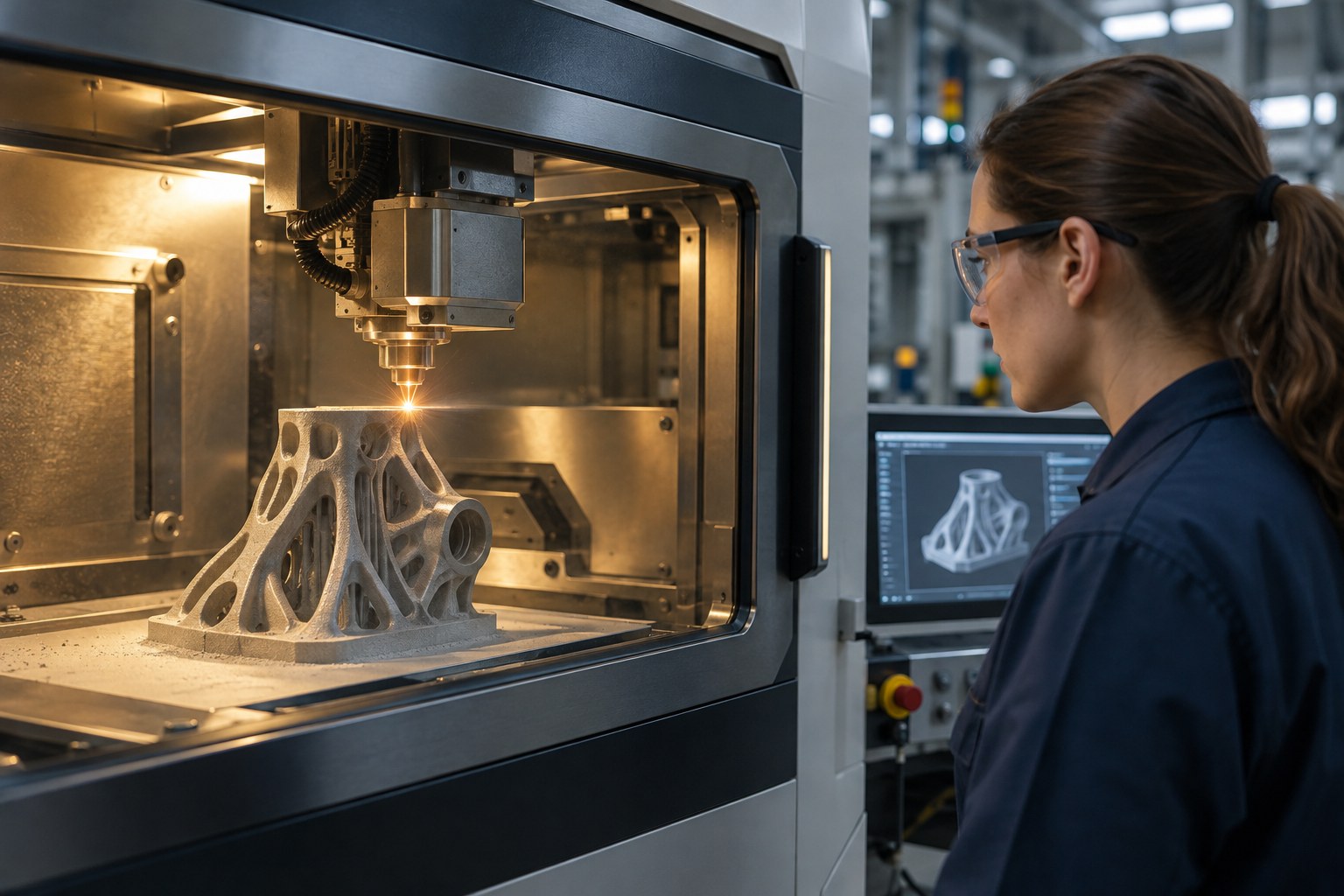
MeitY's National Strategy for Additive Manufacturing (NSAM), released in February 2022, is moving to a second phase, NSAM 2.0. According to PIB, it has trained over 1.54 lakh people, supported 56 start-ups and developed 65 India-specific technologies. NSAM 2.0 plans faster IPR generation, cheaper machines and materials through clusters, and greater support for defence.
Syllabus: Prelims · Current Affairs & IR; GS3 · Liberalisation & Industry; GS3 · Science & Technology
Why it matters
3D printing helps India make complex items at home, from rocket engines and Army housing to bone grafts and electronic components, and PIB says it is reducing reliance on imports. The first phase has trained over 1.54 lakh people and supported 56 start-ups, and the push is creating skilled jobs, according to PIB. The second phase aims to make machines and materials more affordable and to give extensive support to defence; these priorities, PIB says, can carry the technology into the mainstream of industry and society. With the global market for AM machines projected to reach US$149 billion by 2035, PIB sees a real opening for India to become a maker of the technology, not just a buyer.
Prelims pointers
- STL (Standard Tessellation Language) file: describes a 3D model as a set of triangular surfaces; one of the common input formats for AM.
- Thermoplastics such as ABS, polycarbonate and PLA are the most popular AM materials; water-soluble PVA forms temporary supports that are later dissolved.
- Atal Tinkering Labs (Atal Innovation Mission, NITI Aayog): a ₹20 lakh grant per lab for 1,200-1,500 sq ft spaces with 3D printers, robotics and IoT kits; Grades VI-XII.
- ESTIC-2026, the second Emerging Science, Technology and Innovation Conclave, is organised by CSIR at Bharat Mandapam, New Delhi, on 27-29 October 2026, across 12 thematic areas.
- National Additive Manufacturing Symposium (NAMS): MeitY held its second edition on 13 March 2026 in New Delhi; panels discussed NSAM 2.0 and defence adoption.
- Technology Development Board, a statutory body under the Technology Development Board Act, 1995, backs 3D-printed bone grafts of indigenous bioceramic materials.
- Additive manufacturing builds parts up layer by layer, unlike subtractive machining, which cuts material away; PIB counts more than 40 AM processes in the market or R&D.
- 3D construction printing: early use points to possible savings of 30% in material and logistics costs and 90% lower emissions than cement-based construction.
Practise a UPSC-style question
With reference to additive manufacturing, consider the following statements:
1. It shapes an object by cutting material away from a solid block under the control of a digital file.
2. An STL file, commonly used to prepare models for printing, describes a 3D model as a collection of triangular surfaces.
3. Slicing software divides a digital model into horizontal layers, which the machine then builds one after another.
Which of the statements given above is/are correct?
- (a) 1 and 2 only
- (b) 2 and 3 only
- (c) 1 and 3 only
- (d) 1, 2 and 3
Show the answer
Answer: (b) 2 and 3 only
1 is incorrect: additive manufacturing builds an object up layer by layer; cutting material away is subtractive machining. 2 is correct: an STL (Standard Tessellation Language) file represents the model as triangular surfaces. 3 is correct: slicing turns the model into hundreds or thousands of layers that the printer lays down in turn.
Explainers on this topic
More from the 7 October 2026 edition
- NCAHP notifies autonomous boards, central assessment committee for allied health National
- India, EU formally launch Green Shipping Corridor industry coalition Environment
- First self-stabilising thorium-229 nuclear clock runs in Vienna Sci-Tech
- Defence Ministry eases industry access to DRDO and military test ranges Defence
- MoSPI releases 2026–2030 roadmap for environmental-economic accounting Environment
- Farm workers moving to cities land in low-productivity informal jobs: study Economy
- Navy's first Fleet Support Ship, FSS-1, launched at Visakhapatnam Defence
- Projectile strikes ship in Strait of Hormuz, injuring 11 Indian crew World & IR
- India, Switzerland sign mobility pacts, widen defence and nuclear cooperation World & IR
- MoSPI plans to widen monthly services index to 78.4% of services GVA Economy
- Seven-judge SC bench closes legislative privilege case, keeps free-speech questions open Polity
- India seeks equal focus on adaptation at Pre-COP31 in Fiji Environment