
Who manages India's floods: State subject, central bodies and funding
Why in news: On 27 October 2026, the Ganga Flood Control Board's 19th meeting deliberated on a revised mandate for the Ganga Flood Control Commission.
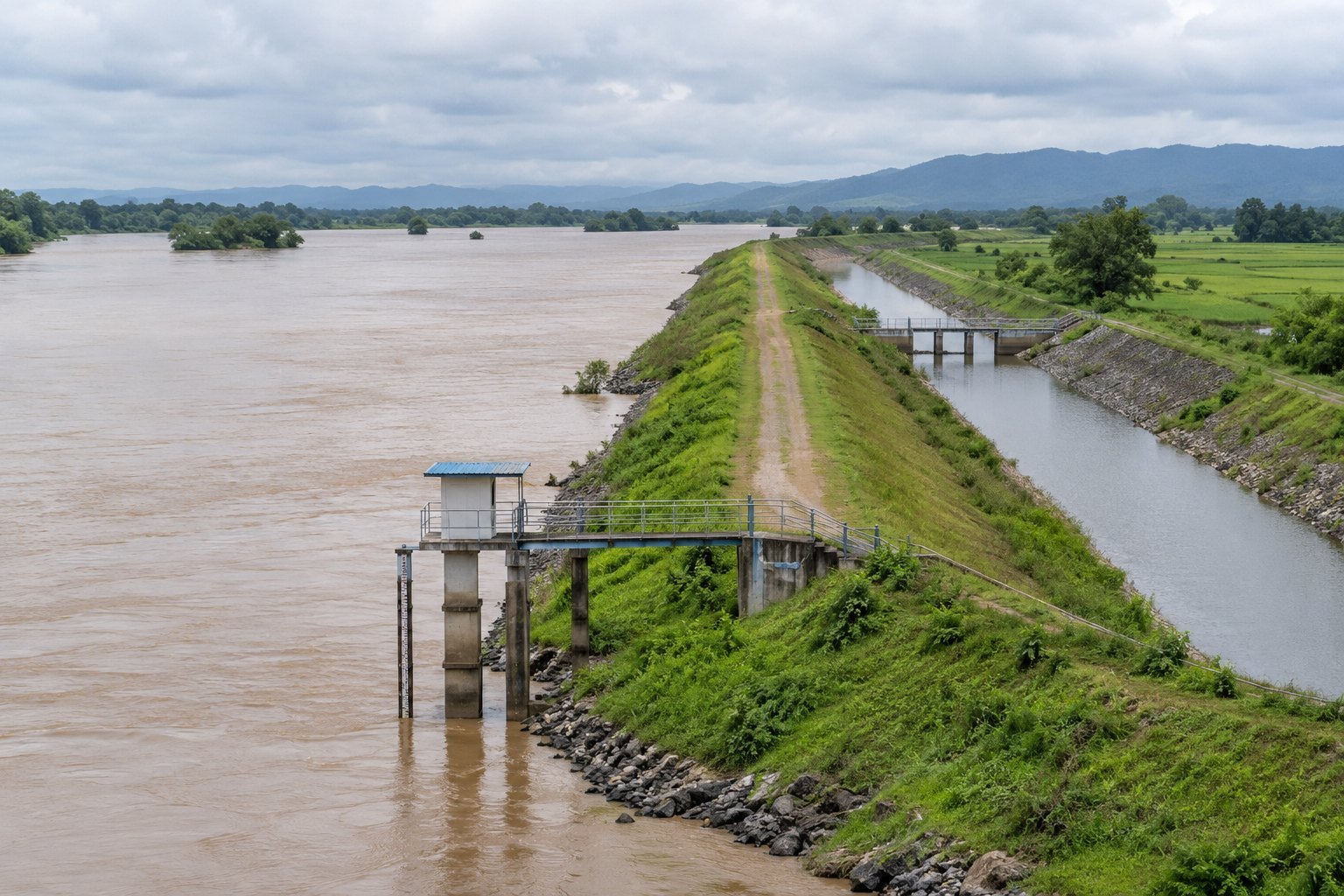
India leaves flood control to the States, which plan, pay for and build embankments and drains. The Union backs them with basin bodies for the Ganga and the Brahmaputra, national flood forecasting and a co-funding scheme. On 27 October 2026, the Ganga basin's Centre-State board weighed a new role for its technical commission.
Syllabus: GS2 · Federalism & Local Government; Prelims · Geography; GS3 · Disaster Management
Why this matters for UPSC
GS3 disaster management and GS2 federalism: who manages floods in India. Prelims asks bodies, parent ministries and the State List; Mains, Centre-State roles.
In short
Flood management in India is a State responsibility under Entry 17 of the State List; the Centre supports it through basin bodies, forecasting and co-funding, raising a federal coordination question.
India's flood regime rests on the States; the Centre's value lies in basin-wide planning, timely warnings and money that rewards zoning over embankments alone.
Why it matters
A farmer on the Kosi or a family in a low-lying Assam village depends first on the State government. It decides which embankment is raised, where drains go and who is moved when the river rises. Because the State carries that duty with its own budget, a poorer or smaller State often cannot afford the works its rivers need, so central help decides how safe many people are. Basin bodies matter because a river ignores State borders: an embankment upstream can push water onto a town downstream. Early warnings from the Central Water Commission give district officials time to evacuate people and livestock. The larger issue is federal: India must protect people from worsening floods without taking away the States' constitutional responsibility.
Prelims pointers
- The Ganga Flood Control Commission, headquartered at Patna since 1972, has a Chairman and two full-time Members; it also arranges maintenance of the Kosi and Gandak flood works.
- The Brahmaputra Board is a statutory body under a 1980 Act of Parliament; the Ganga Flood Control Board was constituted by the Government of India in 1972.
- The Brahmaputra Board's jurisdiction covers all north-eastern States, including Sikkim, and North Bengal; it updates master plans for the Brahmaputra and Barak basins.
- Under the Flood Management Programme, the Centre pays 90% for north-eastern and Himalayan special category States and 60% for other States.
- The River Management and Border Areas component funds, at 100%, works on border rivers, including Kosi and Gandak protection works inside Nepal.
- The Central Water Commission is the nodal agency for flood forecasting; it issues an Orange Bulletin above danger level and a Red Bulletin above the highest flood level.
- Manipur, Rajasthan, Uttarakhand and the erstwhile State of Jammu and Kashmir enacted flood plain zoning laws; the Union circulated a model bill to all States.
- The NDMA issued its Guidelines on Management of Floods in January 2008, and separate guidelines on urban flooding in September 2010.
Practise a UPSC-style question
With reference to the constitutional position of flood control in India, consider the following statements:
1. Flood control appears as a separate entry in the Union List of the Seventh Schedule.
2. Water, including drainage and embankments, falls under Entry 17 of the State List.
3. Entry 17 of the State List is subject to Entry 56 of the Union List on inter-State rivers.
Which of the statements given above is/are correct?
- (a) 1 and 2 only
- (b) 2 and 3 only
- (c) 1 and 3 only
- (d) 1, 2 and 3
Show the answer
Answer: (b) 2 and 3 only
Answer: (b) 2 and 3 only. Flood control sits with the States through Entry 17 of the State List.
Statement 1: incorrect. No Union List entry names flood control; water, drainage and embankments are in the State List.
Statement 2: correct. Entry 17 of the State List covers water supplies, irrigation, drainage and embankments, water storage and water power.
Statement 3: correct. Entry 17 is subject to Entry 56 of the Union List, which covers regulation of inter-State rivers declared by Parliament by law.
Eliminate: Statement 1 is wrong because embankments are a State List subject. Out: (a), (c), (d).
Trap: Wrong scope. The question moves a State subject into the Union List because big floods feel like a national matter.
Remember: Floods are a State subject; the Centre helps with guidance and funds.
More Explainers
- Crypto in Indian law: virtual digital assets, tax and PMLA cover Economy
- The collegium system for appointing and transferring higher court judges Polity
- Protected Area, Restricted Area and Inner Line Permits Polity
- Scheduled Tribe seats in Assemblies: Article 332 and Goa's 2025 Act Polity
- Ballot papers and EVMs: where India still votes on paper Polity
- Gelephu Mindfulness City: Bhutan's special zone on the Assam border World & IR
- Nuclear fusion, the tokamak and India's role in ITER Sci-Tech
- Gilgit-Baltistan, CPEC and India's sovereignty objection World & IR
- India-Nepal electricity trade: how Nepal sells power to India World & IR
- Infant mortality and child malnutrition among Scheduled Tribes National
- Genocide Convention, 1948: the legal test and who can judge it World & IR
- Chola bronzes: lost-wax casting and Nataraja iconography National