
UPI's merchant discount rate: zero MDR and the 2026 framework
Why in news: On 13 October 2026, NPCI's UPI and Services Steering Committee deferred MDR on select UPI merchant payments to immediately after Diwali, date unannounced.
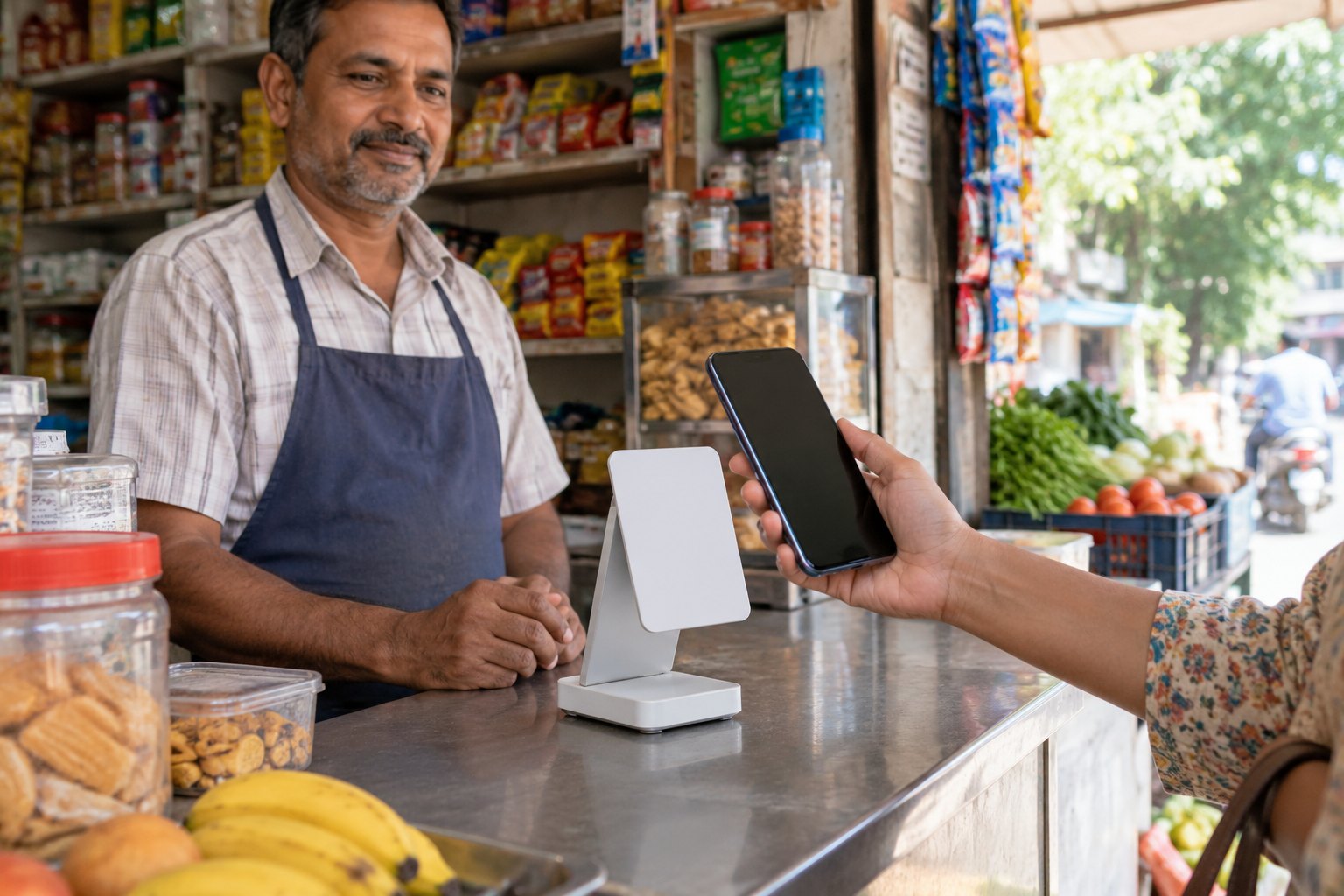
The merchant discount rate (MDR) is what a merchant pays its bank to accept a digital payment. Zero MDR on UPI dates from January 2020, under section 10A of the Payment and Settlement Systems Act, 2007. On 13 October 2026, NPCI said MDR on select UPI merchant payments would start immediately after Diwali, on a date to be notified.
Syllabus: GS3 · Indian Economy & Growth; Prelims · Economy & Social Development; GS2 · Government Policies
Why this matters for UPSC
GS III, Indian economy and digital payments, and GS II, government policies: Prelims can ask what MDR is, section 10A of the PSS Act, 2007 and NPCI's role; Mains, how to fund UPI without hurting small merchants.
In short
The merchant discount rate (MDR) is a merchant's fee to its bank for accepting digital payments; zero MDR on UPI since 2020 leaves open who funds its running costs.
MDR should fund UPI's upkeep without pushing small traders back to cash; a notified date and a working small-merchant fund must come first.
Why it matters
A clothes shop that takes a ₹3,000 UPI payment pays its bank nothing today. Under the announced framework it would pay ₹12, while a vegetable seller taking in less than ₹1 lakh a month, or anyone sending money to family, would still pay nothing, and buyers are not to be charged at all. The choice reaches beyond one fee. If UPI stays free, the banks and apps that run it depend on yearly Government payouts to keep it working and secure. If larger merchants pay, the money comes from business, but shopkeepers on thin margins may nudge customers back to cash. How India pays for UPI decides whether its main digital payment system stays free for the poor and sound for everyone.
Prelims pointers
- Section 10A, PSS Act, 2007 (Act 23 of 2019, in force 1 November 2019): no bank or system provider may charge a payer or payee using a protected mode.
- Rule 119AA, Income-tax Rules, 1962 (from 1 January 2020): RuPay debit card, BHIM-UPI and UPI QR code; made by CBDT Notification No. 105/2019.
- NPCI: a not-for-profit company under section 25 of the Companies Act, 1956 (now section 8 of the 2013 Act); it also runs NACH, NETC and e-RUPI.
- UPI: piloted in April 2016 with 21 member banks, opened to the public in August 2016; the BHIM app came in December 2016 (PIB factsheet, August 2026).
- Debit-card MDR: RBI allows up to 0.90% of transaction value; NPCI's ceiling for UPI P2M MDR stood at 0.30% (PIB, March 2025).
- Incentive scheme terms (FY 2024-25): 80% of admitted claims paid outright; 10% each tied to technical decline below 0.75% and system uptime above 99.5%.
- GST is levied on payment charges such as MDR, so a UPI payment carrying zero MDR attracts no GST (Finance Ministry, April 2025).
Practise a UPSC-style question
With reference to the merchant discount rate (MDR) on digital payments, consider the following statements:
1. The Reserve Bank of India allows an MDR of up to 0.90% of the transaction value on debit card payments.
2. MDR on a digital payment is a fee paid by the customer who makes the payment.
3. GST is levied on MDR, so a payment that carries zero MDR attracts no GST.
Which of the statements given above is/are correct?
- (a) 1 and 2 only
- (b) 2 and 3 only
- (c) 1 and 3 only
- (d) 1, 2 and 3
Show the answer
Answer: (c) 1 and 3 only
Answer: (c) 1 and 3 only. MDR is paid by the merchant, not the customer, so statement 2 is wrong.
Statement 1: correct. Per RBI, MDR of up to 0.90% of transaction value applies to debit cards across card networks.
Statement 2: incorrect. MDR is payable by the merchant to its bank; customers are not charged for UPI payments.
Statement 3: correct. GST is levied on charges such as MDR; with no MDR on UPI, no GST arises on those payments.
Eliminate: Judge statement 2 first: MDR is the merchant's cost of accepting a payment, so statement 2 is incorrect. Out: (a), (b), (d).
Trap: Reversed direction. The fee is moved from the merchant who receives the money to the customer who pays it.
Remember: MDR = merchant's fee to its bank; GST rides on MDR, so zero MDR means zero GST.
In the news
More Explainers
- State Legislative Councils: Articles 168-172 and the graduates' and teachers' seats Polity
- Whales and dolphins in Indian waters: legal protection, IUCN status and strandings Environment
- The Aligarh Movement, AMU and the Article 30 minority test Polity
- Environmental clearance by States: SEIAA, SEAC and the EIA Notification, 2006 Environment
- Software vulnerabilities: CVE, CVSS, coordinated disclosure and CERT-In's role Sci-Tech
- Drug trafficking law in India: NDPS Act, PIT-NDPS, NCB and NCORD National
- Choosing the UN Secretary-General: Article 97, UNSC veto and straw polls World & IR
- UN Convention against Torture, and why India has not ratified it Polity
- NavIC: why India's navigation constellation cannot give a standalone position Sci-Tech
- International Energy Agency: membership, 90-day oil stocks and India's status World & IR
- PM Surya Ghar: Muft Bijli Yojana and the rooftop solar subsidy Economy
- HFSS foods: FSSAI's draft limits and front-of-pack warning labels National