
UPI gets a 0.4% merchant fee above ₹2,000
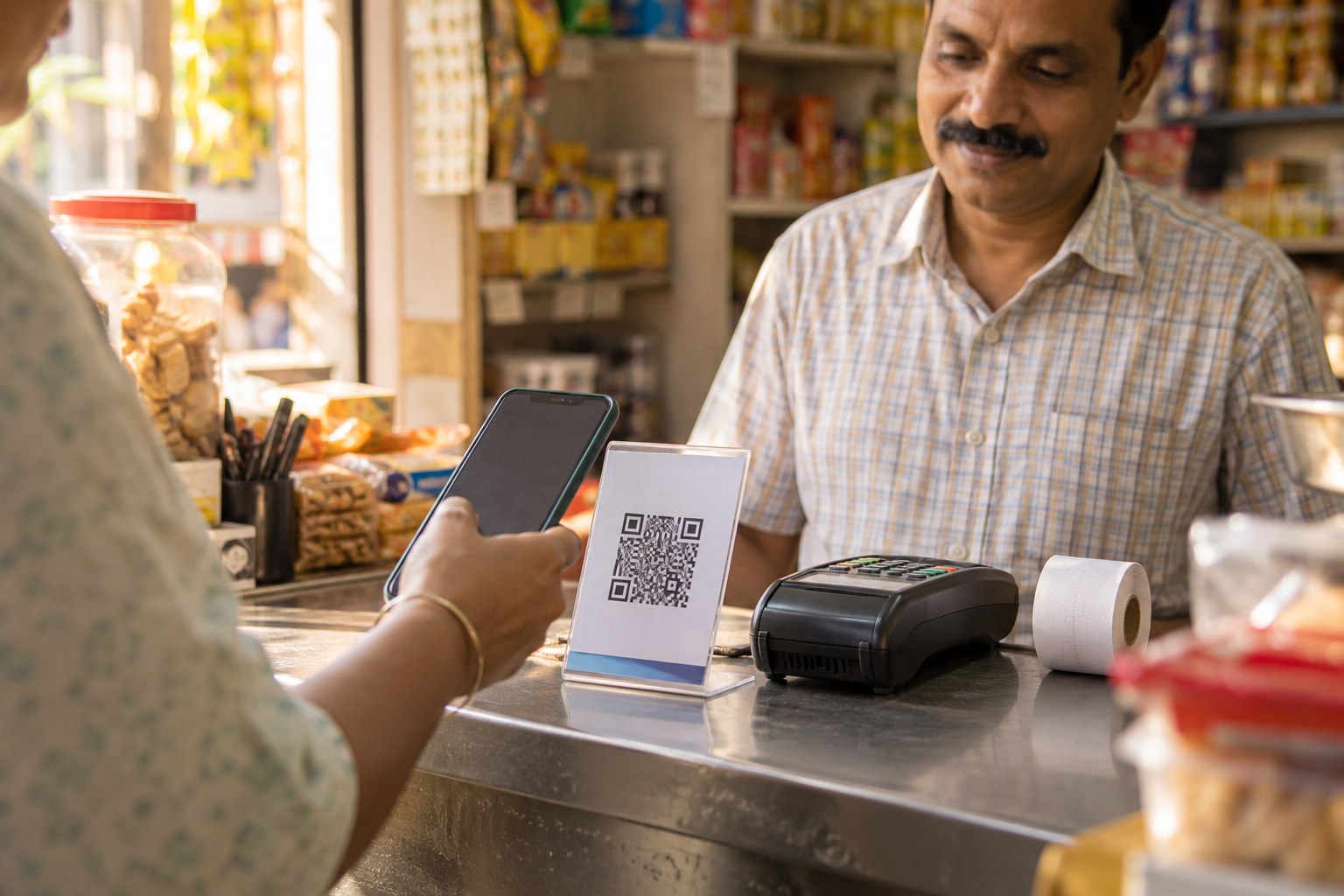
From 15 October, UPI payments above ₹2,000 to merchants will attract a 0.4% Merchant Discount Rate, capped at ₹300 for payments of ₹75,000 and above. Person-to-person transfers stay free. Payments above ₹2,000 were 4% of merchant transactions by volume but 67% by value in August, NPCI data show. MDR on UPI was cut to zero in January 2020.
Syllabus: GS3 · Indian Economy & Growth; Prelims · Economy & Social Development; GS2 · Executive & Judiciary
Why it matters
A large shop that takes a ₹3,000 payment through UPI will, from 15 October, pay ₹12 of it as a fee; on ₹50,000 the fee is ₹200. The money goes to the banks and apps that carry the payment. The buyer pays nothing extra: NPCI says merchants cannot pass the charge on, and UPI apps are barred from charging platform fees. A street vendor receiving up to ₹1 lakh a month through a UPI QR code pays nothing either. In recent years the Budget met part of the cost of free UPI. Larger merchant payments will now help pay for servers, fraud prevention and cybersecurity. NPCI expects merchants to absorb the fee; whether large retailers instead build it into prices remains to be seen.
Prelims pointers
- Merchant Discount Rate (MDR): the fee a merchant, not the customer, pays to the banks and payment companies that process a digital payment.
- Section 10A of the Payment and Settlement Systems Act, 2007: no bank or system provider may charge for payments made through the electronic modes the Centre specifies.
- Zero MDR on RuPay debit cards and BHIM-UPI began in January 2020 through Section 10A and Section 269SU of the Income-tax Act, 1961.
- National Payments Corporation of India (NPCI): a not-for-profit company, an initiative of the Reserve Bank of India and the Indian Banks' Association; it operates UPI and RuPay.
- UPI and Services Steering Committee: headed by NPCI; it decides the MDR's operational parameters, fee distribution and category caps.
- Incentive scheme for low-value BHIM-UPI transactions (P2M), 2024-25: 0.15% of the transaction value on payments up to ₹2,000 to small merchants; outlay ₹1,500 crore.
- Card MDRs, as NPCI states them: debit cards up to 0.90%; credit cards typically 1.5% to 2.5%.
- NPCI runs UPI under an authorisation from the Reserve Bank of India; UPI processed 2,451 crore transactions worth ₹29.9 lakh crore in August 2026.
Practise a UPSC-style question
With reference to the zero Merchant Discount Rate (MDR) regime brought in in January 2020, consider the following statements:
1. Before it, UPI person-to-merchant payments carried an MDR of up to 0.30%.
2. It was given effect through Section 10A of the Banking Regulation Act, 1949.
3. The zero-MDR regime covered transactions made through RuPay debit cards and BHIM-UPI.
Which of the statements given above is/are correct?
- (a) 1 and 2 only
- (b) 2 and 3 only
- (c) 1 and 3 only
- (d) 1, 2 and 3
Show the answer
Answer: (c) 1 and 3 only
1 is correct: UPI person-to-merchant payments could carry an MDR of up to 0.30% before January 2020. 2 is incorrect: zero MDR came through Section 10A of the Payment and Settlement Systems Act, 2007, read with Section 269SU of the Income-tax Act, 1961, not through the Banking Regulation Act, 1949. 3 is correct: MDR was made zero for RuPay debit card and BHIM-UPI transactions.
Explainers on this topic
More from the 18 September 2026 edition
- US Bill threatens up to 100% tariffs on buyers of Russian oil World & IR
- Report: a fifth of India's GDP rests on the Himalayas Environment
- Shaksgam Valley and the 1963 pact: India rejects China-Pakistan boundary commission World & IR
- EPFO wage ceiling raised to ₹25,000 after 12 years Economy
- Centre proposes Article 371K for Ladakh Polity