
The Ramsar Convention and India's wetlands
Why in news: On 15 October 2026 the Union Environment Minister announced Sukhna Wetland and Sauj Jheel as India's newest Ramsar sites, taking the national tally to 103.
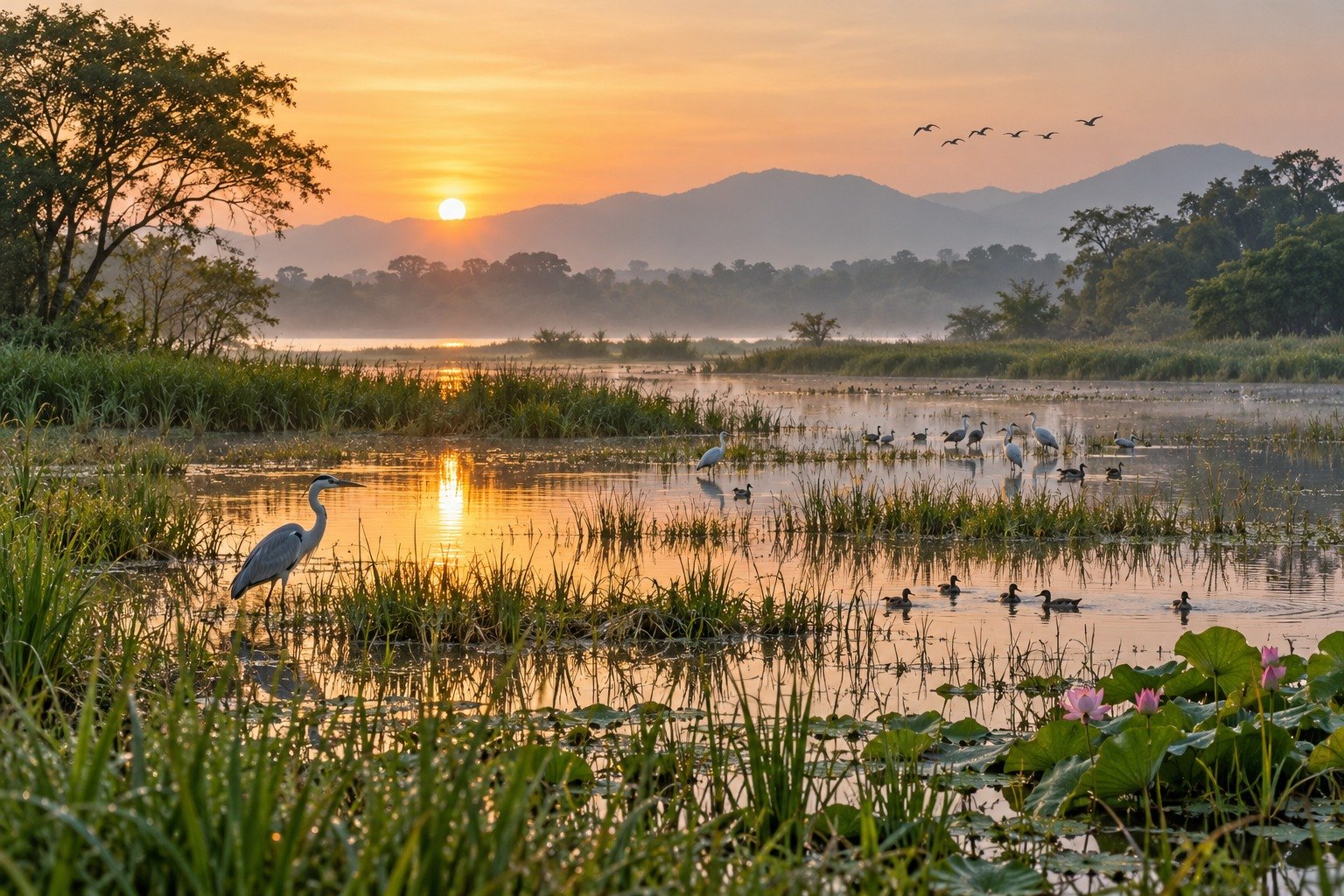
The Ramsar Convention, adopted in Iran in 1971 and in force for India since 1 February 1982, commits its Parties to list Wetlands of International Importance, use all wetlands wisely and cooperate across borders. On 15 October 2026 the Environment Minister announced Sukhna Wetland (Chandigarh) and Sauj Jheel (Uttar Pradesh) as new sites, taking India's tally to 103.
Syllabus: Prelims · Environment & Ecology; GS3 · Environment & Conservation; GS2 · Groupings & Agreements
Why this matters for UPSC
GS3 conservation and GS2 international agreements: Prelims asks the Ramsar Convention's depositary, nine criteria and Montreux Record, and the Wetlands (Conservation and Management) Rules, 2017; Mains asks why listed wetlands still degrade.
In short
The Ramsar Convention (1971) is an intergovernmental treaty for conserving and wisely using wetlands; India, a Party since 1982, applies it through the Wetlands Rules, 2017.
India's Ramsar count measures recognition, not health; the test is notified, funded, community-run management that keeps sites off the Montreux Record.
Why it matters
Wetlands feed and protect the people who live beside them: villagers who graze cattle and fish at Sauj Jheel, families in Manipur who draw irrigation and household water from Loktak Lake, and Chandigarh residents who walk and boat on Sukhna. When a wetland silts up, fills with weeds or is built over, water for homes and fields shrinks, fish and birds leave, and floodwater has nowhere to go. A Ramsar listing brings international attention and a duty to plan, but on its own it cannot stop overgrazing, dumping or encroachment; local enforcement and the users' own care decide whether a site survives. The wider question is how a crowded, growing country keeps land and water for nature when farms and towns want both.
Prelims pointers
- Ramsar Convention text: each Party lists at least one wetland on joining; listing leaves its sovereign rights intact; it may delete or shrink a site for urgent national interest.
- Nine criteria: Criterion 5, 20,000 or more waterbirds regularly; Criterion 6, 1% of a waterbird population; Criteria 7 and 8, fish; Criterion 9, 1% of a non-avian wetland-dependent animal.
- Montreux Record (Recommendation 4.8): Keoladeo National Park, added 1990, and Loktak Lake, added 1993, are India's entries; Chilika Lake, added 1993, was removed in 2002.
- World Wetlands Day, 2 February, marks the Convention's 1971 adoption; UN General Assembly Resolution 75/317 of 30 August 2021 made it an official UN day.
- Wetlands Rules, 2017, ban in covered wetlands: conversion to other uses, new or expanded industry, solid-waste dumping, untreated effluent, permanent construction near the flood line, and poaching.
- Wetlands Rules, 2017: the Central Government constitutes each State and UT Wetlands Authority; a State must notify a wetland within 240 days of the Authority's recommendation.
- National Plan for Conservation of Aquatic Ecosystems (NPCA): formed in February 2013 by merging the National Wetlands Conservation Programme and the National Lake Conservation Plan; costs shared with States.
- National Wetland Decadal Change Atlas (SAC-ISRO, Ahmedabad): 2,31,195 wetlands of 2.25 ha or more, 15.98 million ha, 4.86% of India's area in 2017-18; Gujarat has the largest wetland area.
Practise a UPSC-style question
With reference to the Ramsar Convention, consider the following statements:
1. The United Nations Environment Programme (UNEP) is the depositary of the Convention.
2. The Convention's Secretariat is based at the headquarters of the International Union for the Conservation of Nature (IUCN) in Gland, Switzerland.
3. Every Contracting Party must designate at least one wetland for the List of Wetlands of International Importance.
Which of the statements given above is/are correct?
- (a) 1 and 2 only
- (b) 2 and 3 only
- (c) 1 and 3 only
- (d) 1, 2 and 3
Show the answer
Answer: (b) 2 and 3 only
Answer: (b) 2 and 3 only. UNESCO, not UNEP, is the depositary, which rules out every option with statement 1.
Statement 1: incorrect. Instruments of ratification or accession are deposited with UNESCO's Director-General, so UNESCO is the depositary.
Statement 2: correct. The Secretariat runs the Convention's day-to-day work from IUCN's headquarters at Gland, Switzerland.
Statement 3: correct. The Convention obliges each Party to designate at least one wetland for the Ramsar List when it joins.
Eliminate: Judge statement 1 first: the depositary is UNESCO, so statement 1 is incorrect. Out: (a), (c), (d).
Trap: Swapped attribution. UNEP is the familiar UN environment body, but the treaty's instruments go to UNESCO.
Remember: Ramsar: UNESCO holds the treaty; IUCN at Gland hosts the Secretariat.
In the news
More Explainers
- State Legislative Councils: Articles 168-172 and the graduates' and teachers' seats Polity
- Whales and dolphins in Indian waters: legal protection, IUCN status and strandings Environment
- The Aligarh Movement, AMU and the Article 30 minority test Polity
- Environmental clearance by States: SEIAA, SEAC and the EIA Notification, 2006 Environment
- Software vulnerabilities: CVE, CVSS, coordinated disclosure and CERT-In's role Sci-Tech
- Drug trafficking law in India: NDPS Act, PIT-NDPS, NCB and NCORD National
- Choosing the UN Secretary-General: Article 97, UNSC veto and straw polls World & IR
- UN Convention against Torture, and why India has not ratified it Polity
- NavIC: why India's navigation constellation cannot give a standalone position Sci-Tech
- International Energy Agency: membership, 90-day oil stocks and India's status World & IR
- PM Surya Ghar: Muft Bijli Yojana and the rooftop solar subsidy Economy
- HFSS foods: FSSAI's draft limits and front-of-pack warning labels National