
India's Ramsar sites reach 103 with Sukhna Wetland and Sauj Jheel
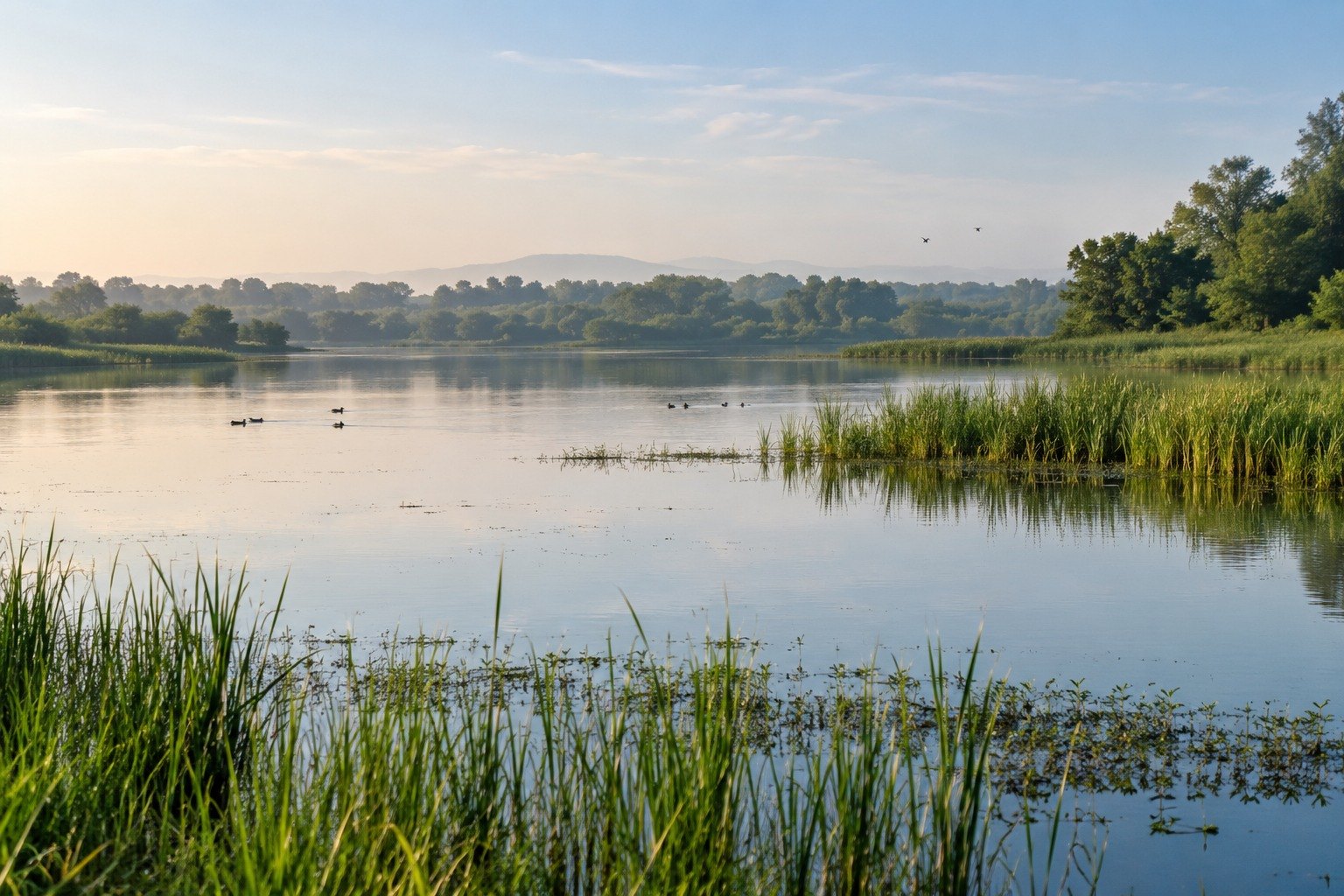
Union Environment Minister Bhupender Yadav announced on 15 October 2026 that India now has 103 Ramsar sites, after Sukhna Wetland in Chandigarh and Sauj Jheel in Uttar Pradesh were designated Wetlands of International Importance under the Ramsar Convention. He said the additions serve biodiversity conservation, water and climate security, and local livelihoods.
Syllabus: Prelims · Current Affairs & IR; Prelims · Environment & Ecology; GS3 · Environment & Conservation
Why this matters for UPSC
Ramsar sites are a GS3 conservation staple. Prelims can ask about the Ramsar Convention, the Montreux Record, the nine designation criteria and where Sukhna Wetland and Sauj Jheel lie; Mains, about wetland protection under the Wetlands (Conservation and Management) Rules, 2017.
Why it matters
A lake that holds monsoon rain, recharges wells and gives birds and fish a home serves the people around it every day. Once such a lake is a Ramsar site, the 2017 Rules apply to it: nobody may fill it for plots, put up a factory on it, dump garbage in it or build anything permanent within fifty metres of its high-flood line. For residents near Sukhna and Sauj, that can mean cleaner water and fewer floods, along with limits on building close to the shore. The minister's call to tourists shows the other side: visitors bring income, but also crowds and litter. The larger question is whether a listing is followed by money, a management plan and enforcement, since a label alone does not stop a wetland from shrinking.
Prelims pointers
- Ramsar Convention, Article 4.2: a party that, in its urgent national interest, deletes or shrinks a listed site should as far as possible compensate, for example by creating new reserves.
- World Wetlands Day, 2 February: fixed by UN General Assembly Resolution 75/317 of 30 August 2021.
- Designation criteria: nine in all; Criterion 5 is 20,000 or more waterbirds, Criterion 6 is 1% of a waterbird population, Criterion 9 is 1% of a non-avian wetland animal population.
- Indian sites placed on the Montreux Record: Keoladeo National Park in 1990, Loktak Lake and Chilika Lake in 1993, per the Ramsar Bureau's records.
- 2017 Rules' reach: Ramsar sites and notified wetlands, except those in areas under the Indian Forest Act, 1927, Wild Life (Protection) Act, 1972, other forest laws or CRZ Notification, 2011.
- Wetland under the 2017 Rules: includes marine water up to six metres deep at low tide; excludes river channels, paddy fields and tanks built for drinking water or irrigation.
- National Wetlands Committee: chaired by the Environment Ministry's Secretary; recommends Ramsar designations and monitors how the 2017 Rules are carried out.
- National Plan for Conservation of Aquatic Ecosystems: centrally sponsored; Centre-State cost shared 60:40, 90:10 for north-eastern States, and fully central for Union Territories.
Practise a UPSC-style question
With reference to the Ramsar Convention, consider the following statements:
1. The Convention on Wetlands was adopted in 1971 in Ramsar, an Iranian city on the coast of the Caspian Sea.
2. India became a Contracting Party to the Convention in 1975, the year the Convention came into force.
Which of the statements given above is/are correct?
- (a) 1 only
- (b) 2 only
- (c) Both 1 and 2
- (d) Neither 1 nor 2
Show the answer
Answer: (a) 1 only
Answer: (a) 1 only. The Convention was adopted at Ramsar in 1971, but India joined it only in 1982.
Statement 1: correct. The Convention on Wetlands was adopted on 2 February 1971 at Ramsar, an Iranian city on the Caspian Sea, which gives it its common name.
Statement 2: incorrect. The Convention came into force in 1975, but India became a Contracting Party on 1 February 1982, per the Environment Ministry.
Eliminate: Statement 2 is the surest call: India joined in 1982, seven years after the treaty came into force. Out: (b), (c).
Eliminate: Statement 1 holds, since the treaty is named after the Iranian city where it was adopted. Out: (d).
Trap: Near-miss figure. The statement pairs a real date, the treaty's entry into force in 1975, with India's joining, which came in 1982.
Remember: Ramsar: adopted 1971 in Iran, in force 1975, India a Contracting Party since 1 February 1982.
Explainers on this topic
- The Ramsar Convention and India's wetlands Environment
More from the 16 October 2026 edition
- Black Sea and the Turkish Straits: drone strikes hit merchant shipping World & IR
- India approves rollover of ₹30 billion currency swap for the Maldives World & IR
- Census Rules, 1990 amended to spell out who can be enumerators Polity
- Sports Ministry issues norms for revised National Sports Federations assistance scheme National
- Section 163 BNSS order and park closure curb Connaught Place assembly Polity
- India presses terrorism, connectivity norms at CICA's Baku summit World & IR
- ISRO: Aditya-L1 and Proba-3 coronagraphs jointly study coronal mass ejections Sci-Tech
- Centre cancels paraquat herbicide's registration; Madhya Pradesh orders stocks destroyed Environment
- UN DESA's World Social Report 2026 scores 168 countries on inclusive transformation World & IR
- AT-1 bonds: Supreme Court upholds quashing of Yes Bank write-down Economy
- CERT-In issues critical advisory on AI agents reaching Indian systems Sci-Tech
- UN report urges limits on neurotechnology and neural data in justice Sci-Tech