
The Middle Corridor: the Trans-Caspian route from China to Europe
Why in news: An Indian Express column of 27 October 2026 discussed India's reset with Azerbaijan after the External Affairs Minister's visit to Baku.
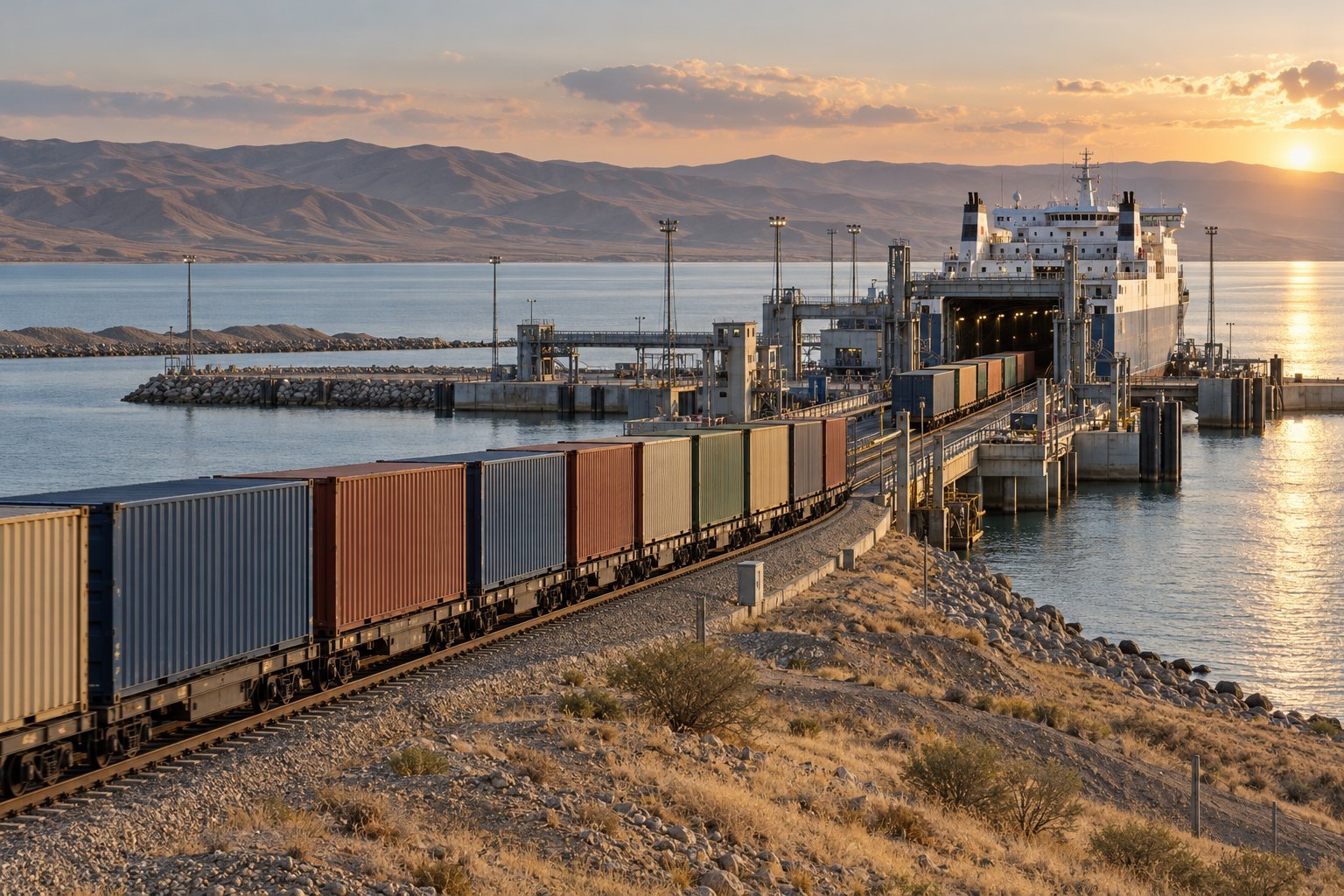
The Trans-Caspian International Transport Route (TITR), or Middle Corridor, carries cargo from China and Southeast Asia through Kazakhstan, across the Caspian Sea to Azerbaijan, then through Georgia to Europe. Its Caspian leg is a rail-ferry link joining rail and sea transport. Azerbaijan's role in Eurasian transport drew fresh attention after India's External Affairs Minister visited Baku in October 2026.
Syllabus: Prelims · Geography; GS3 · Infrastructure; GS2 · Groupings & Agreements
Why this matters for UPSC
GS2 international relations and GS1 world geography: Prelims can ask the Middle Corridor's route, members and Caspian ports; Mains, how the INSTC and Eurasian corridors serve India's interests.
In short
The Trans-Caspian International Transport Route, or Middle Corridor, is a rail-and-sea route carrying goods from China across Kazakhstan, the Caspian Sea, Azerbaijan and Georgia towards Europe.
India gains most by treating the two Caspian corridors as complements, joining INSTC ports to east-west links while protecting its energy assets in Azerbaijan.
Why it matters
For an Indian exporter, the Caspian is where two trade corridors cross. Goods on the INSTC head north to Russia, while the Middle Corridor carries China-Europe cargo east to west through Azerbaijan. Every sea leg means lifting containers off trains onto ships and back again, so the speed of Caspian ports decides how long a shipment takes and what it costs. For India the larger issue is access. Oil assets in Azerbaijan, transit through Iran and markets in Central Asia all depend on these routes working, so a Caspian state like Azerbaijan matters to India's continental diplomacy.
Prelims pointers
- The Ateshgah fire temple near Baku, dedicated to goddess Jvala Devi, bears inscriptions left by Indian merchants, per the MEA.
- Baku takes its name from Bagavan or Bhagavan, its name under Sassanian rule, per the MEA's brief.
- Astrakhan is a Russian Caspian port and Bandar-e-Anzali an Iranian one; both are INSTC transfer points.
- Shahid Beheshti Port at Chabahar in Iran has a deep draft of 16 m, per PIB.
Practise a UPSC-style question
With reference to the Trans-Caspian International Transport Route, consider the following statements:
1. It runs through Armenia after Azerbaijan before reaching Georgia.
2. It crosses the Caspian Sea between Kazakhstan and Azerbaijan.
3. Its coordination began with an agreement among the railways of Kazakhstan, Azerbaijan and Georgia.
Which of the statements given above is/are correct?
- (a) 1 and 2 only
- (b) 2 and 3 only
- (c) 1 and 3 only
- (d) 1, 2 and 3
Show the answer
Answer: (b) 2 and 3 only
Answer: (b) 2 and 3 only. The route goes from Azerbaijan straight into Georgia; Armenia is not on it.
Statement 1: incorrect. The TITR Association lists the route as Kazakhstan, the Caspian Sea, Azerbaijan, Georgia and on to Europe, with no Armenian leg.
Statement 2: correct. The route runs through Kazakhstan, across the Caspian Sea, to Azerbaijan; the ports of Aktau and Baku are members of its association.
Statement 3: correct. Kazakhstan Temir Zholy, Azerbaijan Railways and Georgian Railway signed the agreement at Astana in 2013.
Eliminate: statement 1 is false, so options holding it go. Out: (a), (c), (d).
Trap: Sounds right. Armenia sits in the South Caucasus beside Azerbaijan and Georgia, so a leg through it looks plausible, but the corridor does not use it.
Remember: Middle Corridor order: China, Kazakhstan, Caspian Sea, Azerbaijan, Georgia, then Turkiye and Europe.
More Explainers
- Crypto in Indian law: virtual digital assets, tax and PMLA cover Economy
- The collegium system for appointing and transferring higher court judges Polity
- Protected Area, Restricted Area and Inner Line Permits Polity
- Scheduled Tribe seats in Assemblies: Article 332 and Goa's 2025 Act Polity
- Ballot papers and EVMs: where India still votes on paper Polity
- Gelephu Mindfulness City: Bhutan's special zone on the Assam border World & IR
- Nuclear fusion, the tokamak and India's role in ITER Sci-Tech
- Gilgit-Baltistan, CPEC and India's sovereignty objection World & IR
- India-Nepal electricity trade: how Nepal sells power to India World & IR
- Infant mortality and child malnutrition among Scheduled Tribes National
- Genocide Convention, 1948: the legal test and who can judge it World & IR
- Chola bronzes: lost-wax casting and Nataraja iconography National