
Sickle cell disease and the National Sickle Cell Anaemia Elimination Mission
Why in news: IIT Bombay's low-cost blood-smear device for screening sickle cell disease and anaemia, reported on 26 October 2026, has not yet won regulatory approval.
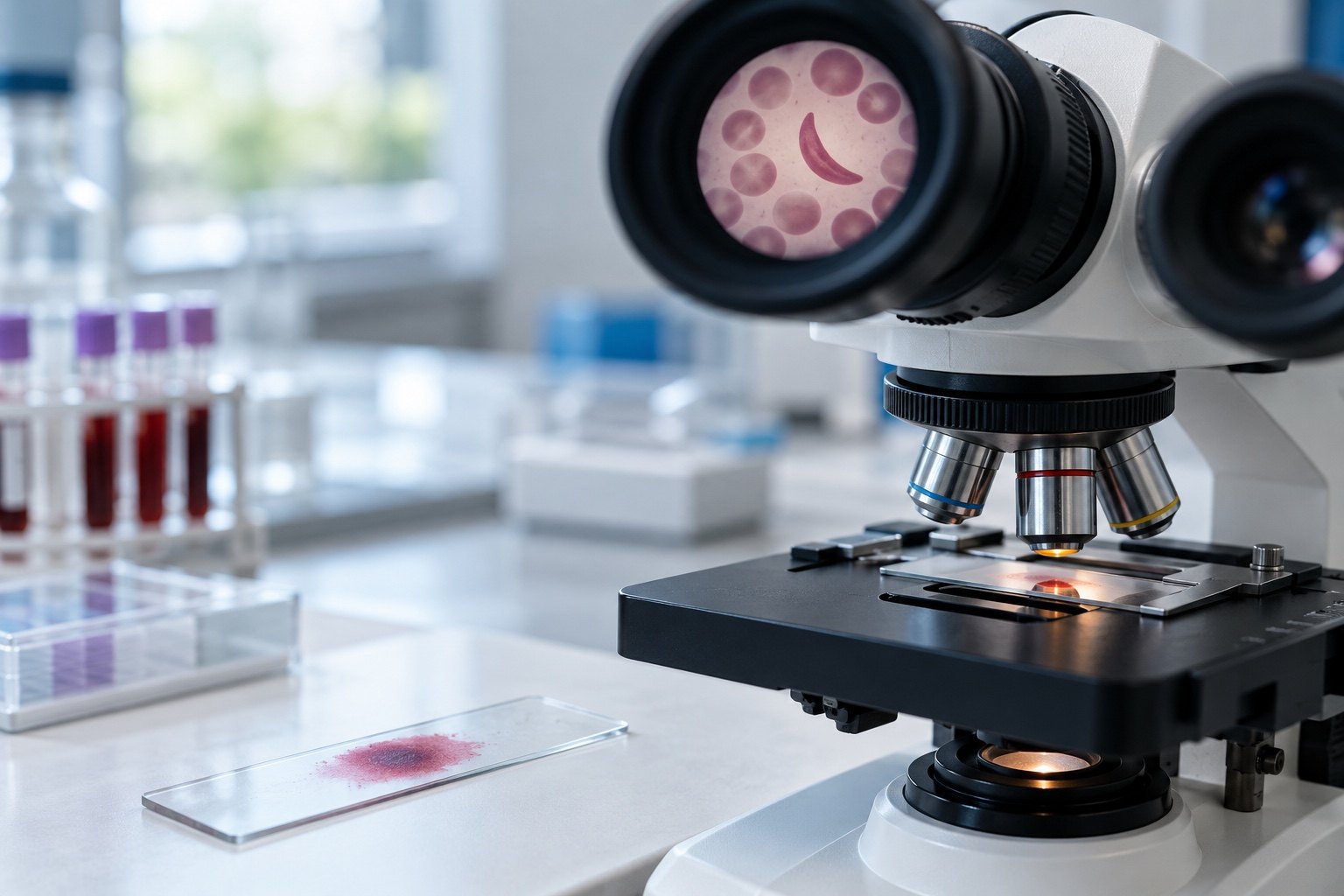
Sickle cell disease is an inherited blood disorder: a mutation in the HBB gene makes sickle haemoglobin (HbS), turning red blood cells rigid and sickle-shaped. The National Sickle Cell Anaemia Elimination Mission, launched on 1 July 2023, aims to eliminate it by 2047. IIT Bombay researchers have developed a low-cost blood-smear device to screen for it.
Syllabus: Prelims · Science & Technology; GS2 · Welfare of Vulnerable Sections; GS3 · Indian Achievements in S&T
Why this matters for UPSC
GS II (health and the welfare of Scheduled Tribes) and GS III (biotechnology): Prelims can ask how sickle cell disease is inherited, the mission's design and BIRSA 101; Mains, about tribal health and genetic counselling.
In short
Sickle cell disease is an inherited, autosomal recessive haemoglobin disorder; India's National Sickle Cell Anaemia Elimination Mission (2023) seeks to end it as a public health problem by 2047.
Screening at scale is in place; eliminating sickle cell disease by 2047 now depends on counselling without stigma and steady care in tribal areas.
Why it matters
A tribal family in central India can lose a child to infections or a stroke without knowing why, because carriers look healthy. Screening tells each young person whether they carry the gene, and the card lets two carriers learn before marriage or pregnancy that each child is at risk. Early diagnosis brings cheap protection: vaccines, folic acid and hydroxyurea mean fewer crises and hospital stays. The larger issue is fairness in health care. The burden falls on communities far from laboratories and specialists, so care depends on village health centres, trained health workers and medicines kept in stock close to home.
Prelims pointers
- The HBB gene carries the code for the beta-globin chain; normal adult haemoglobin (HbA) has two alpha-globin and two beta-globin subunits.
- When both parents have sickle cell trait, each child has a 25% chance of disease, 50% of being a carrier and 25% of normal haemoglobin.
- WHO lists bone marrow transplant and gene therapy as curative options, and routine vaccines and folic acid as preventive care for sickle cell disease.
- The Schedule of the RPwD Act, 2016 lists three blood disorders as specified disabilities: haemophilia, thalassemia and sickle cell disease.
- World Sickle Cell Day is observed every year on 19 June.
- ICMR runs the National Institute for Research in Tribal Health at Jabalpur, Madhya Pradesh, and a haemoglobinopathies research centre at Chandrapur, Maharashtra.
- HbS beta thalassemia arises when a child inherits one sickle gene from one parent and one beta-thalassemia gene from the other; it is usually severe.
Practise a UPSC-style question
With reference to sickle cell disease, consider the following statements:
1. It is caused by a mutation in the HBB gene, which codes for the beta-globin chain of haemoglobin.
2. A person who inherits one sickle haemoglobin gene and one normal gene has sickle cell disease.
3. It is inherited in an autosomal recessive manner.
Which of the statements given above is/are correct?
- (a) 1 and 2 only
- (b) 2 and 3 only
- (c) 1 and 3 only
- (d) 1, 2 and 3
Show the answer
Answer: (c) 1 and 3 only
Answer: (c) 1 and 3 only. The disease needs two faulty copies of the HBB gene; one copy makes a carrier.
Statement 1: correct. A point mutation in the HBB (beta-globin) gene swaps valine for glutamic acid and produces sickle haemoglobin (HbS), per WHO and the NHM manual.
Statement 2: incorrect. One HbS gene with one normal gene gives sickle cell trait, a usually symptom-free carrier state; the disease needs two HbS genes (HbSS).
Statement 3: correct. The mission's guidelines describe sickle cell disease as a monogenic disorder with autosomal recessive inheritance.
Eliminate: Statement 2 is the surest: a single HbS gene makes a carrier, not a patient. Out: (a), (b), (d).
Trap: Look-alike names. Sickle cell trait and sickle cell disease sound alike; the question passes off the carrier state as the disease.
Remember: One HbS gene is trait (carrier); two HbS genes (HbSS) is disease.
More Explainers
- Crypto in Indian law: virtual digital assets, tax and PMLA cover Economy
- The collegium system for appointing and transferring higher court judges Polity
- Protected Area, Restricted Area and Inner Line Permits Polity
- Scheduled Tribe seats in Assemblies: Article 332 and Goa's 2025 Act Polity
- Ballot papers and EVMs: where India still votes on paper Polity
- Gelephu Mindfulness City: Bhutan's special zone on the Assam border World & IR
- Nuclear fusion, the tokamak and India's role in ITER Sci-Tech
- Gilgit-Baltistan, CPEC and India's sovereignty objection World & IR
- India-Nepal electricity trade: how Nepal sells power to India World & IR
- Infant mortality and child malnutrition among Scheduled Tribes National
- Genocide Convention, 1948: the legal test and who can judge it World & IR
- Chola bronzes: lost-wax casting and Nataraja iconography National