
PM-KUSUM: solar pumps and farm solar plants, explained
Why in news: On 21 October 2026, the New and Renewable Energy Minister restated that PM-KUSUM's next phase is to carry agrivoltaics; it is not yet approved.
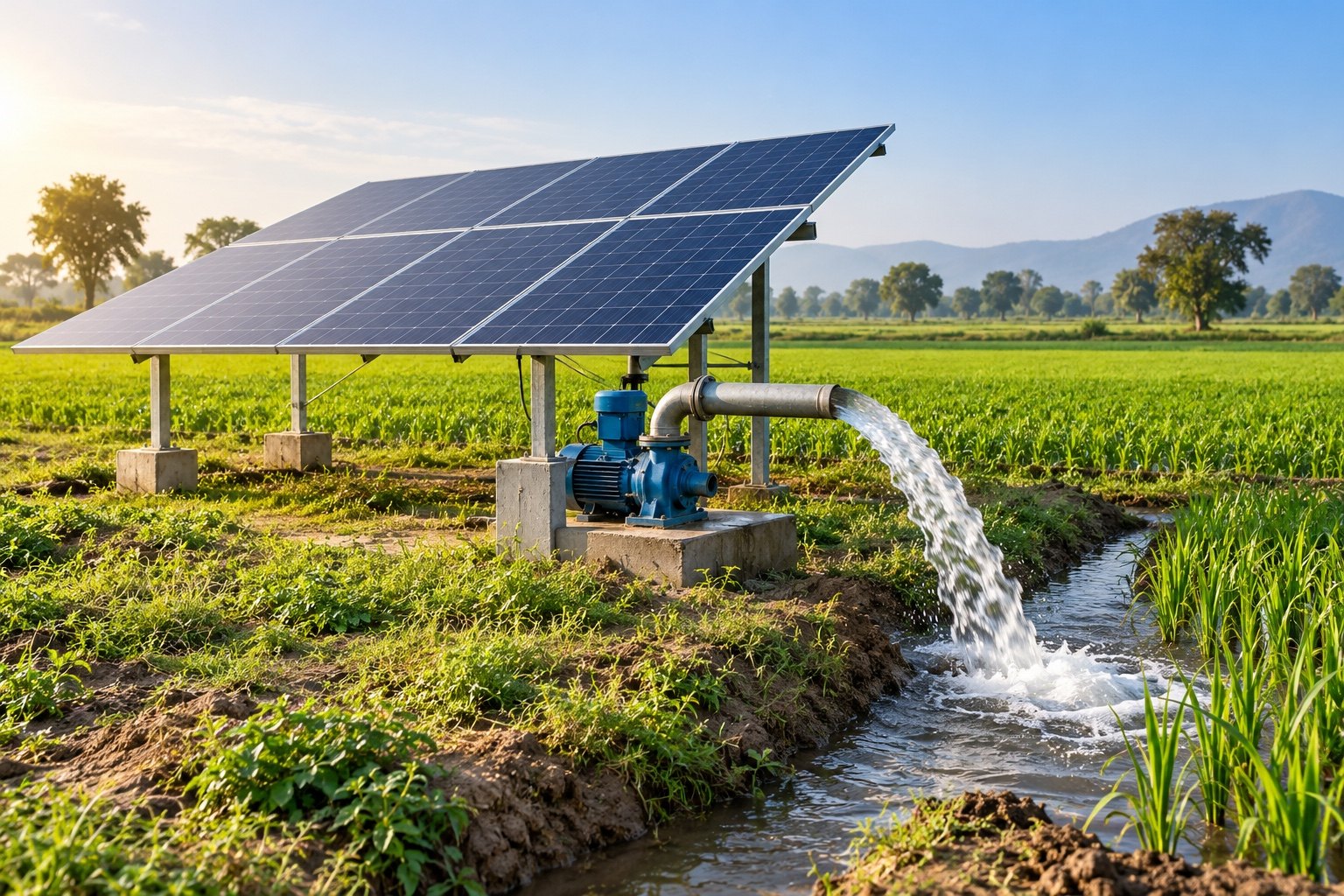
PM-KUSUM, the Ministry of New and Renewable Energy's farm solar scheme launched in February 2019, has three components: small solar plants on farmers' land, standalone solar pumps and solarisation of grid-connected pumps. It runs till 31 March 2027. On 21 October 2026, the government restated that its next phase is to carry agrivoltaics, a plan not yet approved.
Syllabus: GS3 · Agriculture & Irrigation; GS3 · MSP, Subsidies & Food Security; GS3 · Infrastructure
Why this matters for UPSC
PM-KUSUM is a GS3 topic on energy infrastructure, irrigation and farm subsidies. Prelims asks its ministry, three components, assistance shares and who buys the power; Mains, solar pumps, discom finances and why States' uptake differs.
In short
PM-KUSUM, the Ministry of New and Renewable Energy's scheme of 2019, puts solar power into farming through plants on farmers' land, off-grid solar pumps and solarised grid pumps.
PM-KUSUM's pumps have outrun its farm plants; the next phase should fix land, finance and State gaps before adding a costlier agrivoltaics layer.
Why it matters
A farmer who irrigates with a diesel pump pays for fuel every hour it runs; a solar pump removes that cost, and a solarised grid pump can earn money from spare power. Daytime solar supply also spares farmers from watering fields at night. For a State, running farm feeders on solar power can shrink the electricity subsidy it pays every year. The catch is money and land: where a State is slow with its share or farmers cannot get cheap loans, few pumps or plants get built. The larger question is how India weans farming off diesel and grid subsidies without leaving small and marginal farmers behind.
Prelims pointers
- Nodal ministry: the Ministry of New and Renewable Energy; capacity goes to States on demand and performance, with no fixed State-wise targets, and funds follow milestones.
- Component A: plants of up to 2 MW on barren, fallow, pasture, marshy or cultivable land; on cultivated fields, panels stand high enough for crops beneath.
- Pump assistance: 30% of benchmark or tender cost, whichever is lower; 50% in North-Eastern States, Sikkim, Jammu and Kashmir, Ladakh, Himachal Pradesh, Uttarakhand, Lakshadweep and Andaman and Nicobar Islands.
- State share: at least 30% by design, but Component B and individual pump solarisation may proceed without it, the farmer then bearing 70%.
- Feeder solarisation support: Rs 1.05 crore per MW from the Centre, with no mandatory contribution from the State or Union Territory.
- Discom incentive: 40 paise per kWh or Rs 6.60 lakh per MW a year, whichever is lower, for five years; Rs 33 lakh per MW in all.
- Electricity Act, 2003: section 82 constitutes each State Electricity Regulatory Commission; section 86 empowers it to fix tariffs and set a renewable purchase share for discoms.
- State farm solar schemes: Mukhyamantri Saur Krushi Vahini Yojana 2.0 (Maharashtra), Kisan Suryoday Yojana (Gujarat) and Surya Raitha Scheme (Karnataka).
Practise a UPSC-style question
With reference to the components of PM-KUSUM, consider the following statements:
1. Component A supports decentralised solar power plants of up to 2 MW on farmers' land.
2. Component B supports the solarisation of existing grid-connected agricultural pumps.
3. Component C can be implemented by solarising a whole agricultural feeder instead of individual pumps.
Which of the statements given above is/are correct?
- (a) 1 and 2 only
- (b) 2 and 3 only
- (c) 1 and 3 only
- (d) 1, 2 and 3
Show the answer
Answer: (c) 1 and 3 only
Answer: (c) 1 and 3 only. Grid-connected pumps fall under Component C; Component B is for standalone pumps.
Statement 1: correct. Component A funds decentralised ground- or stilt-mounted solar plants of up to 2 MW on farmers' barren, fallow, pasture, marshy or cultivable land.
Statement 2: incorrect. Component B installs standalone solar pumps in off-grid areas; solarising existing grid-connected pumps is Component C.
Statement 3: correct. Component C works through individual pump solarisation or feeder-level solarisation, which runs a whole agricultural feeder on a solar plant.
Eliminate: Judge statement 2 first: grid-connected pumps belong to Component C, so statement 2 is incorrect. Out: (a), (b), (d).
Trap: Swapped attribution. The work of Component C is pinned on Component B; the swap reads naturally because both components deal with farm pumps.
Remember: A = farm solar plants up to 2 MW; B = off-grid standalone pumps; C = grid pumps, singly or by feeder.
More Explainers
- Crypto in Indian law: virtual digital assets, tax and PMLA cover Economy
- The collegium system for appointing and transferring higher court judges Polity
- Protected Area, Restricted Area and Inner Line Permits Polity
- Scheduled Tribe seats in Assemblies: Article 332 and Goa's 2025 Act Polity
- Ballot papers and EVMs: where India still votes on paper Polity
- Gelephu Mindfulness City: Bhutan's special zone on the Assam border World & IR
- Nuclear fusion, the tokamak and India's role in ITER Sci-Tech
- Gilgit-Baltistan, CPEC and India's sovereignty objection World & IR
- India-Nepal electricity trade: how Nepal sells power to India World & IR
- Infant mortality and child malnutrition among Scheduled Tribes National
- Genocide Convention, 1948: the legal test and who can judge it World & IR
- Chola bronzes: lost-wax casting and Nataraja iconography National