
Paddy stubble burning: the CRM scheme, CAQM and residue management
Why in news: On 13 October 2026, the Union Agriculture and Environment Ministers jointly reviewed States' stubble management for the ongoing paddy harvest.
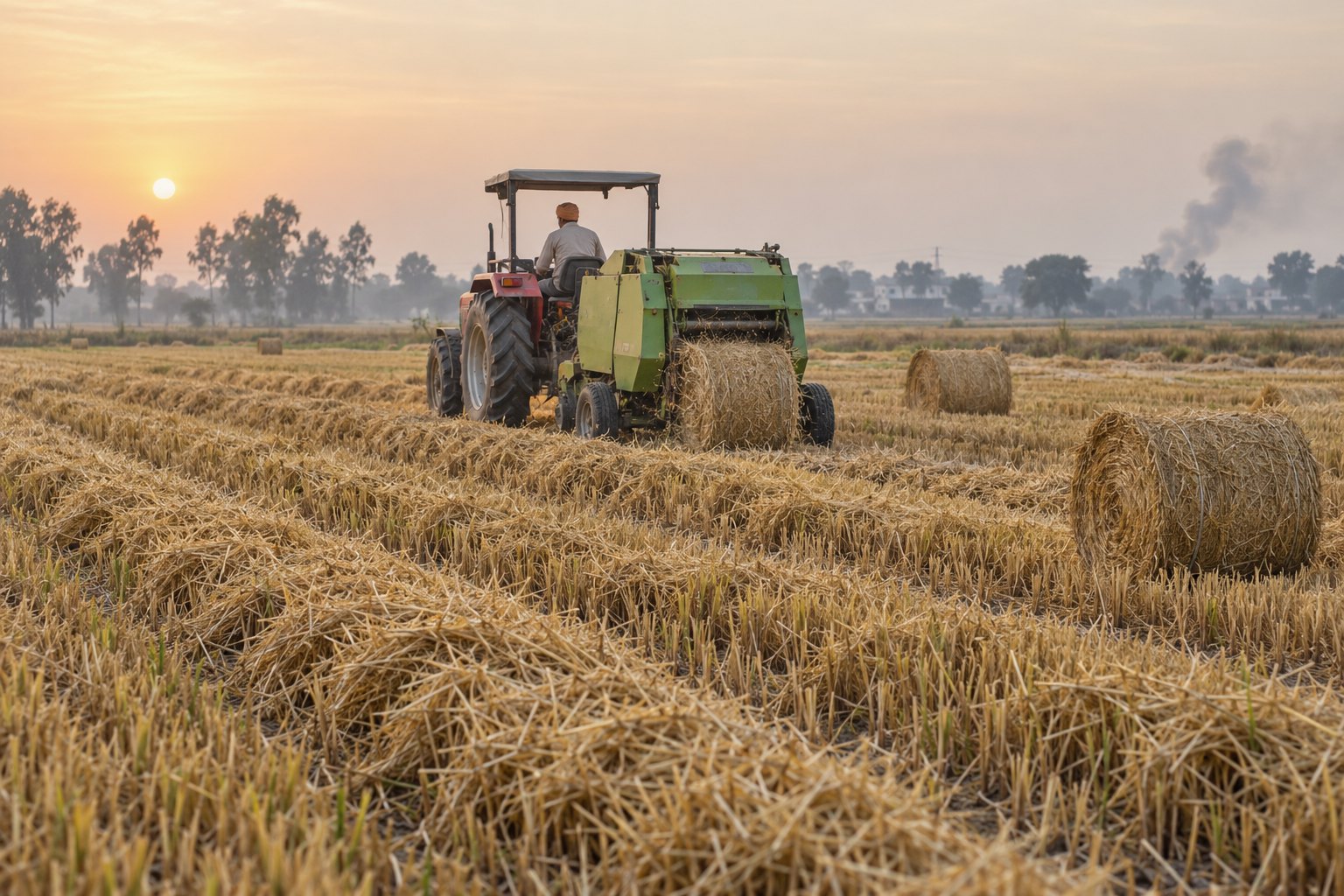
Paddy stubble burning is the setting alight of crop residue to clear fields quickly for rabi sowing in Punjab, Haryana and Uttar Pradesh. The Agriculture Ministry's Central Sector Scheme on Crop Residue Management subsidises straw machines, and the Commission for Air Quality Management issues binding directions. On 13 October 2026, the Union Agriculture and Environment Ministers reviewed States' preparedness.
Syllabus: GS3 · Agriculture & Irrigation; Prelims · Environment & Ecology; GS3 · Environment & Conservation
Why this matters for UPSC
GS3 (environmental pollution; agriculture): Prelims can ask the Crop Residue Management scheme's ministry and subsidy rates, in-situ versus ex-situ machines, CAQM's statutory basis and the 2023 co-firing Rules; Mains, why stubble burning persists.
In short
Paddy stubble burning is the firing of straw left after harvest in Punjab, Haryana and Uttar Pradesh: a cheap private shortcut with a public cost.
Enforcement deters, but burning ends only when not burning pays: working machines, earlier-maturing paddy and assured buyers must make straw an asset.
Why it matters
A paddy farmer in Sangrur or Kaithal has a few weeks to clear straw before sowing the next crop. A match costs nothing; a Happy Seeder or a baler costs money and must be available on the right day. That is why the subsidy, the Custom Hiring Centre and rent-free machines for small farmers matter more than bans. When fields burn, smoke adds to the winter haze over Delhi NCR, affecting people who never lit a fire, and the soil loses nutrients and organisms. Turning straw into a product, through power plant pellets, compressed biogas or fodder, gives the farmer a reason not to burn. The larger issue is how to change a cheap, rational private choice that imposes a public cost.
Prelims pointers
- Crop Residue Management scheme: a Central Sector Scheme, fully funded by the Centre; Ministry of Agriculture and Farmers Welfare; launched in 2018-19.
- In-situ machines: Super Straw Management System, Happy Seeder, Super Seeder, Smart Seeder, Surface Seeder, Zero Till Seed cum Fertilizer Drill.
- Ex-situ equipment: balers and straw rakes collect straw for biomass power, biofuel, pellets and fodder.
- CHC beneficiaries (80%): rural entrepreneurs, farmer cooperatives, DAY-NRLM Cluster Level Federations and SHGs, FPOs and Panchayats.
- CAQM: statutory body under the CAQM Act, 2021, for NCR and adjoining areas; it issues statutory directions to the States on stubble burning.
- CREAMS Laboratory: Division of Agricultural Physics, ICAR-Indian Agricultural Research Institute, New Delhi; publishes daily fire event data.
- CAQM co-firing direction: coal-based thermal power plants within 300 km of Delhi co-fire 5-10% biomass pellets or briquettes.
- Pradhan Mantri JI-VAN Yojana: Ministry of Petroleum and Natural Gas; supports advanced bio-ethanol projects using lignocellulosic biomass such as crop residue.
Practise a UPSC-style question
With reference to the Central Sector Scheme on Crop Residue Management, consider the following statements:
1. Individual farmers receive financial assistance of 80% of the cost of crop residue management machinery.
2. It has been implemented by the Ministry of Agriculture and Farmers Welfare since 2018-19.
3. Panchayats and Farmer Producer Organizations can receive 80% assistance to set up Custom Hiring Centres.
Which of the statements given above is/are correct?
- (a) 1 and 2 only
- (b) 2 and 3 only
- (c) 1 and 3 only
- (d) 1, 2 and 3
Show the answer
Answer: (b) 2 and 3 only
1 is incorrect: individual farmers get 50% of the machine cost; 80% is for Custom Hiring Centres. 2 is correct: the Ministry of Agriculture and Farmers Welfare has run the scheme since 2018-19. 3 is correct: Panchayats, FPOs, cooperatives, rural entrepreneurs and SHG federations get 80% for Custom Hiring Centres.
In the news
More Explainers
- State Legislative Councils: Articles 168-172 and the graduates' and teachers' seats Polity
- Whales and dolphins in Indian waters: legal protection, IUCN status and strandings Environment
- The Aligarh Movement, AMU and the Article 30 minority test Polity
- Environmental clearance by States: SEIAA, SEAC and the EIA Notification, 2006 Environment
- Software vulnerabilities: CVE, CVSS, coordinated disclosure and CERT-In's role Sci-Tech
- Drug trafficking law in India: NDPS Act, PIT-NDPS, NCB and NCORD National
- Choosing the UN Secretary-General: Article 97, UNSC veto and straw polls World & IR
- UN Convention against Torture, and why India has not ratified it Polity
- NavIC: why India's navigation constellation cannot give a standalone position Sci-Tech
- International Energy Agency: membership, 90-day oil stocks and India's status World & IR
- PM Surya Ghar: Muft Bijli Yojana and the rooftop solar subsidy Economy
- HFSS foods: FSSAI's draft limits and front-of-pack warning labels National