
Mumbai-Ahmedabad High Speed Rail: Shinkansen, JICA loan and the delay
Why in news: A press report of 24 October 2026 traced why the corridor, first due by 2022, may open its first section only by December 2027.
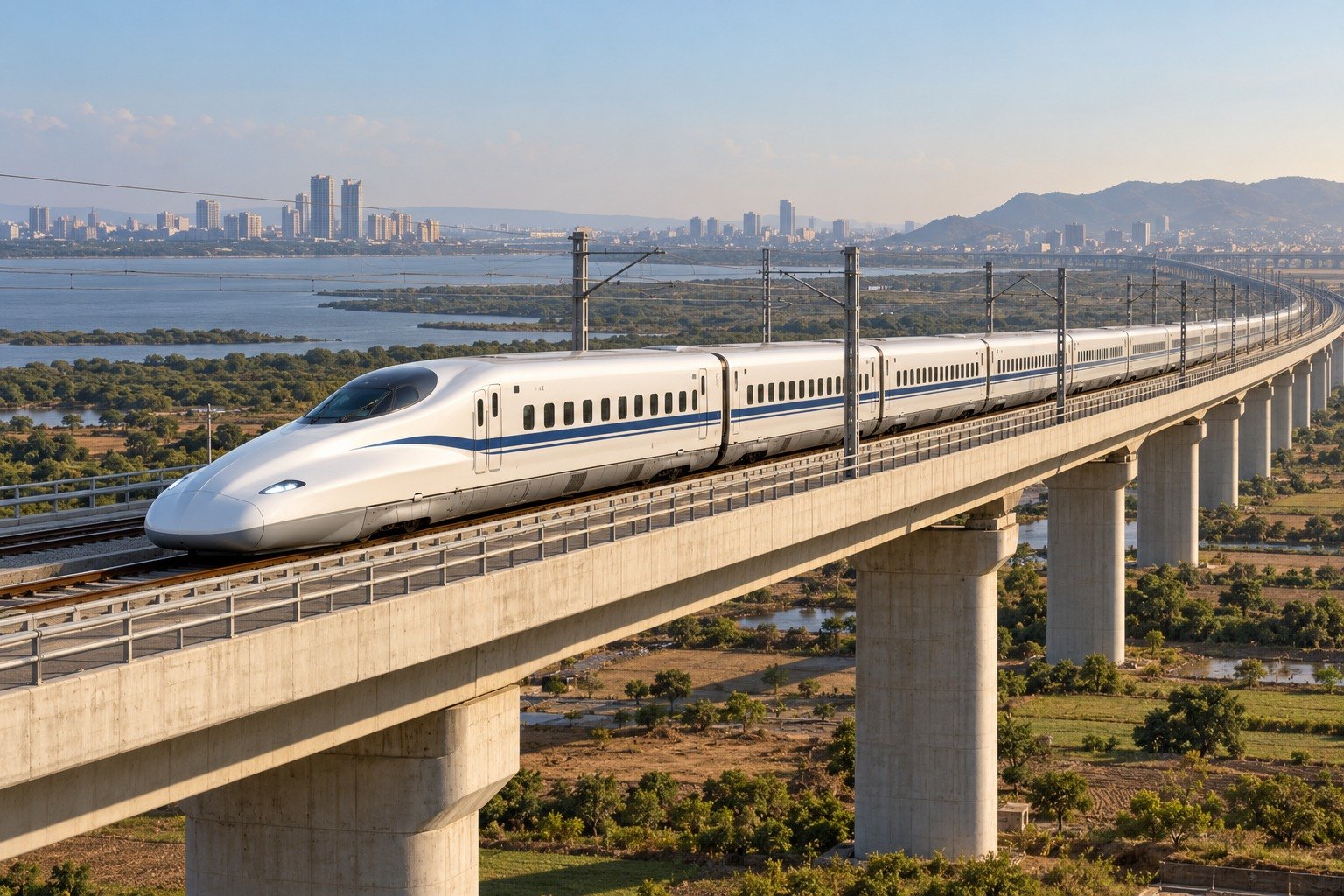
The Mumbai-Ahmedabad High Speed Rail (MAHSR) is India's first bullet train corridor, 508 km long with 12 stations. The National High-Speed Rail Corporation Limited (NHSRCL) is building it on Japan's Shinkansen system. A JICA loan meets about 81% of the cost. Its first section is officially due in August 2027; press reports now expect December 2027.
Syllabus: GS3 · Infrastructure; GS3 · Investment Models; GS3 · Indian Achievements in S&T
Why this matters for UPSC
GS III infrastructure and GS II India-Japan relations: Prelims can ask about the Shinkansen system, JICA's loan terms, the Thane Creek tunnel and NHSRCL's owners; Mains, about cost overruns, land acquisition and indigenisation of technology.
In short
The Mumbai-Ahmedabad High Speed Rail is India's first bullet train corridor, built with Shinkansen technology and JICA finance; press reports call it a Japanese-European-Indian hybrid.
MAHSR's value now lies less in the 2022 promise than in proving that a mixed system runs safely and seeds India's own high-speed industry.
Why it matters
For a traveller, a Mumbai-Ahmedabad trip of 8 to 9 hours by road could fall to under two hours. That can pull business, jobs and investment towards towns on the line such as Vapi, Bharuch and Anand, several of which have no airport. For the Railways, the corridor is a training ground: the skills, factories and standards built here are meant to be reused on seven more corridors. The delay matters because each year of slippage adds cost that the Indian government must meet. The choice of trains and signals decides whether India gains its own high-speed industry or stays tied to one supplier.
Prelims pointers
- For operational purposes, high-speed rail means trains running above 250 km/h; Vande Bharat's design speed is about 180 km/h, per PIB.
- Under the 2015 Memorandum, import tax, land acquisition cost and administration cost are excluded from the portion eligible for the Japanese yen loan.
- New Austrian Tunnelling Method suits variable, fragile rock in mountains; tunnel boring machines suit dense urban, geologically complex ground, per PIB.
- MAHSR passes through the Thane Creek Flamingo Sanctuary and the buffer zones of Sanjay Gandhi National Park and Tungareshwar Wildlife Sanctuary, all in Maharashtra.
- Seven corridors announced in Union Budget 2026-27 (PIB list): Delhi-Varanasi, Varanasi-Patna-Siliguri, Chennai-Bengaluru, Bengaluru-Hyderabad, Chennai-Hyderabad, Mumbai-Pune, Pune-Hyderabad.
- Integral Coach Factory with Bharat Earth Movers Limited (BEML) is designing indigenous high-speed trainsets with a design speed of 280 km/h.
- Shinkansen has run in Japan since 1964; PIB says it runs E5 trains now and that the E10 is the next generation.
Practise a UPSC-style question
With reference to the Mumbai-Ahmedabad High Speed Rail, consider the following statements:
1. The indicated interest rate on the Japanese yen loan under the 2015 Memorandum of Cooperation is 1.5% per annum.
2. The Centre holds 50% of NHSRCL's equity, and Maharashtra and Gujarat hold 25% each.
3. A JICA loan funds about 81% of the project's total cost.
Which of the statements given above is/are correct?
- (a) 1 and 2 only
- (b) 2 and 3 only
- (c) 1 and 3 only
- (d) 1, 2 and 3
Show the answer
Answer: (b) 2 and 3 only
Answer: (b) 2 and 3 only. The loan rate is 0.1%, not 1.5%; the equity split and the 81% share are right.
Statement 1: incorrect. The 12 December 2015 India-Japan Memorandum of Cooperation indicates 0.1% interest a year, with 50 years to repay and a 15-year grace period.
Statement 2: correct. NHSRCL's equity is held 50% by the Government of India through the Ministry of Railways and 25% each by Maharashtra and Gujarat.
Statement 3: correct. NHSRCL says about 81% of the cost will be funded by the Government of Japan through JICA's ODA loan.
Eliminate: statement 1 is wrong because the rate is 0.1%. Out: (a), (c), (d).
Trap: Near-miss figure. A plausible commercial-looking rate replaces the near-zero rate that makes the loan concessional.
Remember: JICA's MAHSR loan: 0.1% interest, 50 years, 15-year grace, about 81% of cost.
More Explainers
- Crypto in Indian law: virtual digital assets, tax and PMLA cover Economy
- The collegium system for appointing and transferring higher court judges Polity
- Protected Area, Restricted Area and Inner Line Permits Polity
- Scheduled Tribe seats in Assemblies: Article 332 and Goa's 2025 Act Polity
- Ballot papers and EVMs: where India still votes on paper Polity
- Gelephu Mindfulness City: Bhutan's special zone on the Assam border World & IR
- Nuclear fusion, the tokamak and India's role in ITER Sci-Tech
- Gilgit-Baltistan, CPEC and India's sovereignty objection World & IR
- India-Nepal electricity trade: how Nepal sells power to India World & IR
- Infant mortality and child malnutrition among Scheduled Tribes National
- Genocide Convention, 1948: the legal test and who can judge it World & IR
- Chola bronzes: lost-wax casting and Nataraja iconography National