
Minimum Support Price: how CACP, CCEA and procurement set farm prices
Why in news: On 29 October 2026, PIB explained the Rabi MSPs for marketing season 2027-28, which the CCEA approved on 30 September 2026.
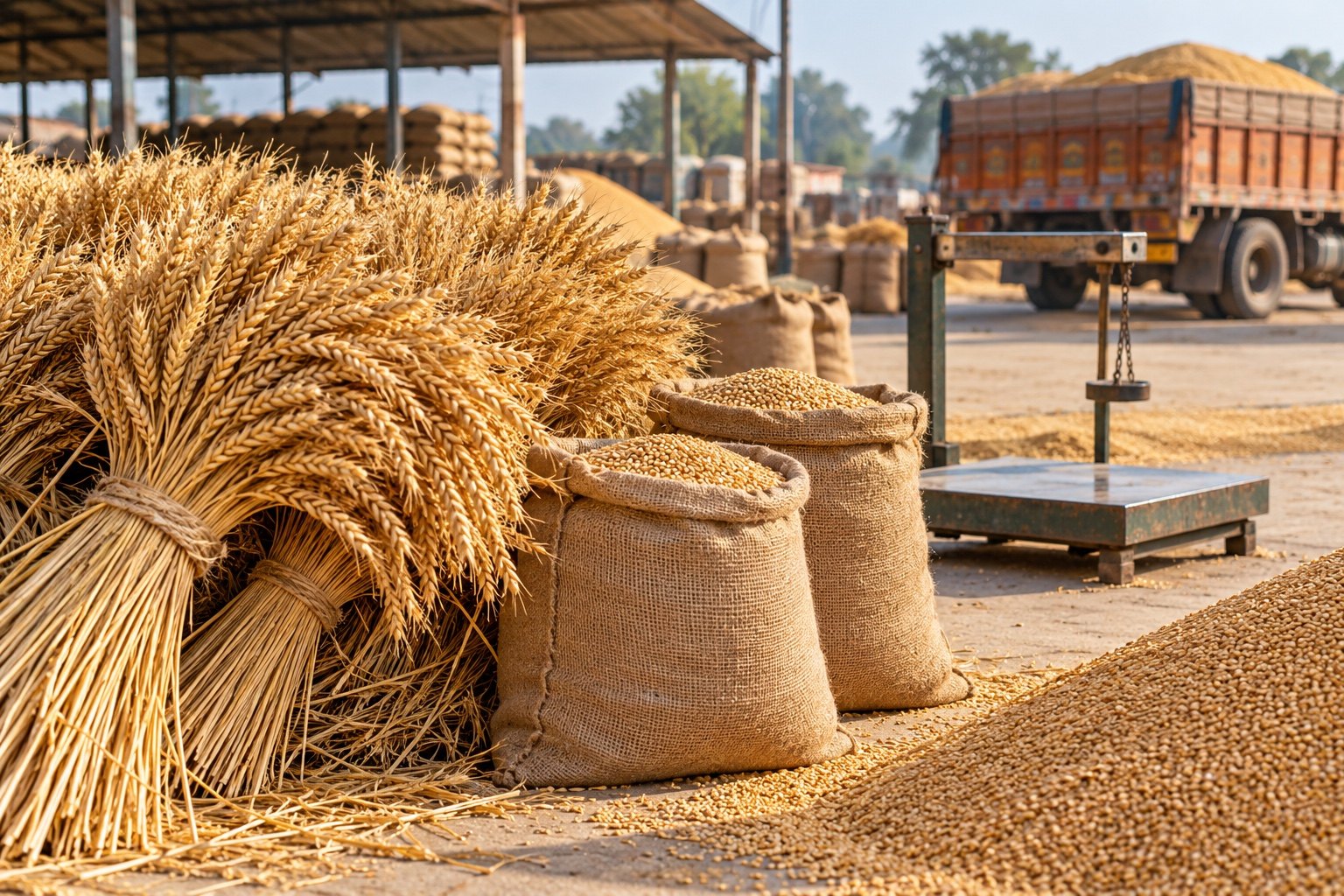
Minimum Support Price (MSP) is the price at which the government offers to buy a crop. The Centre fixes it each year for 22 mandated crops on the advice of the Commission for Agricultural Costs and Prices (CACP). Since 2018-19, MSP is at least 1.5 times the cost of production. PIB explained the 2027-28 Rabi MSPs on 29 October 2026.
Syllabus: GS3 · Agriculture & Irrigation; GS3 · MSP, Subsidies & Food Security; Prelims · Economy & Social Development
Why this matters for UPSC
GS3 agriculture: minimum support prices, procurement and farm subsidies. Prelims can ask the crops covered, CACP's cost concepts and PM-AASHA; Mains, whether MSP serves farmers.
In short
Minimum Support Price is a price the Centre fixes on the CACP's advice and backs with procurement, so farmers have a floor; its worth depends on who actually buys.
MSP is only as strong as the procurement behind it; widening State and PSS buying would matter more than another rise announced on paper.
Why it matters
A wheat grower in a State with procurement centres knows before harvest that a government agency will buy grain of Fair Average Quality at the announced price. That floor lets the family borrow for seed and fertiliser with less fear of a price crash at harvest. A pulse or oilseed grower has a weaker floor: buying starts only when the State asks and market prices have already fallen below the announced price. A farmer far from any buying agency gains little from the price on paper. The higher margins now set for pulses and oilseeds are meant to coax farmers away from cereals, so the price signal also shapes what the country grows.
Prelims pointers
- The 22 mandated crops are 14 kharif, 6 rabi and 2 commercial crops (jute and copra); sugarcane is covered by an FRP instead of an MSP.
- The CACP began in 1965 as the Agricultural Prices Commission, set up by a government resolution, not an Act; it was renamed in 1985.
- Look-alikes: the CACP, an attached office of the Department of Agriculture and Farmers Welfare, only recommends; the CCEA, chaired by the Prime Minister, approves MSPs.
- In CACP's cost concepts, A2 is A1 plus rent for leased-in land; B1 adds interest on owned fixed capital; C3 adds a 10% management input.
- Cotton and jute are bought at MSP by the Cotton Corporation of India and the Jute Corporation of India, not by the FCI.
- Under decentralised procurement, a State buys, stores and issues foodgrain for the Centre under TPDS; surplus goes to the FCI, which also meets any deficit.
- NAFED and NCCF buy under the Price Support Scheme; biometric authentication of farmers became mandatory under it from the 2025-26 season.
- The Mission for Aatmanirbharta in Pulses lets Central Nodal Agencies buy tur, urad and masur from pre-registered growers up to 2030-31.
Practise a UPSC-style question
With reference to the Commission for Agricultural Costs and Prices (CACP), consider the following statements:
1. It was set up in 1965 under an Act of Parliament as a statutory body.
2. It is an attached office of the Department of Agriculture and Farmers Welfare.
3. It recommends the Fair and Remunerative Price of sugarcane besides Minimum Support Prices.
Which of the statements given above is/are correct?
- (a) 1 and 2 only
- (b) 2 and 3 only
- (c) 1 and 3 only
- (d) 1, 2 and 3
Show the answer
Answer: (b) 2 and 3 only
Answer: (b) 2 and 3 only. The CACP is an attached office created by a government resolution, and it advises on both MSP and sugarcane's FRP.
Statement 1: incorrect. The Agricultural Prices Commission was set up in 1965 by a resolution of the Ministry of Food and Agriculture, not by an Act; it was renamed CACP in 1985.
Statement 2: correct. The CACP describes itself as an attached office of the Department of Agriculture and Farmers Welfare.
Statement 3: correct. Its mandate covers MSPs for 22 commodities and the FRP of sugarcane.
Eliminate: statement 1 is wrong, as the CACP rests on an executive resolution. Out: (a), (c), (d).
Trap: Wrong scope. The statement turns an advisory body set up by resolution into a statutory one, a swap UPSC often makes with commissions.
Remember: CACP: resolution of 1965, renamed 1985; it recommends, the CCEA approves.
More Explainers
- Crypto in Indian law: virtual digital assets, tax and PMLA cover Economy
- The collegium system for appointing and transferring higher court judges Polity
- Protected Area, Restricted Area and Inner Line Permits Polity
- Scheduled Tribe seats in Assemblies: Article 332 and Goa's 2025 Act Polity
- Ballot papers and EVMs: where India still votes on paper Polity
- Gelephu Mindfulness City: Bhutan's special zone on the Assam border World & IR
- Nuclear fusion, the tokamak and India's role in ITER Sci-Tech
- Gilgit-Baltistan, CPEC and India's sovereignty objection World & IR
- India-Nepal electricity trade: how Nepal sells power to India World & IR
- Infant mortality and child malnutrition among Scheduled Tribes National
- Genocide Convention, 1948: the legal test and who can judge it World & IR
- Chola bronzes: lost-wax casting and Nataraja iconography National