
Groundwater in India: assessment, regulation and the Atal Bhujal Yojana
Why in news: On 8 October 2026, SANDRP said tests at Ambad, Nashik, found hexavalent chromium in groundwater over 1,000 times the BIS drinking-water limit.
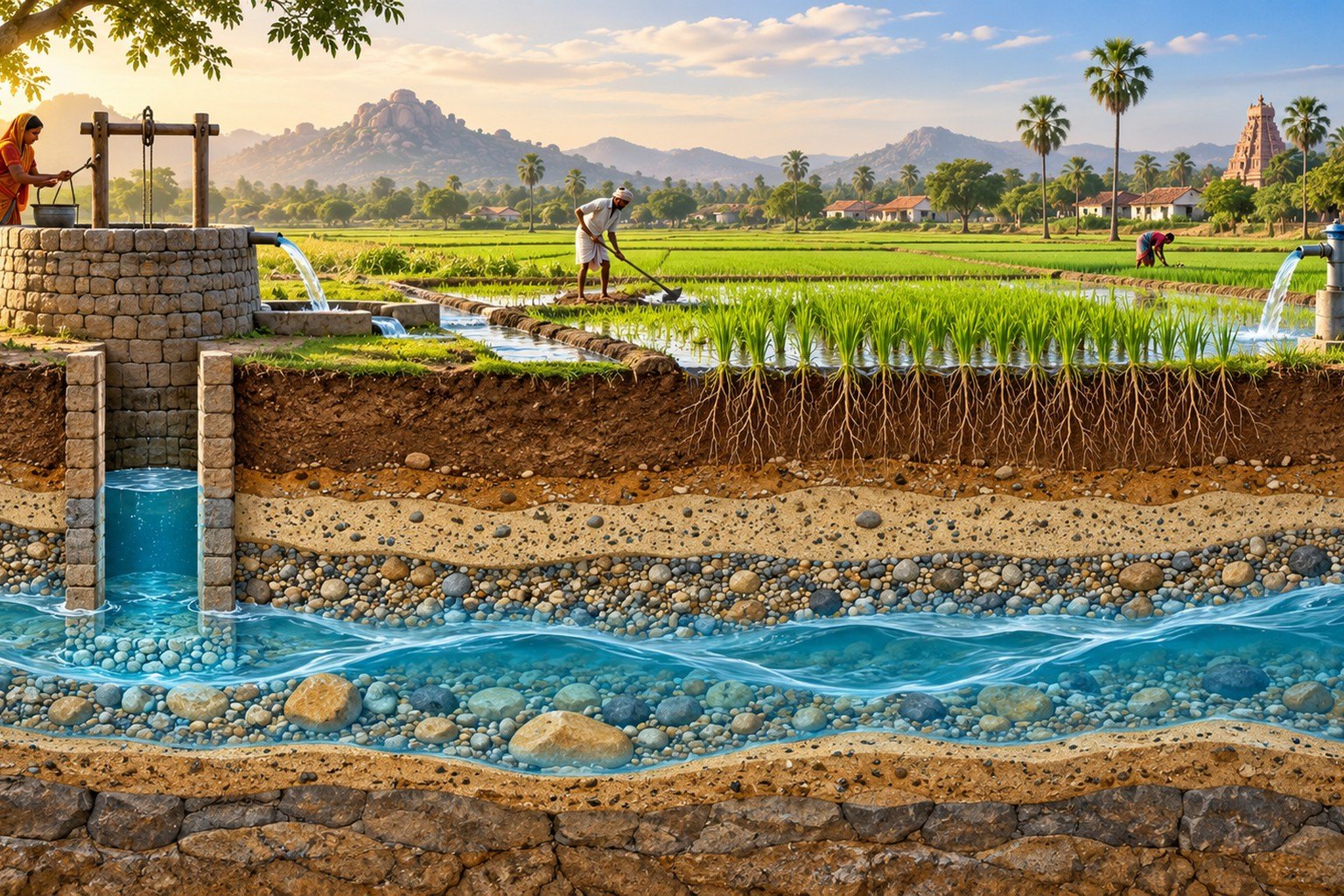
Groundwater stress in India is measured each year by the Central Ground Water Board and the States. Their 2025 assessment, reported by the Ministry of Jal Shakti, put the national stage of extraction at 60.63%, with 730 of 6,762 units over-exploited. Quality is a second worry: an NGO reported toxic chromium in Nashik's groundwater on 8 October 2026.
Syllabus: GS3 · Agriculture & Irrigation; GS2 · Government Policies; GS1 · Resources & Industry Location
Why this matters for UPSC
Groundwater sits in GS3 (conservation, irrigation) and GS2 (government policies). Prelims asks the CGWB's assessment categories, the Central Ground Water Authority's legal basis and the Atal Bhujal Yojana's States; Mains, about overdraft and contamination.
In short
Groundwater is water held in aquifers below the ground. India draws nearly 62% of its irrigation and 85% of rural drinking water from it, per a January 2026 PIB backgrounder.
By the ministry's figures the quantity of groundwater is recovering; enforcing NOCs and treating contamination as seriously as overdraft is the next test.
Why it matters
A farmer in Punjab who runs a tube well, a family in a village that drinks from a hand pump and a factory that draws water for its machines all depend on the same hidden store. When pumping outruns the rain that refills it, wells have to go deeper, power bills rise and some wells run dry. When the water is poisoned, as an NGO says it is near Nashik's industrial area, people fall ill without knowing the cause. Because water is a State subject and most wells are private, no single authority can fix this: it needs rules, meters and the willingness of villages to share a common resource fairly.
Prelims pointers
- Central Ground Water Authority: constituted under Section 3(3) of the Environment (Protection) Act, 1986; may use the Act's penal sections 15 to 21.
- CGWB's parent: Department of Water Resources, River Development and Ganga Rejuvenation, Ministry of Jal Shakti.
- Saline units: a fifth label in the assessment, kept outside the four stage-of-extraction categories.
- Atal Bhujal Yojana States: Gujarat, Haryana, Karnataka, Madhya Pradesh, Maharashtra, Rajasthan and Uttar Pradesh; World Bank loan repaid by the Centre.
- NAQUIM began under the Ground Water Management and Regulation scheme, whose funds CGWB spends itself, not the States.
- CGWA rules: no new industry may draw groundwater in over-exploited areas except MSMEs; industries drawing over 100 KLD need a water audit every two years.
- Master Plan for Artificial Recharge to Groundwater-2020: about 1.42 crore structures to harness about 185 BCM.
Practise a UPSC-style question
With reference to the Dynamic Ground Water Resources Assessment in India, consider the following statements:
1. It is carried out jointly by the Central Ground Water Board and the Central Water Commission.
2. An assessment unit is categorised as 'critical' when its stage of extraction lies between 90% and 100%.
3. An 'over-exploited' unit extracts more groundwater in a year than its annual extractable resource.
Which of the statements given above is/are correct?
- (a) 1 and 2 only
- (b) 2 and 3 only
- (c) 1 and 3 only
- (d) 1, 2 and 3
Show the answer
Answer: (b) 2 and 3 only
Answer: (b) 2 and 3 only. The bands are right, but the assessment is done by the CGWB with the State Governments.
Statement 1: incorrect. The CGWB carries out the assessment jointly with the State Governments, not with the Central Water Commission.
Statement 2: correct. A unit with a stage of extraction between 90% and 100% is critical; 70-90% is semi-critical.
Statement 3: correct. Over-exploited units have a stage of extraction above 100%, drawing more than the yearly extractable recharge.
Eliminate: Statement 1 names the wrong partner, so it is incorrect. Out: (a), (c), (d).
Trap: Swapped attribution. The Central Water Commission is a real Jal Shakti body, but the board's partner in this exercise is the States.
Remember: Safe below 70, semi-critical 70-90, critical 90-100, over-exploited above 100.
In the news
More Explainers
- State Legislative Councils: Articles 168-172 and the graduates' and teachers' seats Polity
- Whales and dolphins in Indian waters: legal protection, IUCN status and strandings Environment
- The Aligarh Movement, AMU and the Article 30 minority test Polity
- Environmental clearance by States: SEIAA, SEAC and the EIA Notification, 2006 Environment
- Software vulnerabilities: CVE, CVSS, coordinated disclosure and CERT-In's role Sci-Tech
- Drug trafficking law in India: NDPS Act, PIT-NDPS, NCB and NCORD National
- Choosing the UN Secretary-General: Article 97, UNSC veto and straw polls World & IR
- UN Convention against Torture, and why India has not ratified it Polity
- NavIC: why India's navigation constellation cannot give a standalone position Sci-Tech
- International Energy Agency: membership, 90-day oil stocks and India's status World & IR
- PM Surya Ghar: Muft Bijli Yojana and the rooftop solar subsidy Economy
- HFSS foods: FSSAI's draft limits and front-of-pack warning labels National