
Tamil Nadu orders State-wide rainwater harvesting drive as a mass movement
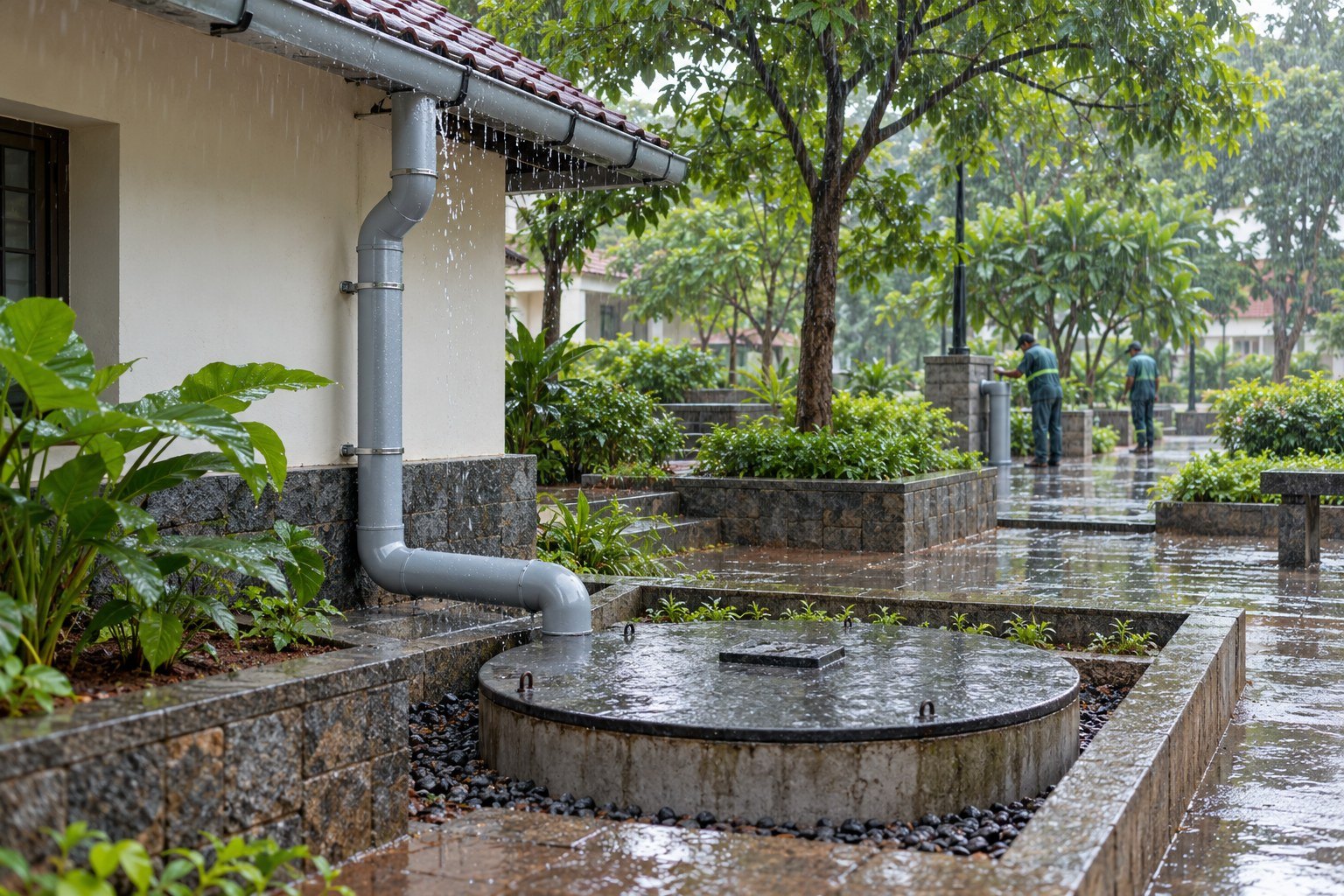
In an order dated 16 October 2026, Tamil Nadu's Municipal Administration and Water Supply Department set out a State-wide campaign to run rainwater harvesting as a mass movement. All government departments and local bodies must make the structures they control fully functional before the Northeast monsoon. It took effect at once and runs on existing budgets.
Syllabus: GS2 · Federalism & Local Government; GS2 · Government Policies; GS1 · Resources & Industry Location
Why this matters for UPSC
GS3 water conservation and GS2 local government: Prelims can ask about Entry 17 of the State List, the Twelfth Schedule, Article 213 ordinances and Jal Shakti Abhiyan: Catch the Rain; Mains, about making rainwater harvesting work through local bodies.
Why it matters
A family that draws water from a borewell feels this order in summer, not in October. When filters clog and pits fill with silt, rooftop rain runs into drains and streets, so the same storms that flood roads leave wells dry months later. The order makes the government's own departments and local bodies fix their structures first, and leans on inspections, awareness and awards to bring households along. Its records, kept block by block and firka by firka, should show whether water tables actually rise. The larger question is whether a State can keep a rule that is more than two decades old working after the first push fades, since a structure built once and never cleaned stops feeding the ground.
Prelims pointers
- Entry 17, State List: water supplies, irrigation and canals, drainage and embankments, water storage and water power, subject to Entry 56 of the Union List.
- Entry 56, Union List: regulation and development of inter-State rivers and river valleys, to the extent Parliament by law declares Union control expedient.
- Twelfth Schedule entries include regulation of land-use and construction of buildings, and water supply for domestic, industrial and commercial purposes; added by the Seventy-fourth Amendment, 1992.
- Eleventh Schedule (Article 243G), added by the Seventy-third Amendment, 1992: 29 matters, including minor irrigation, water management and watershed development, and drinking water.
- Article 213: an ordinance has the force of a State Act, must be laid before the Legislature and lapses six weeks after it reassembles.
- Groundwater is assessed every year by the Central Ground Water Board and the States; stage of extraction is annual extraction for all uses over the annual extractable resource.
- Catch the Rain was launched on World Water Day, 22 March 2021; Jal Shakti Abhiyan 2019 had covered 1,592 water-stressed blocks in 256 districts.
- Jal Sanchay Jan Bhagidari: launched in Surat on 6 September 2024 on the 3Cs (Community, CSR, Cost); merged with Catch the Rain from 1 June 2026.
Practise a UPSC-style question
With reference to Tamil Nadu's order on rainwater harvesting as a mass movement, consider the following statements:
1. It lays down a fine for households whose rainwater harvesting structures are found not working.
2. It directs that the rainwater harvesting provisions in local bodies' building regulations be effectively enforced.
Which of the statements given above is/are correct?
- (a) 1 only
- (b) 2 only
- (c) Both 1 and 2
- (d) Neither 1 nor 2
Show the answer
Answer: (b) 2 only
Answer: (b) 2 only. The order works through departments, local bodies, building rules and awareness, with no penalty on homes.
Statement 1: incorrect. G.O.(Ms) No. 184 names no fine or deadline for households; it promotes rooftop harvesting in homes and urges every household to harvest rain at source.
Statement 2: correct. The order says the rainwater harvesting clauses in the building regulations of urban and rural local bodies shall be effectively enforced and strengthened.
Eliminate: Statement 2 is correct, so the options without it go. Out: (a), (d).
Eliminate: Statement 1 is incorrect, as the order sets no household fine. Out: (c).
Trap: Sounds right. A fine on homes sounds like a natural part of such a drive, but the 2026 order directs departments and local bodies, and the owners' duty dates from the 2003 law.
Remember: Tamil Nadu's 2026 order directs departments and local bodies; the duty on owners dates from the 2003 law.
Explainers on this topic
More from the 22 October 2026 edition
- Counter-drone air defence: MoD signs BEL contract for LLLR-I low-level radars Defence
- Bihar relaxes VB-G RAM G farm-season pause for 38 disaster-hit districts National
- PARAKH turns PRS 2024 learning gaps into monthly district action National
- UNEP Emissions Gap Report 2026: 1.5°C without overshoot is lost Environment
- Vienna Conventions: India presses mission protection at UN Sixth Committee World & IR
- India tells UN Third Committee its safeguards against enforced disappearance World & IR
- India reiterates call for binding PAROS treaty at UNGA First Committee World & IR
- WHO report maps within-country NCD inequalities: 35 indicators, up to eight dimensions World & IR
- Mecca Joint Defence Agreement goes to Turkey's parliament for ratification World & IR
- TV Programme Code: I&B advisory follows Inter-Departmental Committee's findings Polity
- Ladakh dissolves Kargil hill council, sets panchayat polls for 21 November Polity
- ASI begins fresh excavation at Kashipur (Govisana), Uttarakhand National