
Forest Rights Act, 2006: who qualifies, which rights, how claims work
Why in news: A Rural Development Ministry RTI reply of 6 October 2026 shows no order on extra workdays for FRA title holders under VB-G RAM G.
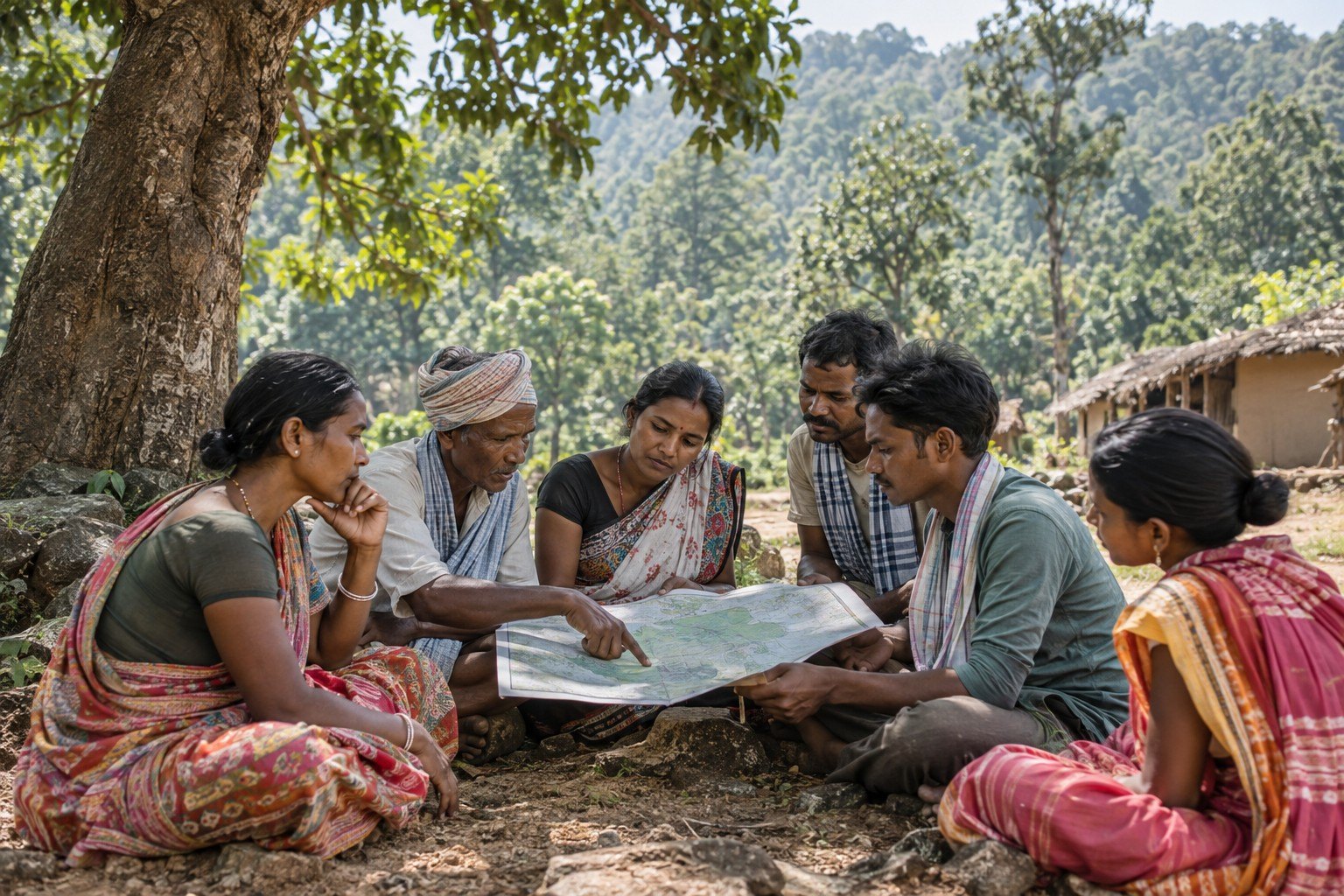
The Forest Rights Act, 2006 recognises the land, forest-produce and community rights of forest-dwelling Scheduled Tribes and other traditional forest dwellers, through claims the Gram Sabha starts. On 6 October 2026, the Rural Development Ministry said in an RTI reply that no order yet gives FRA title holders extra days of work under the new VB-G RAM G Act.
Syllabus: GS3 · Indian Economy & Growth; Prelims · Polity & Governance; Prelims · Environment & Ecology
Why this matters for UPSC
GS2 (laws and bodies protecting vulnerable sections) and GS3 (rural employment). Prelims asks who qualifies under the Forest Rights Act, 2006, which rights it recognises and who decides claims; Mains asks about tenure security, rejected claims and the extra workdays.
In short
The Forest Rights Act, 2006 recognises and vests forest rights in forest-dwelling Scheduled Tribes and other traditional forest dwellers, whose unrecorded rights the Act calls a historical injustice.
The Act's test is a recorded, usable title: Gram Sabha-led verification, reasoned rejections and settled workdays under the new law decide whether it delivers.
Why it matters
For an Adivasi family that has farmed a forest plot for decades, a title turns a tolerated occupation into a right its children inherit, and no official may evict the family while its claim is being decided. A village with a community title can manage its own forest, sell the produce it gathers and decide who uses its forest. When a claim is rejected or left pending for years, the family keeps farming without any record of its right. The extra workdays mattered most to the poorest holders, whose only asset is that land: they meant paid work after the yearly quota ran out. The larger question is whether forests are better protected when the people living in them hold secure rights.
Prelims pointers
- Section 2(o): an other traditional forest dweller needs three generations (a generation is 25 years) of forest residence and dependence before 13 December 2005.
- Section 4(6): land under the habitation and self-cultivation right is limited to the area actually occupied and never exceeds four hectares.
- Section 6: petitions against a Gram Sabha resolution go to the Sub-Divisional Level Committee within 60 days; the District Level Committee's decision is final and binding.
- Section 6(8): all three committees (sub-divisional, district and State monitoring) have Revenue, Forest and Tribal Affairs officers and three Panchayati Raj members, two of them Scheduled Tribes.
- Section 2(i): minor forest produce means non-timber produce of plant origin, including bamboo, tendu or kendu leaves, honey, lac and medicinal plants.
- Section 3(2): the Centre allows diversion of under one hectare of forest land, felling at most 75 trees a hectare, for 13 public facilities recommended by the Gram Sabha.
- Article 371A: Parliament's laws on ownership and transfer of land and its resources apply to Nagaland only if its Assembly so resolves; Nagaland says this excludes the FRA.
- VB-G RAM G Act, 2025, section 22: Centre-State cost sharing is 60:40 for most States and 90:10 for North-Eastern and Himalayan States.
Practise a UPSC-style question
With reference to the Scheduled Tribes and Other Traditional Forest Dwellers (Recognition of Forest Rights) Act, 2006, consider the following statements:
1. The Act defines a generation as a period of thirty years.
2. An other traditional forest dweller must show forest residence and dependence for at least three generations before 13 December 2005.
3. Forest land recognised for habitation or self-cultivation can in no case exceed four hectares.
Which of the statements given above is/are correct?
- (a) 1 and 2 only
- (b) 2 and 3 only
- (c) 1 and 3 only
- (d) 1, 2 and 3
Show the answer
Answer: (b) 2 and 3 only
Answer: (b) 2 and 3 only. The Act counts a generation as 25 years, so statement 1 fails and the other two stand.
Statement 1: incorrect. The Explanation to section 2(o) defines a generation as twenty-five years, not thirty.
Statement 2: correct. Section 2(o) asks for at least three generations of forest residence and dependence before 13 December 2005.
Statement 3: correct. Section 4(6) limits such land to the area actually occupied and never above four hectares.
Eliminate: Judge statement 1 first: a generation is 25 years, so statement 1 is incorrect. Out: (a), (c), (d).
Trap: Near-miss figure. Thirty years sounds like a natural generation, but the Act fixes it at twenty-five, so three generations make 75 years.
Remember: FRA: other traditional forest dwellers need three generations of 25 years each before 13 December 2005.
In the news
More Explainers
- State Legislative Councils: Articles 168-172 and the graduates' and teachers' seats Polity
- Whales and dolphins in Indian waters: legal protection, IUCN status and strandings Environment
- The Aligarh Movement, AMU and the Article 30 minority test Polity
- Environmental clearance by States: SEIAA, SEAC and the EIA Notification, 2006 Environment
- Software vulnerabilities: CVE, CVSS, coordinated disclosure and CERT-In's role Sci-Tech
- Drug trafficking law in India: NDPS Act, PIT-NDPS, NCB and NCORD National
- Choosing the UN Secretary-General: Article 97, UNSC veto and straw polls World & IR
- UN Convention against Torture, and why India has not ratified it Polity
- NavIC: why India's navigation constellation cannot give a standalone position Sci-Tech
- International Energy Agency: membership, 90-day oil stocks and India's status World & IR
- PM Surya Ghar: Muft Bijli Yojana and the rooftop solar subsidy Economy
- HFSS foods: FSSAI's draft limits and front-of-pack warning labels National