
India rejects UN Indigenous Peoples Rapporteur's reference, cites Forest Rights Act
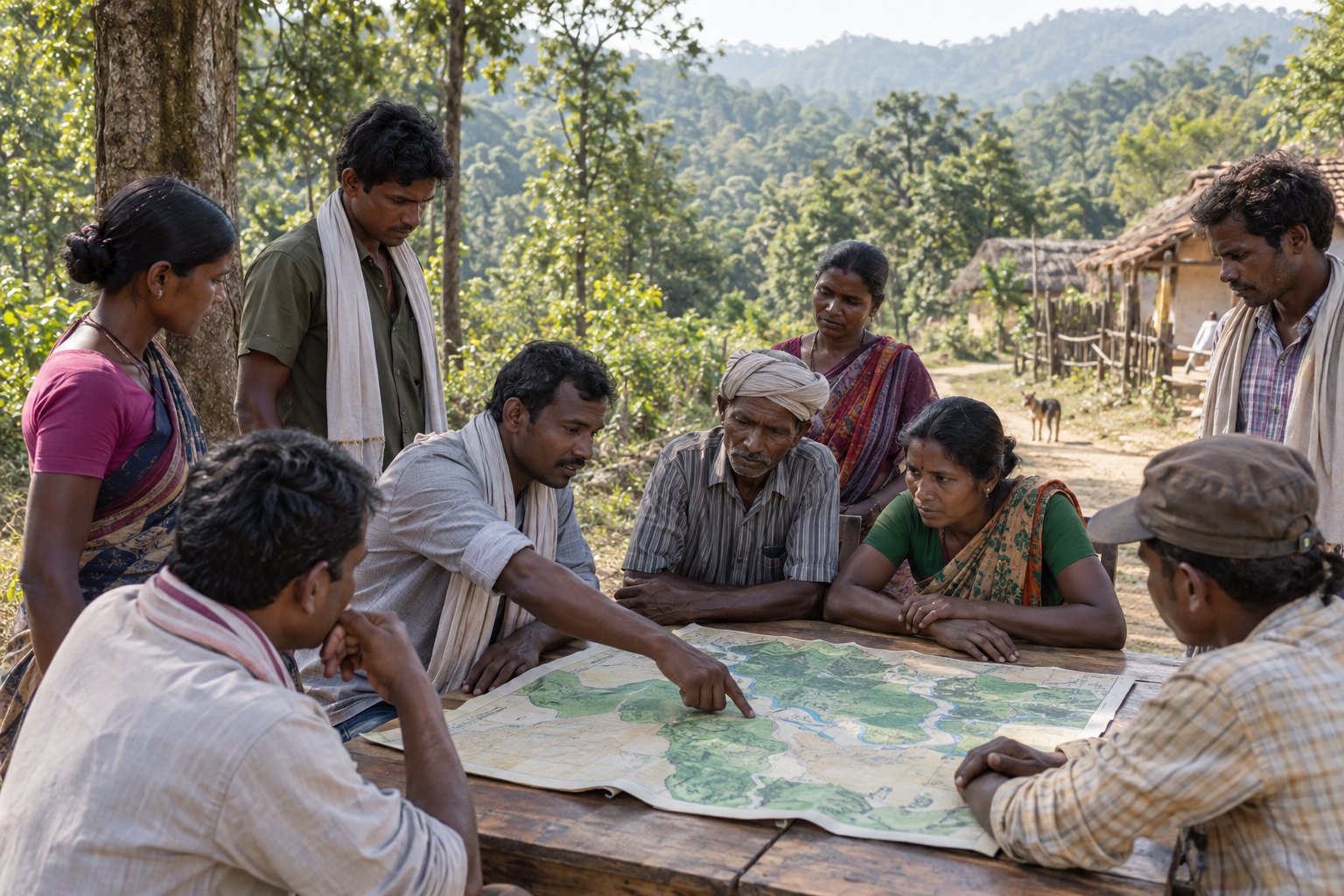
India has rejected an "unsubstantiated reference" to it in a report by the UN Special Rapporteur on the rights of Indigenous Peoples, which called Scheduled Tribe recognition "more administrative than rights-based". At the UN General Assembly Third Committee's 81st session, India cited Forest Rights Act land-title data, backed the 2007 UN Declaration and called its entire population indigenous.
Syllabus: GS2 · Constitution; Prelims · Polity & Governance; GS2 · Welfare of Vulnerable Sections
Why this matters for UPSC
GS2 international institutions and welfare of vulnerable sections: Prelims can ask about special procedures, UNDRIP, Article 342 or the Forest Rights Act, 2006; Mains, about whether tribal recognition in India is rights-based.
Why it matters
Think of an Adivasi family farming forest land it has tilled for generations. A list that only names its tribe gives it schemes; a land title gives it security against eviction. The Rapporteur's criticism goes to that gap: is being listed the same as holding enforceable rights? India's answer is that titles have in fact been granted and services delivered. The exchange also shows a lasting divide. Much of the world treats indigenous peoples as groups that predate settlers, while India counts its whole population as indigenous and protects tribes through its own Constitution. That divide shapes how India reads every UN finding on its tribal people, and how far it lets outside bodies judge domestic policy.
Prelims pointers
- Article 342(2): only Parliament, by law, may include or exclude a community; a presidential notification cannot be varied by a later notification.
- Article 366(25): Scheduled Tribes are those deemed to be so under Article 342; Article 341 deals with Scheduled Castes.
- Fifth Schedule, paragraph 4: a Tribes Advisory Council of up to 20 members, about three-fourths of them ST members of the State Assembly.
- Sixth Schedule: a District Council has up to 30 members, at most four nominated by the Governor; the Bodoland Territorial Council may have up to 46.
- Forest Rights Act, 2006: the District Level Committee's decision is final; occupied-land rights capped at four hectares; Ministry of Tribal Affairs is the nodal agency.
- UNDRIP vote, 13 September 2007: 143 for, 4 against (Australia, Canada, New Zealand, United States), 11 abstentions; all four later reversed their position.
- Fifth Schedule, paragraph 3: the Governor reports to the President on Scheduled Areas annually, and the Union may direct the State on their administration.
Practise a UPSC-style question
With reference to the Special Procedures of the UN Human Rights Council, consider the following statements:
1. The mandate of the Special Rapporteur on the rights of Indigenous Peoples was first created by the Human Rights Council in 2007.
2. Special procedure mandate holders are paid UN staff whose tenure may run up to ten years.
3. The General Assembly's Third Committee hears and interacts with special rapporteurs mandated by the Human Rights Council.
Which of the statements given above is/are correct?
- (a) 1 only
- (b) 2 only
- (c) 3 only
- (d) 1, 2 and 3
Show the answer
Answer: (c) 3 only
Answer: (c) 3 only. Only the Third Committee link is right; the mandate's origin and the experts' terms are both misstated.
Statement 1: incorrect. The Commission on Human Rights created the mandate in 2001; the Human Rights Council renewed it in 2007, 2022 and 2025.
Statement 2: incorrect. Special procedure mandate holders are independent experts who are unpaid, and their tenure is limited to a maximum of six years.
Statement 3: correct. The Third Committee examines reports of the Council's special procedures and hears special rapporteurs and independent experts.
Eliminate: Statement 2 is surely wrong, since mandate holders serve unpaid for at most six years. Out: (b), (d).
Eliminate: Statement 1 credits the mandate's birth to the wrong body; the Commission on Human Rights made it in 2001. Out: (a).
Trap: Swapped attribution. The Human Rights Council renewed the mandate in 2007, so a student may pin its creation on the Council instead of the Commission it replaced.
Remember: Indigenous Peoples Rapporteur: created 2001 by the Commission on Human Rights; experts unpaid, six years at most.
Explainers on this topic
More from the 14 October 2026 edition
- Cooperation Ministry mandates uniform audit report for Multi-State societies Economy
- CCEA approves strategic buyer for 60.72% of IDBI Bank Economy
- India approved to join Southern Indian Ocean Fisheries Agreement Economy
- India–Mauritius tax treaty gets principal purpose test against treaty shopping Economy
- Greater India Society at 100: India's cultural links across Asia National
- Cabinet extends National Social Assistance Programme to 2030-31, renames it National
- Indian Navy to end first command of CMF's Combined Task Force 154 Defence
- Putin signs law ratifying India-Russia temporary labour agreement World & IR
- India tells UNGA Third Committee UN rights bodies must shun selectivity World & IR
- 158 refugees get citizenship in Ahmedabad, 126 under the CAA Polity
- India-Canada reset: PMs back early CEPA to double trade by 2030 World & IR
- Union Territory of Ladakh: India rejects China's objection to standard names World & IR