
Carrying capacity of Himalayan hill towns
Why in news: Himachal Pradesh must report any carrying-capacity decision for Koksar, Manali and Solang within six weeks, the National Green Tribunal directed on 7 October 2026.
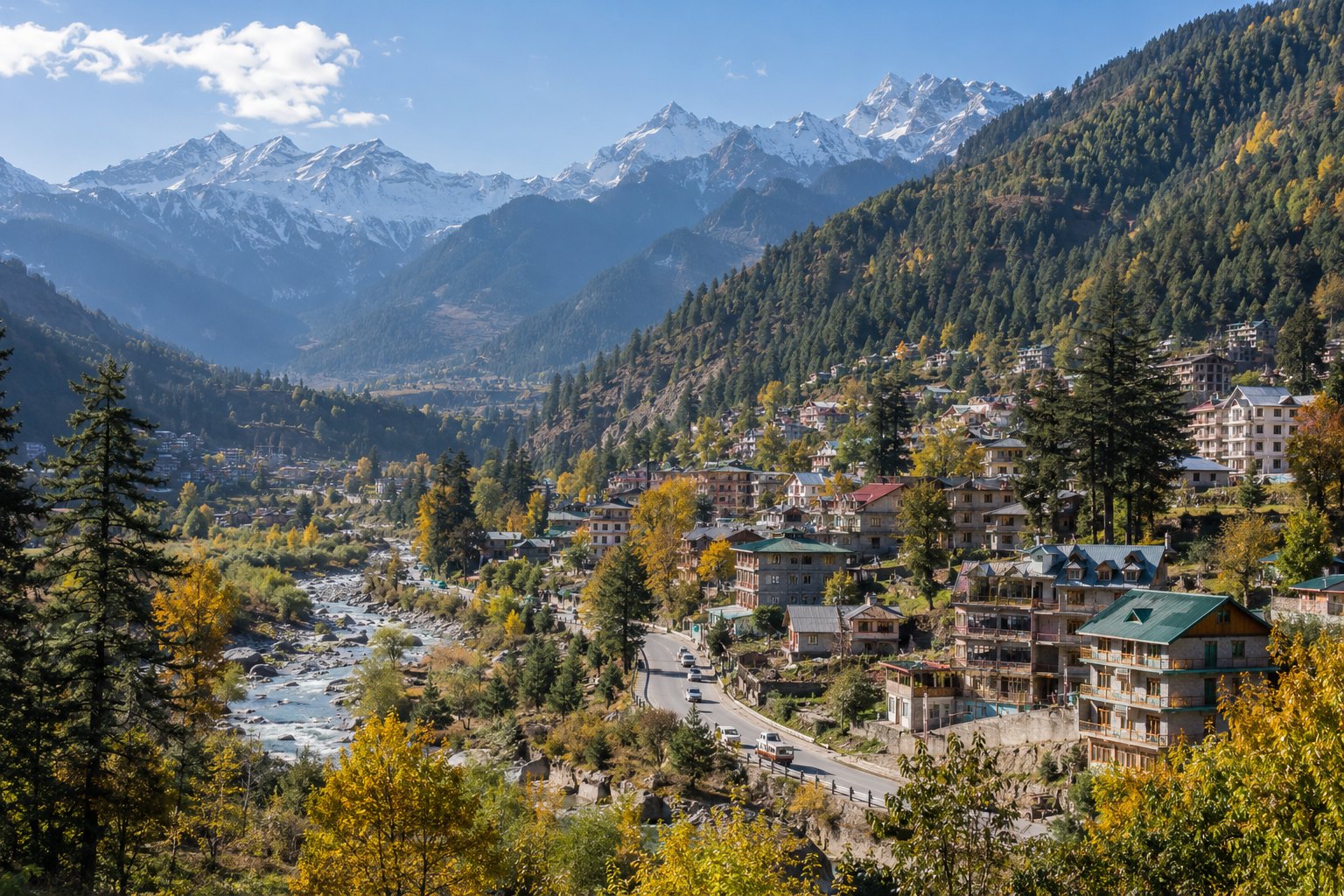
Carrying capacity is the largest number of visitors, vehicles and buildings a place can sustain without degrading its land, water, forests or residents' quality of life. On 7 October 2026 the National Green Tribunal asked Himachal Pradesh to report any capacity decision for Manali, Solang and Koksar.
Syllabus: Prelims · Environment & Ecology; GS3 · Environment & Conservation; GS3 · Disaster Management
In short
Carrying capacity is the most visitors, vehicles and buildings a place can sustain without harming its land, water, forests or residents; in Himalayan towns tourism presses against it.
Himalayan States must turn carrying-capacity numbers into enforceable plans, so tourism earns without wearing out the slopes, water and towns it depends on.
Why it matters
A family in a hill town feels the limit first: taps run dry in the tourist season, sewage reaches the stream and holiday traffic blocks the only road. Hotels cut into steep slopes and choked drains add to landslide risk in a heavy monsoon. A carrying-capacity study tells a State how much building and traffic a town can take, so it can plan water, waste and roads and cap the rest. The larger question is how mountain States can earn from tourism without wearing out the land it depends on.
Prelims pointers
- Carrying capacity (K): the largest population an environment can sustain indefinitely; logistic growth gives an S-shaped curve levelling off at K, unchecked exponential growth a J-shaped one.
- National Green Tribunal: set up in 2010 under the National Green Tribunal Act, 2010; Principal Bench in New Delhi; appeals against its orders lie to the Supreme Court.
- NGT Act, 2010: the Tribunal applies sustainable development, the precautionary principle and polluter pays, and follows natural justice, not the Code of Civil Procedure, 1908.
- NGT Act Schedule I lists seven laws, including the Water Act, 1974, Air Act, 1981 and Environment (Protection) Act, 1986; the Wildlife (Protection) Act, 1972 is not listed.
- G.B. Pant National Institute of Himalayan Environment: autonomous institute of the Environment Ministry, founded 1988-89, headquartered at Katarmal, near Almora, Uttarakhand.
- Indian Himalayan Region: 13 States and UTs, from Ladakh and Jammu and Kashmir to Arunachal Pradesh, including the hill districts of Assam and West Bengal.
- Eco-Sensitive Zones around protected areas are notified by the Ministry of Environment, Forest and Climate Change under the Environment (Protection) Act, 1986.
Practise a UPSC-style question
With reference to carrying capacity in ecology, consider the following statements:
1. It is the rate at which a population grows when food, water and space are unlimited.
2. In logistic growth, a population's growth slows and levels off as it nears the carrying capacity.
3. Growth without resource limits gives a J-shaped curve, while logistic growth gives an S-shaped curve.
Which of the statements given above is/are correct?
- (a) 1 and 2 only
- (b) 2 and 3 only
- (c) 1 and 3 only
- (d) 1, 2 and 3
Show the answer
Answer: (b) 2 and 3 only
1 is incorrect: carrying capacity (K) is the largest population an environment can sustain indefinitely; growth under unlimited resources is the intrinsic rate of natural increase. 2 is correct: in logistic growth, resistance from limited resources slows growth until the population steadies near K. 3 is correct: unchecked exponential growth traces a J-shaped curve; logistic growth traces an S-shaped (sigmoid) curve.
In the news
More Explainers
- State Legislative Councils: Articles 168-172 and the graduates' and teachers' seats Polity
- Whales and dolphins in Indian waters: legal protection, IUCN status and strandings Environment
- The Aligarh Movement, AMU and the Article 30 minority test Polity
- Environmental clearance by States: SEIAA, SEAC and the EIA Notification, 2006 Environment
- Software vulnerabilities: CVE, CVSS, coordinated disclosure and CERT-In's role Sci-Tech
- Drug trafficking law in India: NDPS Act, PIT-NDPS, NCB and NCORD National
- Choosing the UN Secretary-General: Article 97, UNSC veto and straw polls World & IR
- UN Convention against Torture, and why India has not ratified it Polity
- NavIC: why India's navigation constellation cannot give a standalone position Sci-Tech
- International Energy Agency: membership, 90-day oil stocks and India's status World & IR
- PM Surya Ghar: Muft Bijli Yojana and the rooftop solar subsidy Economy
- HFSS foods: FSSAI's draft limits and front-of-pack warning labels National