
Glacial lake outburst flood exposure: Himalayan flood-zone building up 46%
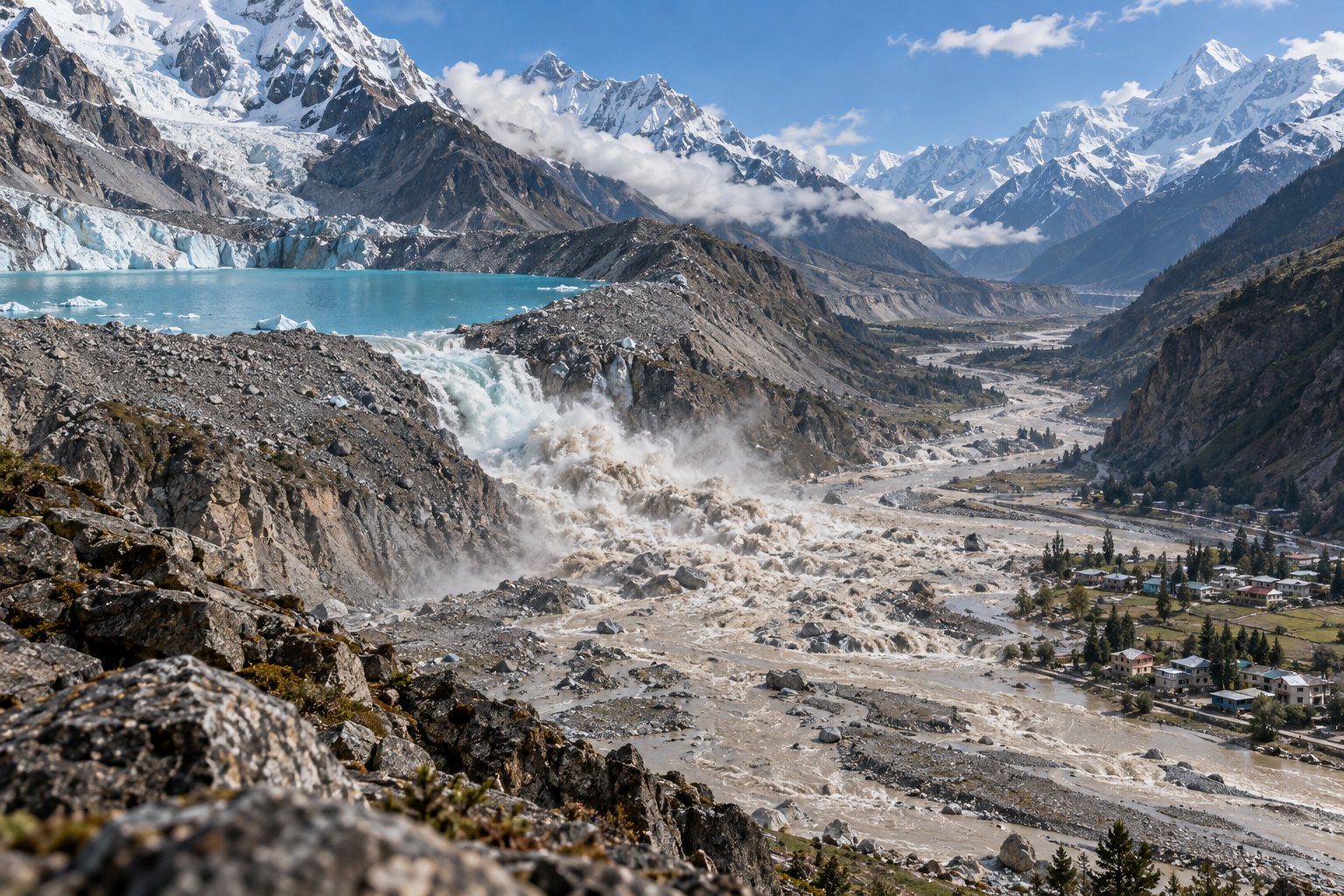
A Scientific Reports study published on 8 October 2026 found building area within 50 vertical metres of rivers below 1,361 glacial lakes in Nepal and adjoining parts of India and China grew about 46% in 2016–2023, and about 78% inside modelled glacial lake outburst flood extents. An estimated 293,800 people across the study area live in that band.
Syllabus: Prelims · Environment & Ecology; GS1 · Geophysical Phenomena; GS3 · Disaster Management
Why it matters
A family running a riverside lodge below a glacial lake earns from the tourist trade on the valley floor, but that is the ground an outburst flood strikes first, and such floods can reach tens of metres above the normal channel through flooding, erosion and debris. Every new building in that band raises what a single burst can destroy, even if the lake is no more dangerous than before. That is the study's larger point: disaster risk can grow through exposure while the hazard stays the same, even as retreating glaciers add lakes across the Himalaya. Up-to-date building maps tell planners where to restrict construction and where early warnings matter most.
Prelims pointers
- Glacial lake outburst flood (GLOF): sudden release of water from a lake dammed by a glacier or moraine; it can turn into a debris flow downstream.
- GLOF triggers: ice or rock avalanche or landslide into the lake (a displacement wave over the dam), heavy rain, seepage, melting buried ice, earthquakes.
- Lake types: supraglacial (on the glacier surface), proglacial (in front of the snout, often moraine-dammed), ice-dammed (where a glacier blocks a valley).
- Disaster risk = hazard × exposure × vulnerability. Exposure: people and assets in hazard-prone places. Vulnerability: their susceptibility and capacity to cope.
- Sendai Framework for Disaster Risk Reduction 2015–2030: voluntary UN agreement adopted in Sendai, Japan, in 2015; seven global targets, four priorities; Priority 1 is understanding disaster risk.
- National Disaster Management Authority (NDMA): set up under the Disaster Management Act, 2005, chaired by the Prime Minister; it issued guidelines on managing GLOFs in 2020.
- South Lhonak Lake, a moraine-dammed lake in north Sikkim, burst in October 2023, sending a flood down the Teesta.
- Kosi (Koshi): a transboundary river whose headstreams rise in Tibet and Nepal; it crosses Nepal and joins the Ganga in Bihar. The study mapped exposure in its Chinese reach.
Practise a UPSC-style question
With reference to glacial lakes in the Himalaya, consider the following statements:
1. Moraine dams are made of loose, unsorted glacial debris, which leaves them prone to sudden breaching.
2. Supraglacial lakes form in front of a glacier's snout and are held back by its terminal moraine.
3. Ice-dammed lakes form where a glacier blocks a valley, and can drain suddenly through tunnels beneath the ice.
Which of the statements given above is/are correct?
- (a) 1 and 2 only
- (b) 2 and 3 only
- (c) 1 and 3 only
- (d) 1, 2 and 3
Show the answer
Answer: (c) 1 and 3 only
1 is correct: a moraine is unsorted rock debris dumped by a glacier, and a dam of such loose material can fail suddenly by overtopping or seepage. 2 is incorrect: supraglacial lakes sit on the glacier's surface; a lake in front of the snout held by the terminal moraine is a proglacial, moraine-dammed lake. 3 is correct: a glacier lying across a valley can pond a lake that empties through channels under the ice.
Explainers on this topic
- Carrying capacity of Himalayan hill towns Environment
More from the 8 October 2026 edition
- CBAM: US invites comments as EU weighs widening carbon border levy Economy
- Nobel Prize in Literature 2026: Swedish Academy honours Canada's Anne Carson World & IR
- World Development Report 2026 on AI gets its India launch Sci-Tech
- Nameri Tiger Reserve in Assam gets CA|TS Approved status Environment
- GST Council recommends scrapping arrest powers, ₹5 crore prosecution threshold Economy
- India joins 14 economies in joint statement on industrial overcapacity Economy
- WMO forecasts December El Niño peak, drier conditions over India Environment
- Chhattisgarh High Court seeks State reply on anti-conversion law challenge Polity
- Centre to release AI regulation consultation paper within a month Sci-Tech
- Supreme Court orders expert panel on statutory curbs for pharma marketing National
- Saudi investment treaty to allow arbitration after two years, officials say Economy
- NMC bars fake reviews, referral fees and AI testimonials for doctors National