
Buddhist diplomacy: India's Buddhist heritage as soft power
Why in news: A 26 October 2026 analysis argued that Buddhist heritage can keep India's diplomatic engagement going when political talks stall.
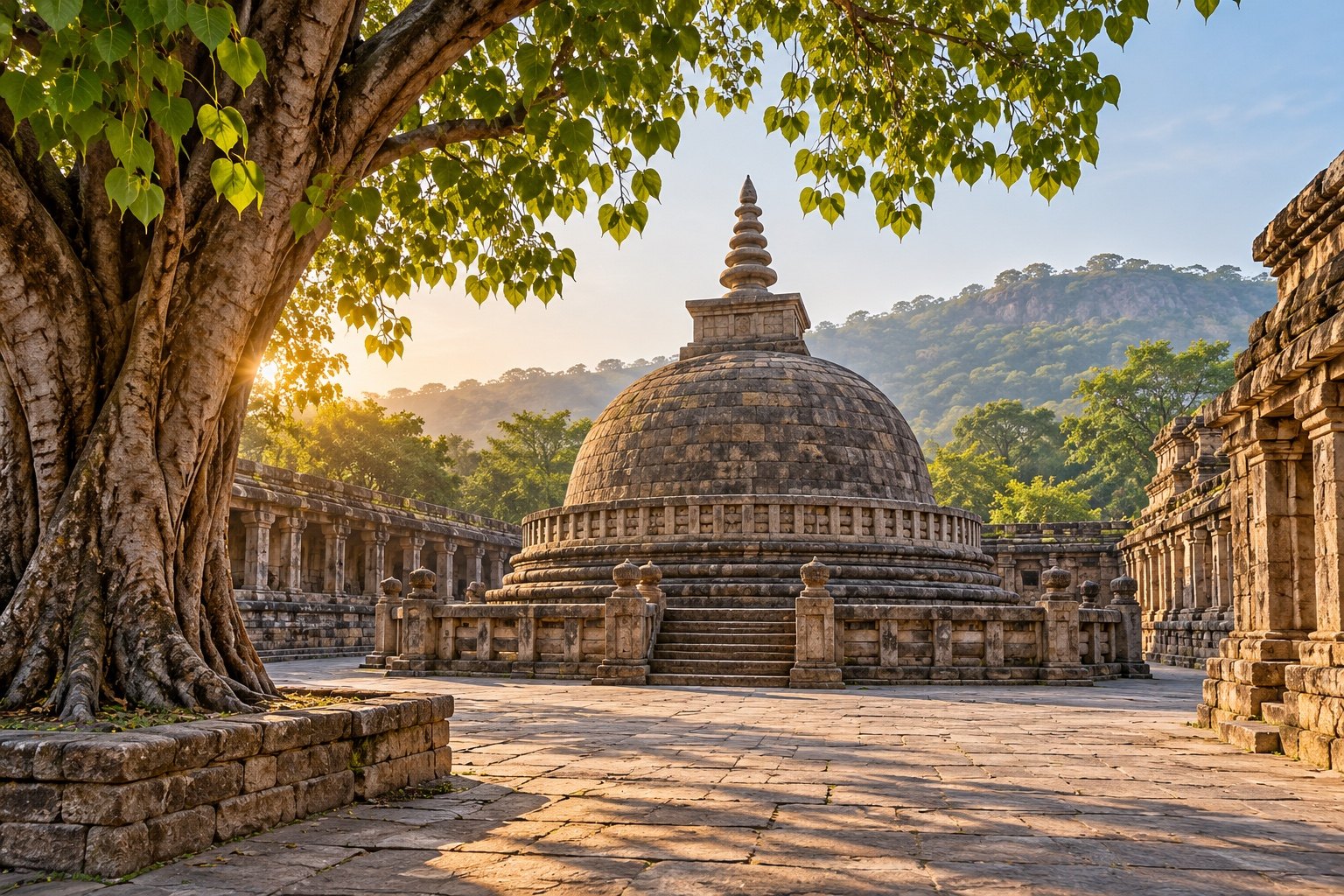
Buddhist diplomacy is India's use of its Buddhist heritage, its sacred sites, relics, Pali texts and monastic links, to deepen ties with Asian countries. The Ministry of Culture runs it largely with the International Buddhist Confederation through summits and relic expositions. Since 2022 India has sent Buddha relics to Mongolia, Thailand, Vietnam, Russia's Kalmykia and Bhutan.
Syllabus: GS1 · Art & Culture; Prelims · History & Culture; GS2 · India & its Neighbourhood
Why this matters for UPSC
Buddhist heritage spans GS1 culture and GS2 international relations. Prelims asks the UNESCO Buddhist sites, Pali's classical status and the Buddha's pilgrimage places; GS2 Mains asks how cultural diplomacy and soft power serve the Act East Policy.
In short
Buddhist diplomacy is India's use of its Buddhist heritage, its sacred sites, relics, Pali texts and monastic links, as soft power to build trust with Asian countries.
Buddhist heritage gives India rare trust across Asia, but it pays only when sustained by scholarship, pilgrim access and steady policy, not one-off events.
Why it matters
For a monk in Sri Lanka, a pilgrim from Japan or a family in Kalmykia, India is first the land of the Buddha. When relics travel abroad or an airport opens beside a pilgrimage town, millions of people in Buddhist countries meet India through faith, not through trade or politics. The pilgrims who follow bring work to guides, hotels and drivers in eastern Uttar Pradesh and Bihar. That goodwill can make governments readier to listen when talks are hard. The same heritage can also cause friction: India's hosting of the Dalai Lama strains ties with China, one analysis notes, and no relic tour settles a border or a trade quarrel. Soft power helps only when real interests are handled alongside it.
Prelims pointers
- UNESCO World Heritage Buddhist sites in India: Ajanta Caves (Maharashtra, 1983), Sanchi (Madhya Pradesh, 1989), Mahabodhi Temple Complex (Bihar, 2002), Nalanda Mahavihara (Bihar, 2016).
- Mahabodhi Temple Complex, Bodh Gaya: the first temple was built by Asoka in the 3rd century BCE; the present brick temple dates from the late Gupta period.
- Buddhist Monuments at Sanchi: on a hill about 40 km from Bhopal; most date from the 2nd and 1st centuries BCE; Stupa 3 held Sariputra's relics.
- Ajanta Caves: 30 caves cut above the Waghora river; five are chaityagrihas and the rest viharas; dug under the Satavahanas and later the Vakatakas.
- Archaeological Site of Nalanda Mahavihara: remains from the 3rd century BCE to the 13th century CE; UNESCO calls it the subcontinent's most ancient university.
- Classical language criteria (2024): early texts 1,500-2,000 years old, ancient literature, knowledge texts including prose and inscriptions, possible discontinuity with later forms.
- Four great Buddhist sites: Lumbini in Nepal (birth), Bodh Gaya (enlightenment), Sarnath (first sermon) and Kushinagar (Mahaparinirvana).
- Abhidhamma Divas: marks the Buddha's descent from Tavatimsa to Sankisa in Uttar Pradesh, a site marked by an Asokan elephant pillar.
Practise a UPSC-style question
With reference to the Mahabodhi Temple Complex at Bodh Gaya, consider the following statements:
1. The first temple at the site was built by Emperor Asoka in the 3rd century BCE.
2. The present temple, built of stone in the Dravida style, dates from the 11th century CE.
Which of the statements given above is/are correct?
- (a) 1 only
- (b) 2 only
- (c) Both 1 and 2
- (d) Neither 1 nor 2
Show the answer
Answer: (a) 1 only
Answer: (a) 1 only. Asoka built the first temple; the present one is a late Gupta brick temple.
Statement 1: correct. UNESCO records that Emperor Asoka built the first temple at the site of the enlightenment in the 3rd century BCE.
Statement 2: incorrect. The present temple dates from the 5th-6th centuries CE and is one of the earliest temples in India built entirely in brick, from the late Gupta period.
Eliminate: Statement 1 is the surest, since Asoka's link with Bodh Gaya is well known. Out: (b), (d).
Eliminate: Statement 2 fails, as the temple is of brick and late Gupta. Out: (c).
Trap: Near-miss figure. The statement moves the temple's date by five centuries and changes its material, so a student who recalls only 'an old temple' may accept it.
Remember: Mahabodhi: Asoka's first temple, 3rd century BCE; present brick temple, late Gupta, 5th-6th century CE.
More Explainers
- Crypto in Indian law: virtual digital assets, tax and PMLA cover Economy
- The collegium system for appointing and transferring higher court judges Polity
- Protected Area, Restricted Area and Inner Line Permits Polity
- Scheduled Tribe seats in Assemblies: Article 332 and Goa's 2025 Act Polity
- Ballot papers and EVMs: where India still votes on paper Polity
- Gelephu Mindfulness City: Bhutan's special zone on the Assam border World & IR
- Nuclear fusion, the tokamak and India's role in ITER Sci-Tech
- Gilgit-Baltistan, CPEC and India's sovereignty objection World & IR
- India-Nepal electricity trade: how Nepal sells power to India World & IR
- Infant mortality and child malnutrition among Scheduled Tribes National
- Genocide Convention, 1948: the legal test and who can judge it World & IR
- Chola bronzes: lost-wax casting and Nataraja iconography National