
Ayushman Vay Vandana: PM-JAY cover for all citizens aged 70+
Why in news: On 29 October 2026, PIB marked two years of Ayushman Vay Vandana, reporting 23.46 lakh authorised hospital admissions as on 20 October 2026.
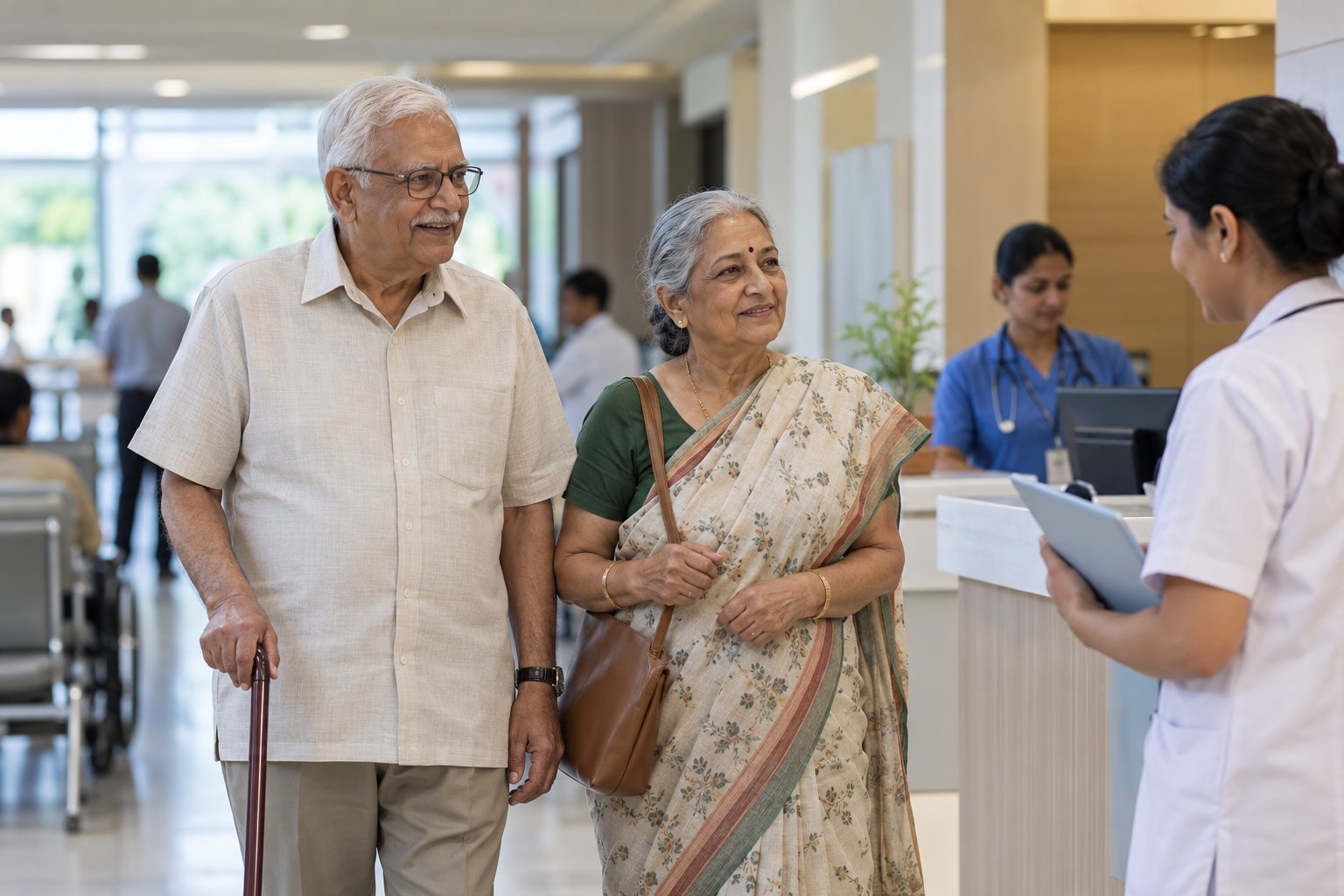
Ayushman Vay Vandana extends Ayushman Bharat Pradhan Mantri Jan Arogya Yojana, or AB PM-JAY, to all citizens of 70 years or more. Income is no bar. It pays for secondary and tertiary hospitalisation up to Rs 5 lakh a year. Seniors in families already covered get a separate top-up. A PIB release of 29 October 2026 marked its second year.
Syllabus: Prelims · Economy & Social Development; GS2 · Welfare of Vulnerable Sections; GS2 · Health, Education & Human Resources
Why this matters for UPSC
GS2 welfare schemes and health: AB PM-JAY and its Ayushman Vay Vandana extension. Prelims can ask eligibility, top-up and funding; Mains, financing hospital care in old age.
In short
Ayushman Vay Vandana is the 2024 extension of AB PM-JAY, the centrally sponsored health assurance scheme, which gives every citizen aged 70 or above hospital cover regardless of income.
Making age the test for hospital cover is sound; the scheme's worth now rests on enrolling the remaining seniors and linking it to primary care.
Why it matters
A 75-year-old in a middle-class home once fell outside the scheme because the family was not poor enough. That senior can now get a cataract operation or dialysis at an empanelled hospital without paying at the counter. Older people need hospital care more often, and one heart procedure can drain a family's savings. Making age the only test removes the need to prove poverty and protects the children who would otherwise pay. Because the senior's top-up is separate, a parent's treatment does not use up the cover meant for younger members. The larger shift is towards universal health coverage: India is moving from covering poor households to covering a whole age group, which raises the bill for the Centre and the States alike.
Prelims pointers
- AB PM-JAY, launched on 23 September 2018, pays only for secondary and tertiary hospitalisation; primary care is the job of Ayushman Arogya Mandirs, another Ayushman Bharat pillar.
- Ayushman Bharat has four pillars: AB PM-JAY, Ayushman Arogya Mandirs, the Ayushman Bharat Digital Mission and the PM-Ayushman Bharat Health Infrastructure Mission (PM-ABHIM).
- AB PM-JAY funding: Centre-State 60:40; 90:10 for North-Eastern States, Himachal Pradesh, Uttarakhand and Jammu and Kashmir; 100% Centre for UTs without a legislature; 60:40 for UTs with one.
- Rural AB PM-JAY families are picked by SECC 2011 deprivation criteria and urban families by 11 occupational categories; families of the old Rashtriya Swasthya Bima Yojana are included.
- An ABHA is a digital health ID for records under the Ayushman Bharat Digital Mission (2021); an Ayushman card is the entitlement for AB PM-JAY's cashless hospital treatment.
- AB PM-JAY offers cashless treatment for 1,961 procedures across 27 medical specialties, per a PIB backgrounder of September 2026.
Practise a UPSC-style question
With reference to Ayushman Vay Vandana under AB PM-JAY, consider the following statements:
1. All citizens aged 70 years and above are eligible, irrespective of their socio-economic status.
2. Senior citizens covered by a private health insurance policy are excluded from its benefits.
3. Seniors in families already under AB PM-JAY get a separate top-up cover of up to Rs 5 lakh a year.
Which of the statements given above is/are correct?
- (a) 1 and 2 only
- (b) 2 and 3 only
- (c) 1 and 3 only
- (d) 1, 2 and 3
Show the answer
Answer: (c) 1 and 3 only
Answer: (c) 1 and 3 only. Age is the only test, and private insurance does not bar a senior.
Statement 1: correct. The Union Cabinet's 2024 decision made every citizen aged 70 or above eligible for AB PM-JAY, whatever the income.
Statement 2: incorrect. Seniors under private health insurance or Employees' State Insurance remain eligible; only CGHS, ECHS and Ayushman CAPF users must choose one scheme.
Statement 3: correct. A senior in a family already covered gets up to Rs 5 lakh a year personally, not shared with members below 70.
Eliminate: Statement 2 is the surest to reject, since private insurance holders stay eligible. Out: (a), (b), (d).
Trap: Reversed direction. Statement 2 turns the rule on private insurance around, borrowing the choose-one condition that applies to CGHS, ECHS and CAPF users.
Remember: Private insurance and ESI holders keep the over-70 cover; CGHS, ECHS and CAPF users choose one scheme.
More Explainers
- Crypto in Indian law: virtual digital assets, tax and PMLA cover Economy
- The collegium system for appointing and transferring higher court judges Polity
- Protected Area, Restricted Area and Inner Line Permits Polity
- Scheduled Tribe seats in Assemblies: Article 332 and Goa's 2025 Act Polity
- Ballot papers and EVMs: where India still votes on paper Polity
- Gelephu Mindfulness City: Bhutan's special zone on the Assam border World & IR
- Nuclear fusion, the tokamak and India's role in ITER Sci-Tech
- Gilgit-Baltistan, CPEC and India's sovereignty objection World & IR
- India-Nepal electricity trade: how Nepal sells power to India World & IR
- Infant mortality and child malnutrition among Scheduled Tribes National
- Genocide Convention, 1948: the legal test and who can judge it World & IR
- Chola bronzes: lost-wax casting and Nataraja iconography National